i Short answer
South Africa shares broad emerging-market characteristics with peer economies, but has its own distinct fundamental profile shaped by its mining sector, credit rating, and political context.
📋 ON THIS PAGE
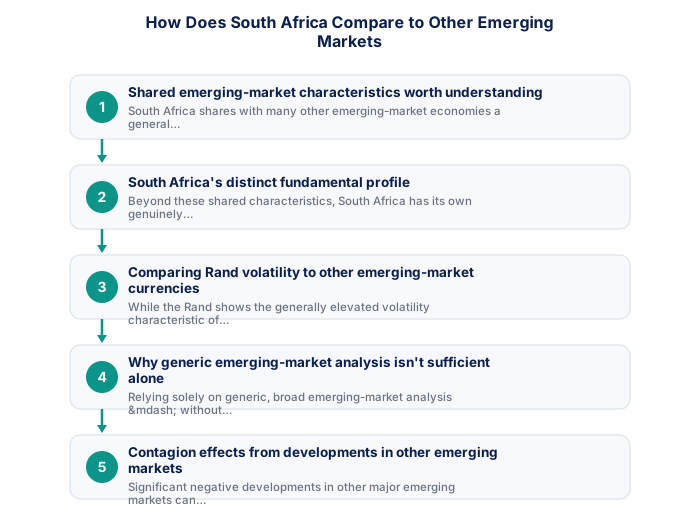
- Shared emerging-market characteristics worth understanding
- South Africa's distinct fundamental profile specifically
- Comparing Rand volatility to other emerging-market currencies
- Why generic emerging-market analysis isn't sufficient alone
- Contagion effects from developments in other emerging markets
- A balanced approach combining both broad and specific perspectives
2. South Africa's distinct fundamental profile specifically
Beyond these shared characteristics, South Africa has its own genuinely distinct fundamental profile shaped by factors , its particular mining and resources sector composition, its specific credit rating trajectory and fiscal position, and its own particular political and policy context, none of which are simply generic, interchangeable emerging-market characteristics shared identically across all peer economies.
See also: How Does SA Unemployment Relate to Currency Markets?
See also: How Does SA's Water Crisis Affect the Economy and Rand?
It's worth building your own mental checklist of these South Africa-specific factors, mining sector exposure, SOE fiscal risk, political developments, and consciously checking Rand movement against this checklist rather than assuming every move simply reflects generic emerging-market sentiment.
- SARB economic calendar checked for the week
- Next Eskom load shedding schedule reviewed
- GNU stability news reviewed
- Stats SA data releases noted
- Credit agency review dates checked
- US/global events that move EM risk noted
3. Comparing Rand volatility to other emerging-market currencies
While the Rand shows the generally elevated volatility characteristic of emerging-market currencies broadly, its precise volatility profile compared to other specific emerging-market peers varies, reflecting differences in each economy's own specific fundamental stability, market depth, and other country-specific factors beyond the shared general emerging-market categorisation alone.
It's worth checking current, comparative volatility data periodically using tools like the volatility calculator discussed elsewhere on this site, rather than relying on a general impression of how the Rand compares to peer currencies, since relative volatility rankings can shift as conditions in different emerging economies evolve.
| Event | Frequency | ZAR impact | Source |
|---|---|---|---|
| SARB MPC | 6x per year | High | resbank.co.za |
| Budget Speech | Annual (February) | Very high | treasury.gov.za |
| Credit reviews | Annual each agency | Very high | Agency sites |
| Stats SA CPI | Monthly | Medium | statssa.gov.za |
| Eskom stage | As needed | Low-medium | eskomsepush.com |
- SA context provides genuine informational edge
- ZAR pairs accessible via FSCA brokers in ZAR accounts
- Rand volatility creates larger intraday ranges
- 6 SARB meetings/year create regular macro setups
- Higher geopolitical risk than G10 pairs
- Load shedding creates unique operational disruptions
- SA rand liquidity thinner than major G10 pairs
- SA-specific news requires constant local monitoring
4. Why generic emerging-market analysis isn't sufficient alone
Relying solely on generic, broad emerging-market analysis, without incorporating the South Africa-specific factors, risks missing genuinely important, country-specific developments that meaningfully affect Rand-specific outcomes, even while broader emerging-market sentiment remains relatively stable. Sound USD/ZAR analysis requires combining both the broad emerging-market context and South Africa-specific fundamental factors together.
It's worth treating generic emerging-market commentary as a useful starting point rather than a complete analysis on its own, supplementing it with South Africa-specific research gives you a genuinely more complete picture than relying on broad, undifferentiated emerging-market coverage alone.
5. Contagion effects from developments in other emerging markets
Significant negative developments in other major emerging markets can sometimes produce contagion effects, where international investors broadly reduce emerging-market exposure across the board rather than discriminating carefully between specific countries, temporarily affecting the Rand even when South Africa-specific fundamentals haven't genuinely changed. This dynamic relates to the broader risk-aversion discussion elsewhere regarding safe-haven currencies and capital flow patterns.
Recognising contagion-driven movement as distinct from genuine South Africa-specific fundamental deterioration helps avoid mistakenly over-interpreting temporary, broad emerging-market-driven Rand weakness as necessarily reflecting a genuine change in South Africa's own specific situation.
It's worth following major developments in other significant emerging markets, even ones you don't directly trade, specifically because of this contagion risk, awareness of a genuine crisis developing elsewhere gives you useful advance context for interpreting an otherwise puzzling Rand move that has little to do with South Africa itself.
6. A balanced approach combining both broad and specific perspectives
A balanced, genuinely informed approach to USD/ZAR analysis combines awareness of broad emerging-market sentiment and potential contagion dynamics with close attention to the South Africa-specific fundamental factors, SARB policy, credit rating, political developments, and mining sector dynamics, rather than relying exclusively on either perspective alone.
This combined approach reflects the broader principle, applied specifically to the particular challenge of understanding Rand movement within both its broader emerging-market context and its own distinct, country-specific circumstances.
This connects directly to the SARB's Monetary Policy Committee (MPC), which meets several times a year to set the repo rate, decisions that ripple through borrowing costs, the Rand, and market sentiment well beyond the immediate announcement.
Its relative standing among peer emerging markets often matters more.
Evaluating South Africa in isolation gives an incomplete picture. Its relative standing among comparable emerging markets often drives capital flow decisions more directly.
★ Why It Matters
Something worth tracking : South Africa's credit rating trajectory relative to peer emerging markets like Brazil or Turkey, since relative positioning among comparable economies often matters more to international capital flows than South Africa's standalone metrics in isolation.
✕ Common mistakes
- Assuming all emerging markets move together as a single block. Each economy has its own distinct fundamental drivers worth understanding separately.
- Ignoring South Africa's specific mining sector exposure in broader EM comparisons. This is a meaningful point of difference from many other emerging markets.
- Not tracking South Africa's credit rating trajectory relative to peers. Relative, not just absolute, rating trends matter for capital flow decisions.
Key Takeaways
- South Africa shares broad emerging-market characteristics with peers but has its own distinct fundamental profile, requiring country-specific rather than generic analysis.
- South Africa shares broad emerging-market characteristics with peer economies, but has its own distinct fundamental profile shaped by its mining sector, credit rating, and political context.
- Shared emerging-market characteristics worth understanding.
- South Africa's distinct fundamental profile specifically.
- Comparing Rand volatility to other emerging-market currencies.
Frequently asked follow-up questions
Does a crisis in another emerging market always affect the Rand?
Sometimes through contagion effects discussed in this piece, particularly if broader emerging-market sentiment shifts, though the specific, direct relevance depends on how connected or comparable the specific situation is to South Africa's own circumstances.
Is the Rand more or less volatile than other major emerging-market currencies?
This varies by specific comparison period and peer currency; checking current volatility data gives the most accurate, current comparison.
Should I follow other emerging-market news even if I only trade USD/ZAR?
Some general awareness of broader emerging-market sentiment is useful given these shared characteristics, though South Africa-specific developments remain the primary, most directly relevant focus.
