i Short answer
Major scheduled policy speeches like the State of the Nation Address can produce Rand volatility based on policy clarity and market reaction.
📋 ON THIS PAGE
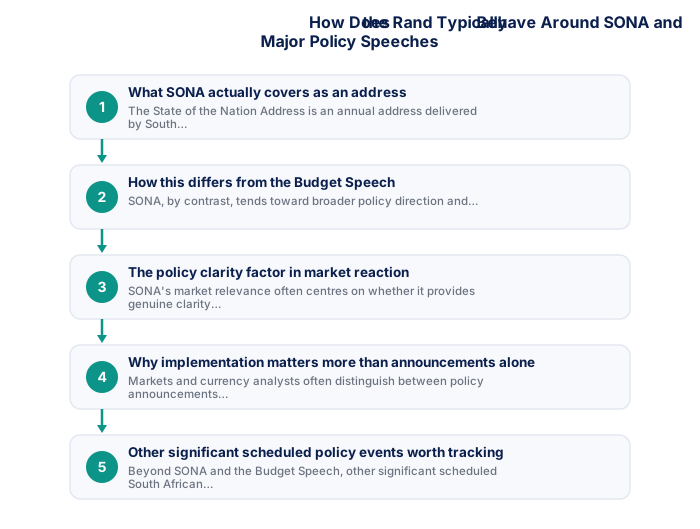
1. What SONA actually covers as an address
The State of the Nation Address is an annual address delivered by South Africa's President, typically covering broader government priorities, policy direction, and significant national issues, distinct from the more specifically fiscal, numbers-focused Budget Speech.
It's worth watching or reading the full address rather than relying solely on media summaries, since specific phrasing and emphasis around key policy areas can carry meaningful signal that a condensed news summary might not fully capture.
2. How this differs from the Budget Speech
That address focuses primarily on detailed fiscal figures, spending plans, tax policy, deficit projections. SONA, by contrast, tends toward broader policy direction and priority-setting, with less specific, immediately quantifiable fiscal detail, meaning its market reaction often depends more on broader sentiment and policy direction clarity than on specific numerical surprises.
See also: How Does SA Land Reform Affect Investor Sentiment?
It's worth understanding these two events as complementary rather than redundant, SONA typically sets the broader policy direction and priorities, while the subsequent Budget Speech then translates those priorities into concrete fiscal figures, worth following both together for a more complete picture.
- SARB economic calendar checked for the week
- Next Eskom load shedding schedule reviewed
- GNU stability news reviewed
- Stats SA data releases noted
- Credit agency review dates checked
- US/global events that move EM risk noted
3. The policy clarity factor in market reaction
SONA's market relevance often centres on whether it provides genuine clarity on significant policy direction, particularly regarding economic reform priorities, or whether it leaves continued ambiguity that investors might interpret as ongoing uncertainty.
It's worth noticing your own reaction, and broader market commentary, specifically for whether an address felt genuinely substantive or largely aspirational, markets tend to respond more meaningfully to concrete, specific commitments than to general statements of good intent, worth distinguishing between the two.
| Event | Frequency | ZAR impact | Source |
|---|---|---|---|
| SARB MPC | 6x per year | High | resbank.co.za |
| Budget Speech | Annual (February) | Very high | treasury.gov.za |
| Credit reviews | Annual each agency | Very high | Agency sites |
| Stats SA CPI | Monthly | Medium | statssa.gov.za |
| Eskom stage | As needed | Low-medium | eskomsepush.com |
- SA context provides genuine informational edge
- ZAR pairs accessible via FSCA brokers in ZAR accounts
- Rand volatility creates larger intraday ranges
- 6 SARB meetings/year create regular macro setups
- Higher geopolitical risk than G10 pairs
- Load shedding creates unique operational disruptions
- SA rand liquidity thinner than major G10 pairs
- SA-specific news requires constant local monitoring
4. Why implementation matters more than announcements alone
Markets and currency analysts often distinguish between policy announcements themselves and genuine, demonstrated implementation of stated priorities over subsequent months, a SONA address making ambitious announcements without subsequent follow-through may produce limited lasting currency effect, while sustained, credible implementation of stated priorities can support more durable currency sentiment over time.
It's worth tracking follow-through on specific SONA commitments over subsequent months, rather than treating the speech itself as the complete story, genuine market and Rand reaction often builds gradually as it becomes clear whether announced priorities are actually being implemented or quietly shelved.
5. Other significant scheduled policy events worth tracking
Beyond SONA and the Budget Speech, other significant scheduled South African policy events include the Medium-Term Budget Policy Statement, and various ministerial statements or parliamentary addresses that might carry meaningful relevance depending on current economic circumstances and specific policy areas under discussion at any given time.
It's worth building a complete personal calendar covering all these South African-specific scheduled events together, rather than tracking them individually and inconsistently, having them all in one place makes it considerably easier to anticipate periods of potentially elevated South African-specific volatility.
6. Incorporating this into your broader fundamental analysis
Adding SONA's scheduled date to your broader economic calendar awareness, alongside the other South African-specific events, supports more complete fundamental analysis preparation for USD/ZAR traders specifically interested in anticipating periods of potentially elevated, policy-related volatility.
The underlying data itself typically comes from Stats SA (Statistics South Africa), whose release calendar is worth knowing if you want to anticipate when market-moving economic data is scheduled to land.
Genuinely new policy commitments tend to move markets more.
Restated existing plans tend to produce minimal market reaction during major policy speeches. Genuinely new policy commitments tend to move markets considerably more.
★ Why It Matters
Worth watching for specifically: SONA's market impact tends to depend heavily on whether genuinely new, specific policy commitments are announced versus a restatement of existing plans, restated intentions with no new detail typically produce minimal Rand reaction regardless of the speech's tone.
✕ Common mistakes
- Trading immediately on speech tone without waiting for specific details. Tone alone is a weaker signal than concrete policy commitments.
- Assuming every major policy speech has comparable market significance. Genuine impact varies considerably depending on content, not just occasion.
- Ignoring how prior speeches' credibility affects the current one's reception. A history of unmet promises can dampen market reaction to new ones.
Key Takeaways
- Major scheduled policy speeches like SONA can produce Rand volatility based on policy clarity and market reaction, similar to the Budget Speech discussed elsewhere.
- Major scheduled policy speeches like the State of the Nation Address can produce Rand volatility based on policy clarity and market reaction.
- What SONA actually covers as an address.
- How this differs from the Budget Speech.
- The policy clarity factor in market reaction.
See also: Why Is August Historically the Rand's Worst Month?.
Frequently asked follow-up questions
When does SONA typically take place each year?
This follows an annual schedule, generally early in the calendar year; checking current government publications or news sources gives the specific current date.
Does SONA usually produce more or less Rand volatility than the Budget Speech?
This varies by specific year and content. The Budget Speech's more numerically specific fiscal detail sometimes produces more immediately quantifiable market reaction.
Should I expect significant Rand movement immediately after SONA?
Reaction varies considerably depending on content and market expectations; not every SONA address produces dramatic, immediate currency movement.
