i Short answer
South Africa's sovereign credit rating, assessed by agencies including Moody's, S&P, and Fitch, affects government borrowing costs and international investor perception of risk.
Downgrades typically weigh on the Rand, while upgrades typically provide some support.
📋 ON THIS PAGE
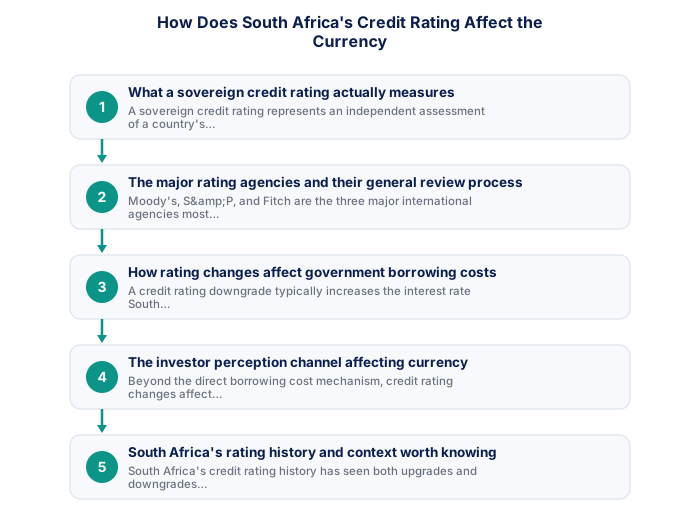
- What a sovereign credit rating actually measures
- The major rating agencies and their general review process
- How rating changes affect government borrowing costs
- The investor perception channel affecting currency
- South Africa's rating history and context worth knowing
- How traders track rating-related developments practically
1. What a sovereign credit rating actually measures
A sovereign credit rating represents an independent assessment of a country's government's ability and willingness to meet its debt obligations, considering factors including fiscal position, debt levels, economic growth prospects, political stability, and broader institutional quality. Higher ratings generally indicate lower perceived default risk, while lower ratings indicate higher perceived risk, directly affecting the interest rate the government must offer to attract lenders.
It's worth understanding this as fundamentally a forward-looking judgement rather than a simple current snapshot, agencies are assessing the government's likely future capacity and willingness to service debt, meaning ratings can shift based on anticipated future conditions, not just present, already-realised fiscal figures.
For related context, see GNU coalition stability, GNU stability is now a key rating factor.
2. The major rating agencies and their general review process
Moody's, S&P, and Fitch are the three major international agencies most commonly referenced regarding sovereign credit ratings, each conducting periodic scheduled reviews (and sometimes unscheduled reviews following significant developments) of South Africa's specific creditworthiness, publishing both a rating level and a broader narrative assessment explaining the reasoning behind any rating action or maintained rating.
It's worth checking each agency's current specific rating and outlook for South Africa directly from their published reports, rather than relying on secondhand summaries, since the three major agencies don't always rate a country identically, and understanding where each currently stands gives a more complete picture.
- SARB economic calendar checked for the week
- Next Eskom load shedding schedule reviewed
- GNU stability news reviewed
- Stats SA data releases noted
- Credit agency review dates checked
- US/global events that move EM risk noted
3. How rating changes affect government borrowing costs
A credit rating downgrade typically increases the interest rate South Africa's government must offer to attract lenders for new debt issuance, since lenders demand greater compensation for the increased perceived risk a downgrade reflects. This increased borrowing cost can compound existing fiscal pressures, creating a potentially self-reinforcing dynamic in more severe scenarios.
It's worth appreciating this as a genuinely compounding effect over time, higher borrowing costs following a downgrade mean a larger share of government revenue goes toward servicing existing debt, which itself can further pressure the same fiscal metrics rating agencies assess in future reviews.
| Event | Frequency | ZAR impact | Source |
|---|---|---|---|
| SARB MPC | 6x per year | High | resbank.co.za |
| Budget Speech | Annual (February) | Very high | treasury.gov.za |
| Credit reviews | Annual each agency | Very high | Agency sites |
| Stats SA CPI | Monthly | Medium | statssa.gov.za |
| Eskom stage | As needed | Low-medium | eskomsepush.com |
- SA context provides genuine informational edge
- ZAR pairs accessible via FSCA brokers in ZAR accounts
- Rand volatility creates larger intraday ranges
- 6 SARB meetings/year create regular macro setups
- Higher geopolitical risk than G10 pairs
- Load shedding creates unique operational disruptions
- SA rand liquidity thinner than major G10 pairs
- SA-specific news requires constant local monitoring
4. The investor perception channel affecting currency
Beyond the direct borrowing cost mechanism, credit rating changes affect broader international investor perception and, in some cases, formal investment mandates, certain large institutional investors operate under specific rules requiring minimum credit rating thresholds for holdings, meaning a downgrade below certain key thresholds can trigger forced selling of South African bonds and, by extension, reduced demand for Rand-denominated assets generally.
It's worth understanding 'investment grade' status specifically as a genuine threshold with real, mechanical consequences, some large institutional investors are formally restricted by their own mandates from holding below-investment-grade debt, meaning a rating that crosses this specific threshold can trigger considerably larger capital flow effects than a smaller rating change within the same broad category.
5. South Africa's rating history and context worth knowing
South Africa's credit rating history has seen both upgrades and downgrades over various periods, reflecting changing assessments of the country's fiscal position, growth prospects, and institutional developments over time. Checking current rating status directly through the rating agencies' own published materials or reputable financial news sources gives the most accurate, current picture, since this status can change.
It's worth reviewing this history specifically to understand what factors previously drove both upgrades and downgrades, seeing the concrete, historical reasons agencies cited for past rating actions gives useful context for anticipating what considerations are likely to matter in future reviews.
Outlook changes often move markets before the eventual rating action itself, meaning much of the impact can already be priced in by the time the formal rating change happens.
★ Why It Matters
Something worth tracking specifically: a ratings outlook change (from 'stable' to 'negative', for instance) often moves the Rand more than an actual downgrade does, since the outlook shift is the market's first genuine warning, the downgrade itself frequently arrives largely priced in already.
✕ Common mistakes
- Reacting only to the rating change itself, not the outlook shift before it. Outlook changes often move markets more than the eventual rating action.
- Assuming a downgrade always produces a large, sudden Rand move. Much of the impact is sometimes already priced in beforehand.
- Ignoring relative rating trends compared to peer emerging markets. Relative standing matters as much as the absolute rating.
- Not tracking all three major agencies, only the most commonly cited one. Different agencies can move at different times with different signals.
Key Takeaways
- Credit rating changes affect borrowing costs and international investor perception, with downgrades typically weighing on the Rand and upgrades supporting it.
- South Africa's sovereign credit rating, assessed by agencies including Moody's, S&P, and Fitch, affects government borrowing costs and international investor perception of risk.
- Downgrades typically weigh on the Rand, while upgrades typically provide some support.
- What a sovereign credit rating actually measures.
- The major rating agencies and their general review process.
Frequently asked follow-up questions
Is South Africa's current credit rating investment grade?
This changes over time and is worth checking directly through current rating agency publications or reputable financial news for the most accurate, up-to-date status.
Do all three major agencies always agree on South Africa's rating?
Not necessarily; different agencies can sometimes reach somewhat different conclusions or maintain different specific rating levels, reflecting their own independent assessment methodologies.
Can a credit rating change happen unexpectedly, outside scheduled reviews?
Yes, particularly following significant unexpected developments, agencies can sometimes conduct unscheduled reviews or rating actions outside their normal periodic schedule.
