i Short answer
During major scheduled news events, currency pairs typically experience widening spreads, temporarily thinning liquidity, and sometimes sharp price gaps.
This creates both genuine trading opportunity and meaningfully elevated risk simultaneously, a dynamic covered in detail specifically for Non-Farm Payrolls, one of the most closely watched monthly releases.
📋 ON THIS PAGE
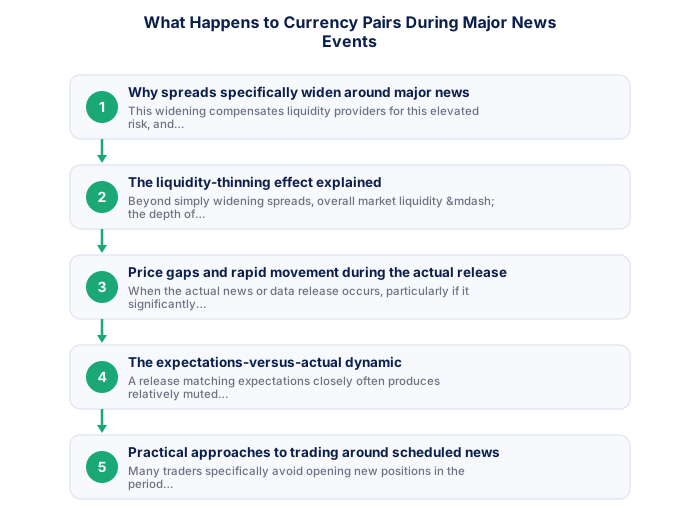
1. Why spreads specifically widen around major news
Market makers and liquidity providers widen spreads around major scheduled news because offering tight, continuous pricing gets genuinely riskier when an imminent announcement could trigger significant, unpredictable price movement. That widening compensates them for the elevated risk, and it's a consistent, predictable pattern around virtually all major scheduled releases.
It's worth checking your specific broker's actual spread behaviour around a genuine, past news event, rather than assuming a general estimate applies, comparing screenshots or logged spreads from before and during a recent release gives you concrete, personally relevant data on how your specific platform handles this widening.
2. The liquidity-thinning effect explained
Beyond wider spreads, overall market liquidity, the depth of real buying and selling interest at any given price level, often thins noticeably in the moments right before and during a major news release, as many participants pause active trading to avoid getting caught in the chaotic price action the release might trigger.
That temporary liquidity drop compounds the spread-widening above, together making conditions meaningfully worse during this window than under normal market conditions.
| Lot type | Size | USD/ZAR pip value | Min recommended account |
|---|---|---|---|
| Standard | 100,000 units | ~R1.00 | R100,000+ |
| Mini | 10,000 units | ~R0.10 | R10,000+ |
| Micro | 1,000 units | ~R0.01 | R1,000+ |
| Nano | 100 units | ~R0.001 | R100+ |
- V = Pip value in account currency
- E = Current exchange rate of quote vs account currency
- L = Lot size (100,000 standard / 10,000 mini / 1,000 micro)
- USD/ZAR example = 1 pip = R1 per standard lot
- Leveraged instrument
- Long and short available
- Overnight financing applies
- No ownership of asset
- Typically unleveraged
- Physical currency received
- No daily financing
- Currency ownership
3. Price gaps and rapid movement during the actual release
When the actual release lands, especially if it significantly surprises expectations, prices can move extremely fast, sometimes appearing to "gap," jumping from one price level to another without trading through the prices in between, given the thinned liquidity above. That rapid, sometimes discontinuous movement is exactly what produces elevated slippage risk.
It's worth understanding why this genuinely differs from the more gradual price movement you're used to seeing during calmer conditions, the sheer speed and discontinuity of news-driven movement means normal assumptions about how orders will execute can break down precisely during these windows.
4. The expectations-versus-actual dynamic
The size of the price move following a release often depends more on how the actual result compares to what markets already expected and priced in, rather than the raw figure itself. A release that closely matches expectations often produces fairly muted movement, while a genuinely surprising result, even on a seemingly modest figure, can trigger a much bigger move simply because it wasn't anticipated.
It's worth checking published consensus forecasts before any major scheduled release specifically, discussed elsewhere on this site regarding economic calendar awareness, understanding what the market already expects gives you a genuine reference point for judging how significant the eventual actual reaction is likely to be.
5. Practical approaches to trading around scheduled news
Many traders avoid opening new positions right before a major scheduled release, given the elevated cost and risk above, and wait until the initial, often chaotic reaction has settled before considering new positions based on the post-release direction. Others actively seek out the opportunities this volatility creates, accepting the elevated risk as a deliberate, calculated part of their strategy.
Neither approach is universally right. It depends on your strategy, risk tolerance, and experience level, though beginners often benefit from the more cautious approach until they've built enough experience to manage this kind of volatility deliberately and with proper risk management.
It's worth deciding your specific approach to any given release well in advance, rather than improvising in the moment, having a predetermined plan, whether that's avoiding the window entirely or trading it deliberately with adjusted risk parameters, removes the need for reactive decision-making during exactly the conditions least suited to it.
6. The specific elevated risk of slippage during these events
Any open position, including predetermined stop-loss orders, carries a higher risk of executing at a meaningfully different price than intended during this high-volatility window, given the combination of thinned liquidity and rapid price movement covered above.
Ask specifically whether your account is ring-fenced against a negative balance. negative balance protection should be stated in the agreement rather than in support chat.
Major news events typically produce an immediate sharp spike, followed by a drift or reversal as markets reassess the data. Spread widening and slippage make this period particularly challenging to trade.
★ Why It Matters
Worth checking with your own broker: their stated maximum allowable slippage tolerance during high-impact news windows. Some brokers widen this automatically during scheduled releases, meaning your order can fill considerably further from your intended price than under normal conditions, by design rather than error.
✕ Common mistakes
- Trading a normal-sized position straight through a major scheduled release. Reduced liquidity and wider spreads warrant extra caution.
- Assuming spreads will return to normal immediately after the release. Elevated spreads can persist briefly beyond the initial reaction.
- Ignoring the calendar entirely and being caught unprepared by a release. A quick weekly calendar check avoids most unpleasant surprises.
Key Takeaways
- Major news events typically cause spreads to widen, liquidity to thin, and price gaps to occur, creating both opportunity and elevated risk for traders.
- During major scheduled news events, currency pairs typically experience widening spreads, temporarily thinning liquidity, and sometimes sharp price gaps.
- This creates both genuine trading opportunity and meaningfully elevated risk simultaneously.
- Why spreads specifically widen around major news.
- The liquidity-thinning effect explained.
Frequently asked follow-up questions
How long does elevated volatility typically last after a major release?
It varies considerably by event and result, but the initial chaotic price action often settles within minutes to an hour, though broader directional effects can persist longer.
Should I close existing positions before a major scheduled news event?
Some traders do this to avoid news-related risk on positions opened for unrelated reasons. It's a personal risk management choice, not a universal requirement.
Does this apply equally to all currency pairs?
The general pattern applies broadly, though the size of the effect varies by how directly relevant the news event is to each particular pair.
