i Short answer
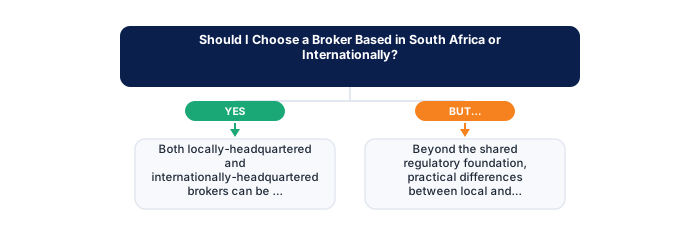
Both locally-headquartered and internationally-headquartered brokers can be genuinely FSCA-regulated and suitable for South African traders.
The practical difference often comes down to local support quality, ZAR account convenience, and product range, rather than location alone.
📋 ON THIS PAGE
1. Why broker headquarters location isn't the key factor
What genuinely matters for South African traders is whether a broker holds an authentic, verifiable FSCA licence, rather than where that broker happens to be headquartered. A genuinely FSCA-regulated international broker offers the same core regulatory protections as a locally-headquartered one.
It's worth internalising this specifically because it corrects a fairly common, intuitive but mistaken assumption, many newer traders assume a locally-headquartered broker is automatically safer or better regulated, when in reality an internationally-headquartered broker with genuine FSCA authorisation offers identical regulatory protection for your specific account.
2. What genuinely differs between local and international brokers
Beyond the shared regulatory foundation, practical differences between local and international brokers tend to involve specific operational details, local support team availability and time zone alignment, the specific ease of ZAR-denominated account funding and withdrawal, and the particular range of instruments each specific broker offers.
It's worth listing out these specific practical differences explicitly for each candidate broker you're comparing, rather than making headquarters location itself a deciding factor, since the actual, concrete differences that matter to your daily trading experience cut across this geographic distinction rather than following it neatly.
- Search FSP name or number at fsca.co.za
- Confirm licence is current and not suspended
- Check scope covers forex and CFD activity
- Confirm client funds in segregated accounts
- Read FSCA enforcement actions history
- Test customer support before depositing
- Client funds legally segregated
- FSCA complaints process available
- SA consumer protections apply
- ZAR account, no FX conversion costs
- Some offshore brokers offer wider instruments
- Regulatory overhead passed on in spreads
- Stricter position limits for retail clients
- FICA verification required before trading
- Client funds segregated
- Formal FSCA complaints process
- SA consumer protections apply
- ZAR account available
- Fund safety not guaranteed
- Overseas disputes only
- SA law does not apply
- Currency conversion costs
3. Local support and language considerations
Locally-headquartered brokers, or international brokers with a dedicated South African support presence, may offer more naturally aligned support hours, and potentially staff with direct, specific familiarity with South African-specific considerations like FICA documentation, or local banking practices.
It's worth testing this directly before committing, contacting a candidate broker's support during your own typical trading hours and evaluating the response quality gives more reliable information than assuming support quality based on headquarters location alone.
4. ZAR account and payment method convenience
Some brokers offer more smooth ZAR-denominated account options and local payment method integration than others, regardless of headquarters location specifically, this is more about each individual broker's specific product offering than a broad, reliable pattern based purely on local versus international headquarters.
It's worth checking this specifically for each broker you're seriously considering, rather than assuming it correlates with headquarters location, some internationally-headquartered brokers offer excellent ZAR account and local payment support specifically because they've built dedicated infrastructure for the South African market.
| Protection | FSCA Regulated | Offshore Unregulated |
|---|---|---|
| Client fund segregation | ✓ Required | Varies by broker |
| SA complaints process | ✓ Available | ✗ Not available |
| SA consumer law applies | ✓ Yes | ✗ No |
| ZAR account available | ✓ Typically | Often USD/EUR only |
5. Product range differences worth checking
Checking each specific candidate broker's available instrument range, rather than assuming local or international brokers systematically differ in this respect, gives the most accurate picture for your specific trading interests, since product range varies considerably by individual broker rather than following a consistent local-versus-international pattern.
6. The one non-negotiable regardless of broker location
Regardless of whether you ultimately choose a locally-headquartered or internationally-headquartered broker, verifying genuine, current FSCA licensing status directly through the official register remains the single non-negotiable check that matters considerably more than headquarters location itself in determining whether a specific broker is genuinely safe and appropriate to use.
Check the agreement for what happens when a loss exceeds the deposit. negative balance protection is offered by some brokers and not others.
The FSCA regulatory framework provides South African retail traders with meaningful protection that includes segregated client funds, mandatory disclosure requirements, and a formal complaints process backed by regulatory enforcement. Traders considering offshore brokers outside the FSCA framework should evaluate whether the incremental instrument access or other benefits justify the loss of these domestic regulatory protections, particularly for higher deposit amounts where the downside of unregulated broker failure would be material.
International brokers need additional verification of local compliance.
A South Africa-based FSCA-regulated broker offers clearer local protections, ZAR accounts, and local EFT deposits. International brokers require additional verification of their local regulatory standing.
★ Why It Matters
Something worth testing directly: contact both a local and an international broker's support with the same specific question and time the response, response time and quality during this single interaction often reveals more about practical day-to-day experience than headquarters location alone.
✕ Common mistakes
- Assuming headquarters location alone determines service quality. A direct support test often reveals more than location-based assumptions.
- Ignoring ZAR account support availability when choosing internationally. This convenience varies meaningfully between international providers.
- Not checking both options' FSCA licensing status equally carefully. Regulatory verification matters regardless of where a broker is based.
- Choosing based on brand recognition rather than tested support quality. A well-known name doesn't guarantee better day-to-day service.
When evaluating whether a broker is appropriate for South African retail trading, the FSCA public register provides the starting point, but the quality of regulatory compliance goes beyond simply holding a licence. Checking how long the broker has been licensed, whether there are any enforcement actions in their history, and what the FSCA inspection record shows, if available, provides a more complete picture than the licence alone. South African financial consumer bodies periodically publish guidance on broker evaluation that supplements the FSCA register as a due diligence resource.
South African traders choosing between locally-based and internationally-based brokers should weigh FSCA regulatory protection, rand deposit convenience, and ZAR account access against the potentially broader instrument range of some offshore providers. Most South African retail traders' needs are well served by FSCA-regulated brokers who maintain segregated client funds and provide ZAR accounts with EFT deposit and withdrawal support. For traders who specifically need instruments not available through FSCA-regulated providers, verifying the offshore broker's regulation through its home regulator's public register is the essential due diligence step before depositing.
Key Takeaways
- Both can be FSCA-regulated and suitable, with the practical difference often coming down to local support, ZAR account convenience, and product range.
- Both locally-headquartered and internationally-headquartered brokers can be genuinely FSCA-regulated and suitable for South African traders.
- The practical difference often comes down to local support quality, ZAR account convenience, and product range, rather than location alone.
- Why broker headquarters location isn't the key factor.
- What genuinely differs between local and international brokers.
Frequently asked follow-up questions
Are local South African brokers always cheaper than international ones?
Not necessarily; cost competitiveness varies by individual broker's specific fee schedule and liquidity relationships rather than following a reliable local-versus-international pattern.
Does choosing an international broker complicate my tax reporting?
Generally not directly, since your tax obligation depends on your trading activity and profit regardless of broker location, though maintaining clear records remains important either way.
Can I switch from an international broker to a local one later?
Yes, the general broker-switching process applies regardless of whether you're moving between local and international brokers specifically.
