i Short answer
A requote occurs when a broker cannot fill your order at the requested price and offers an alternative instead, which you can accept or decline.
This typically happens during fast-moving market conditions or thin liquidity.
📋 ON THIS PAGE
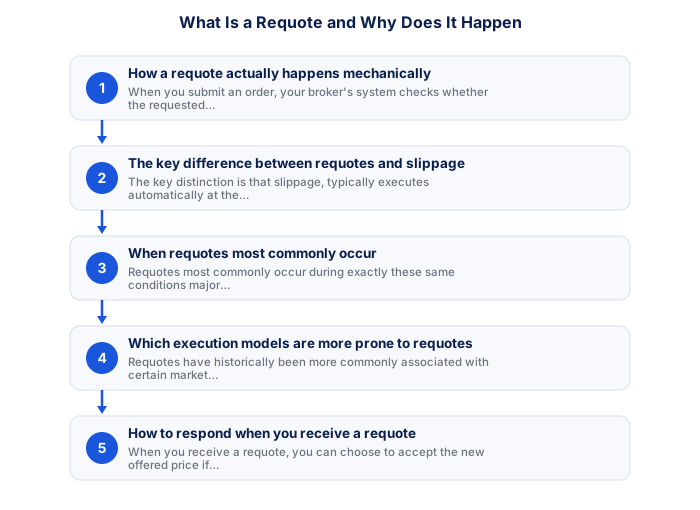
1. How a requote actually happens mechanically
When you submit an order, your broker's system checks whether the requested price is still available. If price has moved during the brief interval between your submission and the system's check, particularly likely during fast-moving conditions, rather than automatically executing at a different price the way slippage, typically works, a requote presents you with the new available price and explicitly asks you to confirm whether you still want to proceed.
It's worth understanding why this differs from simply letting your order execute at whatever price is available, a requote specifically pauses to ask for your explicit confirmation before proceeding at the new price, rather than executing automatically, a meaningful difference in how much control you retain.
2. The key difference between requotes and slippage
The key distinction is that slippage, typically executes automatically at the new price without requiring your explicit confirmation, while a requote specifically pauses the process, requiring you to actively accept the new price or decline the trade. Some platforms and brokers use one approach predominantly, while others may use a hybrid depending on specific order types or conditions.
See also: What Is a Broker's Order Execution Speed?
It's worth keeping this distinction clear specifically because it affects how you should respond to each, discussed elsewhere on this site regarding slippage generally, slippage happens without your input while a requote specifically asks for it, worth understanding both mechanisms rather than treating them as interchangeable.
- Two-factor authentication enabled
- Unique password not shared with other sites
- Broker mobile app installed and tested
- Mobile data backup connection tested
- Price alerts set for active instruments
- Broker emergency number saved in phone
- Know how to close all positions in under 30 seconds
- Desktop: full charting, multi-monitor, all order types
- Mobile: real-time monitoring and load shedding backup
- Mobile: price alerts when away from desk
- Desktop: useless during load shedding without UPS
- Mobile: limited charting for detailed analysis
- Mobile: higher risk of fat-finger errors
- Full charting and analysis
- Best for trade entry
- Multi-monitor support
- More order types available
- Monitor and manage on the go
- Load shedding backup use
- Push price alerts
- Limited charting tools
3. When requotes most commonly occur
Requotes most commonly occur during exactly these same conditions, major scheduled announcements, periods of unusually low liquidity, or any sudden, sharp price movement that outpaces the broker's ability to confirm your originally requested price remains genuinely available.
It's worth being especially prepared for requotes specifically around scheduled news releases, discussed elsewhere on this site regarding trading around major events, since this is precisely when the rapid price movement most likely to trigger a requote tends to occur.
| Feature | MT4 | MT5 |
|---|---|---|
| Broker availability | Very wide | Growing |
| EA library | Largest available | Smaller but growing |
| Timeframes | 9 built-in | 21 built-in |
| Asset classes | Forex and CFDs | Forex, CFDs, stocks |
| Mobile app | Good | More modern UI |
4. Which execution models are more prone to requotes
Requotes have historically been more commonly associated with certain market maker execution structures, though modern ECN and STP models, more commonly handle price changes through the slippage mechanism instead, making this distinction worth understanding when evaluating a specific broker's typical execution behaviour.
It's worth connecting this directly to the market maker versus ECN distinction discussed elsewhere on this site, understanding which execution model your specific broker uses helps set appropriate expectations about how frequently you might genuinely encounter requotes.
5. How to respond when you receive a requote
When you receive a requote, you can choose to accept the new offered price if it remains acceptable given your specific strategy and risk management, or decline and reassess the trade given the changed market conditions the requote itself reflects. Acting decisively rather than hesitating extensively is generally advisable, since price can continue moving while you deliberate.
It's worth deciding your general approach to requotes in advance, during calm planning, rather than each time reactively, having a predetermined sense of your own acceptable price tolerance helps you respond quickly and confidently when an actual requote appears.
6. Reducing your exposure to frequent requotes
Reducing exposure to frequent requotes involves avoiding trading immediately around major scheduled news events, where this phenomenon is most common, and considering a broker whose specific execution model, is less prone to this particular friction if you find it genuinely disruptive to your specific trading approach.
Confirm what happens if a position moves past your balance. negative balance protection varies between brokers, and the terms are the only reliable source.
NDD and ECN brokers pass orders through directly with lower requote risk.
Requotes occur when a broker's internal price moves between your order and its execution, more common with market makers during fast markets. NDD and ECN brokers pass orders to liquidity providers, reducing requote risk.
★ Why It Matters
Worth checking specifically with your broker: their stated requote policy during high-volatility periods , since some brokers requote more frequently than others under identical market conditions, this is a genuine, measurable point of comparison worth factoring into broker selection.
✕ Common mistakes
- Assuming requotes indicate broker misconduct. They typically reflect genuine inability to fill at the requested price during fast-moving conditions.
- Accepting every requoted price without considering whether it still fits your plan. A requote changes the trade's actual entry, worth a quick reassessment.
- Trading large size during known thin-liquidity periods without expecting requotes. These conditions are precisely when requotes become more likely.
Key Takeaways
- A requote occurs when a broker cannot fill your order at the requested price and offers an alternative, typically during fast-moving or thin liquidity conditions.
- A requote occurs when a broker cannot fill your order at the requested price and offers an alternative instead, which you can accept or decline.
- This typically happens during fast-moving market conditions or thin liquidity.
- How a requote actually happens mechanically.
- The key difference between requotes and slippage.
See also: What Is a Broker's Client Categorisation Process?.
Frequently asked follow-up questions
Are requotes a sign of broker dishonesty?
Not inherently. Requotes can reflect genuine, rapid price movement rather than manipulation, though persistent, suspicious requoting patterns might warrant a formal complaint process.
Can I avoid requotes entirely by using a different order type?
Some order type and execution setting combinations may reduce requote frequency, though this varies by specific platform and broker, making direct inquiry with your broker worthwhile if this is a significant concern.
Does a requote cost me anything if I decline it?
Generally no, declining a requote simply means the trade doesn't proceed at that specific moment, without any direct cost beyond the opportunity itself potentially having passed.
