i Short answer
GDP growth measures overall economic expansion or contraction.
South Africa's consistently weak growth in recent years has contributed to structural Rand pressure and credit rating concerns.
📋 ON THIS PAGE
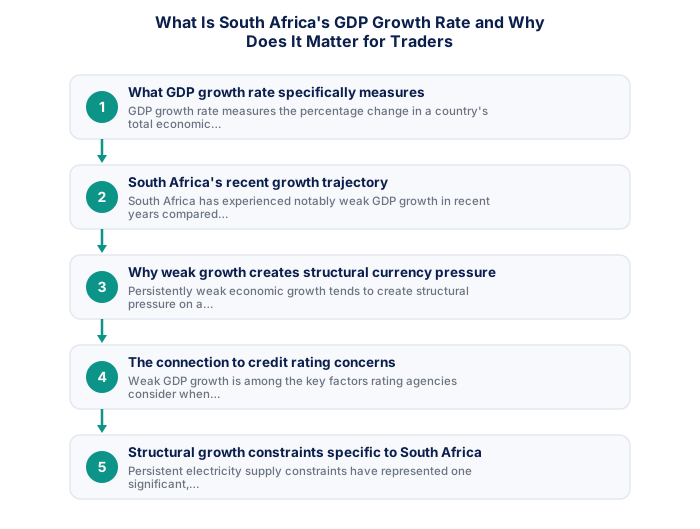
1. What GDP growth rate specifically measures
GDP growth rate measures the percentage change in a country's total economic output over a defined period, typically quarterly and annually. A positive figure means the economy expanded: more goods produced, more services delivered, more value created. A negative figure for two consecutive quarters meets the technical definition of a recession.
For traders, GDP is less useful as a precise input and more useful as a broad indicator of economic trajectory. It confirms whether an economy is accelerating, decelerating, or contracting, which feeds into central bank policy expectations, currency strength, and the risk environment for that country's assets.
See also: Why Does SA's Current Account Deficit Matter?
See also: What Are CFDs on Bonds, and Do South Africans Trade Them?
See also: Can I Change My Account's Base Currency Later?
See also: How Do Proprietary Trading Firms Work for South Africans?
GDP is a lagging indicator, it reports on economic activity that has already occurred, usually several weeks after the period ends. Markets price expectations ahead of the release, which means the actual published figure matters most when it significantly deviates from what analysts had forecast, rather than as a standalone absolute number.
2. South Africa's recent growth trajectory
South Africa has experienced notably weak GDP growth in recent years compared to many other emerging markets, reflecting structural challenges including infrastructure constraints, energy supply difficulties, high unemployment, and policy uncertainty that has weighed on both domestic investment and external investor confidence.
The weakness in South Africa's growth relative to its peers has been a persistent drag on the rand's longer-term performance. When emerging market economies are broadly growing and South Africa is stagnating or contracting, capital tends to flow toward markets with better growth trajectories, creating fundamental selling pressure on ZAR.
- FSCA-regulated broker verified at fsca.co.za
- Demo account tested for minimum 60 days
- Trading plan written: entry, exits, position sizing
- Risk per trade defined (1-2% of account)
- Backup internet connection tested for load shedding
- Tax implications understood
Monitoring the trend in South Africa's GDP relative to consensus expectations provides more actionable context than the absolute growth number. A South Africa that is growing slowly but consistently surprising to the upside creates different currency dynamics than one growing slowly and consistently disappointing, market positioning adjusts to persistent surprise patterns over time.
3. Why weak growth creates structural currency pressure
Persistently weak economic growth tends to create structural pressure on a currency over time, since growth prospects directly affect investment inflows, interest rate expectations, and the relative attractiveness of the country's assets to international investors. A slowly growing economy offers less incentive for capital to park in that currency and those markets.
For USD/ZAR specifically, this dynamic creates a multi-layered driver: the rand weakens not only in response to specific negative data points but also as a reflection of cumulative investor reassessment of South Africa's economic trajectory. This structural pressure can override short-term positive catalysts, making it important context for any analysis of ZAR pairs over medium to long horizons.
Growth differentials between South Africa and its major trading partners, particularly the Eurozone and China, also feed into the rand's relative performance. When South Africa's growth is contracting while global growth is solid, the relative attractiveness of rand-denominated assets weakens even if nothing else changes domestically.
4. The connection to credit rating concerns
Weak GDP growth is among the factors credit rating agencies weigh when assessing a country's fiscal sustainability, since anaemic growth makes it harder to increase tax revenues, reduces the denominator in debt-to-GDP calculations as debt accumulates, and limits the government's capacity to service obligations without accumulating more. South Africa's credit rating history reflects this dynamic.
Credit rating events, downgrades, reviews, or changes in outlook by Moody's, S&P, or Fitch, have historically produced sharp rand reactions. A downgrade to sub-investment grade (junk status) triggers automatic exclusion from certain benchmark indices, forcing index-tracking funds to sell South African bonds and creating forced selling pressure on ZAR.
| Item | Detail |
|---|---|
| Regulator | FSCA, fsca.co.za |
| Exchange control | SARB, resbank.co.za |
| Tax authority | SARS, sars.gov.za |
| JSE hours | 09:00-17:00 SAST Mon-Fri |
| Best forex session | 15:00-17:00 SAST |
| CGT annual exclusion | R50,000 (individuals) |
For traders monitoring ZAR, tracking the scheduled rating review dates from the major agencies is a useful addition to the economic calendar. The market often begins pricing credit concerns weeks before a formal review, meaning a rating event that looks sudden from the outside frequently has a visible build-up in USD/ZAR positioning.
5. Structural growth constraints specific to South Africa
Electricity supply constraints have been one of the most significant and well-documented drags on South African economic growth, creating direct costs for businesses through interrupted production, higher self-generation costs, and uncertainty that reduces investment decisions. The extent to which this constraint eases or worsens has direct implications for South Africa's growth trajectory.
Beyond electricity, South Africa faces structural challenges in several areas: high unemployment reducing the consumer demand base, infrastructure deficits in ports and rail that add costs to tradeable goods, and land and regulatory uncertainty that has weighed on agricultural and mining investment over extended periods.
Traders monitoring South Africa-specific drivers should track not only headline GDP figures but also the data that precede and predict them, electricity production statistics, PMI readings for the manufacturing and services sectors, and freight and port activity data. These more frequent indicators provide a running picture of the growth trajectory between quarterly GDP releases.
6. How traders typically respond to GDP data releases
GDP releases that significantly beat or miss market forecasts can produce meaningful rand movement, particularly in USD/ZAR and ZAR crosses. The reaction is typically sharpest in the immediate minutes after release, with prices finding a new level fairly quickly as positioning adjusts to the new information.
The SARB's Monetary Policy Committee meets several times per year to set the repo rate. GDP trajectory is one input into that decision, persistently weak growth creates pressure for rate cuts to stimulate activity, while stronger growth alongside inflation gives the MPC more room to maintain or increase rates. Understanding how GDP data might shift MPC expectations is therefore part of understanding the GDP release's full impact on ZAR.
Worth comparing in context: South Africa's GDP growth against its population growth rate. GDP growth that's barely above population growth means per-capita income is stagnating, which has implications for long-term economic competitiveness and creditworthiness beyond what the headline GDP figure alone conveys.
✕ Common mistakes
- Focusing only on headline GDP growth, ignoring per-capita growth. Growth barely above population growth implies little real prosperity improvement.
- Expecting a sharp, immediate Rand reaction to GDP data specifically. This is typically a slower-moving, less immediately reactive release than CPI.
- Not comparing actual GDP figures against prior market expectations. The surprise relative to forecasts often matters more than the absolute number.
- Treating a single quarter's data as indicative of a longer-term trend. A genuine trend requires looking at several consecutive readings.
Key Takeaways
- GDP growth measures overall economic expansion, with consistently weak growth contributing to the kind of structural Rand pressure discussed throughout this site.
- GDP growth measures overall economic expansion or contraction.
- South Africa's consistently weak growth in recent years has contributed to structural Rand pressure and credit rating concerns.
- What GDP growth rate specifically measures.
- South Africa's recent growth trajectory.
Frequently asked follow-up questions
How often is South African GDP data released?
This is typically released quarterly, with an additional annual summary figure; checking Statistics South Africa's official release calendar provides the most accurate, current schedule.
Does weak GDP growth always weaken the Rand immediately upon release?
Not necessarily immediately or proportionally. Market reaction depends on whether the figure differs meaningfully from already-priced-in expectations.
Can South Africa's growth improve significantly in the future?
This depends on addressing the structural challenges outlined above. Checking current economic policy developments and forecasts provides the most accurate, up-to-date outlook.
Does GDP growth affect interest rate decisions?
Yes, broader economic growth conditions are among the factors central banks consider when setting interest rate policy.
Should retail traders pay close attention to every GDP release?
Many traders do find this worthwhile to track given its broader market relevance, though its market impact is sometimes less immediate than higher-frequency data like inflation figures.
