i Short answer
A current account deficit means South Africa imports more value in goods, services, and income flows than it exports.
Persistent deficits potentially create Rand vulnerability given the resulting reliance on foreign capital inflows.
📋 ON THIS PAGE
- What the current account specifically measures
- How this differs from the narrower trade balance
- Why a persistent deficit creates genuine vulnerability
- How this connects to foreign capital inflow dependence
- South Africa's historical current account pattern
- What traders should watch for regarding this figure
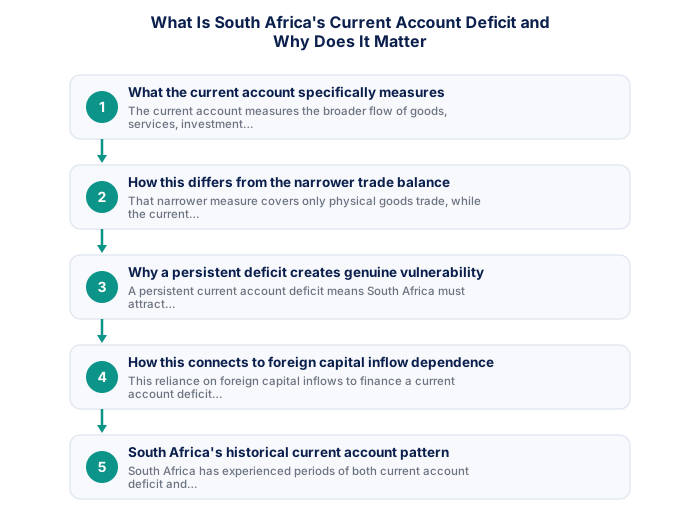
1. What the current account specifically measures
The current account measures the broader flow of goods, services, investment income, and transfers between South Africa and the rest of the world, giving a more complete picture than trade in physical goods alone.
It's worth checking South Africa's current, actual figure directly from SARB publications rather than relying on a fixed historical impression, since this specific balance shifts over time based on evolving trade, income, and capital flow conditions.
2. How this differs from the narrower trade balance
The trade balance covers only physical goods trade, while the current account additionally incorporates services trade, investment income flows, and transfers, giving this more complete, complete economic picture.
See also: How Do SA's Forex Reserves Affect the Rand?
It's worth understanding why economists and analysts generally favour this broader measure for genuine economic assessment, trade balance alone can miss significant income and transfer flows that meaningfully affect a country's genuine external financial position.
- South African ID or valid passport
- Proof of residential address dated within 3 months
- Proof of bank account ownership
- Selfie or photo for biometric verification (some brokers)
- Source of funds declaration if depositing above threshold
Choose FSCA-regulated broker
Verify the FSP number is current at fsca.co.za.
Submit FICA documents
SA ID, proof of address within 3 months, bank account proof.
Fund via EFT
Make the initial deposit from your SA bank account in ZAR.
Open demo account first
Practice on demo before activating your live account.
Start with minimum capital
Begin with an amount you can afford to lose while learning.
3. Why a persistent deficit creates genuine vulnerability
A persistent current account deficit means South Africa must attract sufficient foreign capital inflows to finance this gap, creating a dependence that can leave the Rand more vulnerable to shifts in global investor sentiment.
It's worth understanding this vulnerability concretely, a country running a persistent deficit needs continuous fresh foreign capital simply to maintain its position, any disruption to that capital inflow, whether from global risk aversion or country-specific concerns, can pressure the currency meaningfully.
4. How this connects to foreign capital inflow dependence
This reliance on foreign capital inflows to finance a current account deficit means periods of reduced global risk appetite can disproportionately pressure currencies in South Africa's particular position.
It's worth connecting this directly to the interest rate differential and yield-seeking dynamics discussed elsewhere on this site, since attracting sufficient foreign capital to finance a persistent deficit is precisely one of the practical reasons SARB's policy stance on yield competitiveness matters so significantly.
| Rejection reason | Fix |
|---|---|
| Address proof older than 3 months | Get a recent utility bill or bank statement |
| Name mismatch between documents | Use documents with exactly matching full name |
| Poor quality scan | Retake with good lighting, all corners visible |
| PO Box address | Brokers require physical residential address only |
5. South Africa's historical current account pattern
South Africa has experienced periods of both current account deficit and occasional surplus historically, with the specific pattern reflecting various factors including commodity export prices and broader domestic economic conditions.
It's worth tracking this figure's trend over recent years specifically, rather than a single snapshot, seeing whether the deficit is genuinely widening, narrowing, or stable gives more useful context than any individual quarter's figure viewed in isolation.
6. What traders should watch for regarding this figure
South African traders, particularly those focused on USD/ZAR, may find tracking current account data releases useful context for understanding broader currency vulnerability dynamics over time.
This connects directly to the SARB's Monetary Policy Committee (MPC), which meets several times a year to set the repo rate, decisions that ripple through borrowing costs, the Rand, and market sentiment well beyond the immediate announcement.
South Africa's macroeconomic data is closely monitored by international rating agencies and institutional investors whose assessments directly affect the rand and SA bond yields. The most useful analytical habit for ZAR traders is tracking not just the absolute level of each data release but how it compares to market consensus expectations, because it is the surprise component, not the level, that drives the immediate market reaction. The Stats SA release calendar, SARB quarterly bulletin, and National Treasury's monthly statements are the primary official sources for this data before it is summarised in financial media.
South Africa runs a structural current account deficit, requiring constant foreign capital inflows to fund it. Commodity export spikes provide temporary relief, but the underlying deficit creates persistent Rand vulnerability.
South Africa's macroeconomic indicators are closely monitored by the international institutions and credit rating agencies whose assessments directly affect the rand and SA bond yields. Traders who follow South African economic data regularly develop an intuitive feel for how the data compares to market expectations, which is the key driver of market reaction rather than the absolute level of the indicator. The Stats SA release calendar, the SARB quarterly bulletin, and National Treasury's monthly expenditure statements are the primary official sources that provide this data before it is widely summarised in financial media.
★ Why It Matters
Worth tracking alongside the deficit figure itself: how it's being financed. A deficit covered by stable foreign direct investment is structurally healthier than one covered by short-term portfolio flows that can reverse quickly, the financing composition matters as much as the deficit size.
✕ Common mistakes
- Treating every current account deficit as automatically Rand-negative. The financing quality, stable FDI versus volatile portfolio flows, matters as much as the deficit size.
- Ignoring how the deficit is actually being funded. This detail often determines vulnerability more than the headline figure.
- Assuming this data moves the Rand as sharply as more immediate releases. It tends to matter more for medium-term sentiment than sharp, immediate reactions.
- Not tracking this alongside trade balance figures for fuller context. These related releases are more informative read together.
Key Takeaways
- A current account deficit means South Africa imports more value than it exports, with persistent deficits potentially creating Rand vulnerability over time.
- A current account deficit means South Africa imports more value in goods, services, and income flows than it exports.
- Persistent deficits potentially create Rand vulnerability given the resulting reliance on foreign capital inflows.
- What the current account specifically measures.
- How this differs from the narrower trade balance.
Frequently asked follow-up questions
How often is South Africa's current account data released?
This is typically released on a quarterly basis by the South African Reserve Bank. Checking the SARB's official release calendar gives the most accurate, current schedule.
Does a current account deficit always weaken the Rand immediately?
Not necessarily immediately or directly. This represents one of several factors that can contribute to currency vulnerability over time rather than guaranteeing immediate, direct weakness.
Can South Africa run a current account surplus, and has it before?
Yes, South Africa has experienced surplus periods historically, often related to specific commodity price cycles or unusual domestic economic conditions.
How does this connect to South Africa's credit rating?
Persistent current account deficits are among the factors credit rating agencies consider when assessing a country's broader economic vulnerability.
Should retail traders track this figure as closely as inflation or interest rate data?
This is generally considered somewhat less immediately market-moving than interest rate decisions, though it gives useful broader context for understanding longer-term currency dynamics.
