i Short answer
South Africa's current account balance reflects trade, income, and transfer flows combined, broader than the trade balance alone.
Persistent deficits typically require foreign capital inflows to finance them, directly affecting Rand demand and sentiment.
📋 ON THIS PAGE
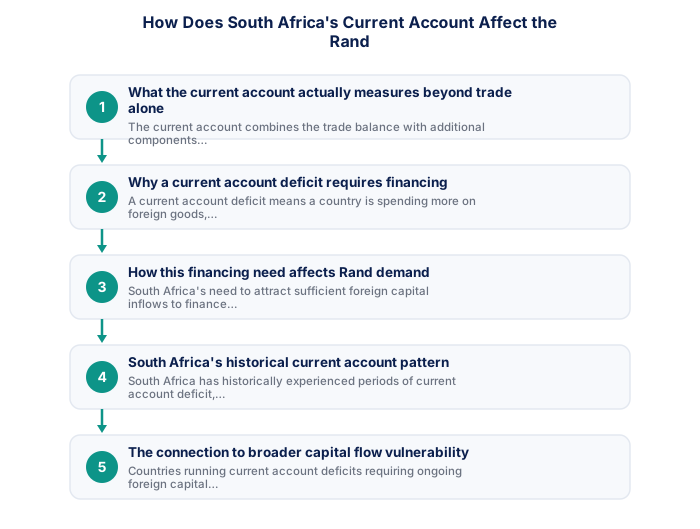
- What the current account actually measures beyond trade alone
- Why a current account deficit requires financing
- How this financing need affects Rand demand specifically
- South Africa's historical current account pattern
- The connection to broader capital flow vulnerability
- Tracking this data as part of broader fundamental analysis
1. What the current account actually measures beyond trade alone
The current account combines the trade balance with additional components including income flows (such as interest and dividend payments to and from foreign investors) and transfer payments, providing a more complete measure of a country's overall transactions with the rest of the world than trade balance data alone.
It's worth understanding why this broader measure matters more than trade balance alone, a country could show a healthy trade surplus while still running an overall current account deficit if income outflows, dividends paid to foreign investors, for example, are large enough to offset that trade surplus, worth checking the complete picture rather than trade figures in isolation.
For related context, see South Africa's household debt levels, household debt affects JSE consumer and banking sectors.
For related context, see South Africa's remittance flows, remittances are a persistent current account factor.
2. Why a current account deficit requires financing
A current account deficit means a country is spending more on foreign goods, services, and income payments than it's earning from abroad, requiring this gap to be financed through foreign capital inflows, either foreign direct investment, portfolio investment into local financial markets, or borrowing, to balance the country's overall international transactions.
It's worth thinking of this financing requirement as a genuine, ongoing dependency worth monitoring, a persistent deficit means the country continuously needs fresh foreign capital inflows simply to maintain its current position, not a one-time gap that resolves itself automatically.
- SARB economic calendar checked for the week
- Next Eskom load shedding schedule reviewed
- GNU stability news reviewed
- Stats SA data releases noted
- Credit agency review dates checked
- US/global events that move EM risk noted
3. How this financing need affects Rand demand specifically
South Africa's need to attract sufficient foreign capital inflows to finance any current account deficit means the country's currency and financial markets need to remain sufficiently attractive to international investors, connecting directly to the interest rate differential dynamics and the broader investor confidence factors, a country struggling to attract sufficient financing can experience meaningful currency pressure as a result.
It's worth connecting this directly to the interest rate differential discussion elsewhere on this site, since attracting sufficient foreign capital to finance a current account deficit is precisely one of the practical reasons SARB's policy stance on yield competitiveness matters so much for the Rand specifically.
| Event | Frequency | ZAR impact | Source |
|---|---|---|---|
| SARB MPC | 6x per year | High | resbank.co.za |
| Budget Speech | Annual (February) | Very high | treasury.gov.za |
| Credit reviews | Annual each agency | Very high | Agency sites |
| Stats SA CPI | Monthly | Medium | statssa.gov.za |
| Eskom stage | As needed | Low-medium | eskomsepush.com |
- SA context provides genuine informational edge
- ZAR pairs accessible via FSCA brokers in ZAR accounts
- Rand volatility creates larger intraday ranges
- 6 SARB meetings/year create regular macro setups
- Higher geopolitical risk than G10 pairs
- Load shedding creates unique operational disruptions
- SA rand liquidity thinner than major G10 pairs
- SA-specific news requires constant local monitoring
4. South Africa's historical current account pattern
South Africa has historically experienced periods of current account deficit, reflecting the country's need to import certain capital goods and services while also managing income outflows to foreign investors holding South African assets, checking current Reserve Bank or Statistics South Africa data provides the most accurate, current specific figures for this evolving balance.
It's worth checking the current, most recent current account figures directly from SARB publications rather than relying on a general historical impression, since this specific balance can shift between deficit and surplus periods depending on evolving trade and capital flow conditions.
5. The connection to broader capital flow vulnerability
Countries running current account deficits requiring ongoing foreign capital financing can be particularly vulnerable during periods of global risk aversion, when international capital tends to flow away from emerging markets generally, potentially making it harder to attract the financing a deficit requires precisely when this financing is most needed.
It's worth understanding this vulnerability as a specific reason why current account deficit countries like South Africa often show more pronounced currency reactions to global risk sentiment shifts, discussed elsewhere on this site regarding emerging-market currency behaviour, than countries running current account surpluses with less ongoing external financing dependency.
6. Tracking this data as part of broader fundamental analysis
Incorporating current account data, released periodically by the South African Reserve Bank, into your broader fundamental analysis alongside the trade balance, GDP, and other factors provides a more complete picture of South Africa's external financing needs and associated currency vulnerability or strength over time.
This connects directly to the SARB's Monetary Policy Committee (MPC), which meets several times a year to set the repo rate, decisions that ripple through borrowing costs, the Rand, and market sentiment well beyond the immediate announcement.
Portfolio flows can reverse quickly, exposing the Rand to sharp moves.
A current account deficit funded by stable foreign direct investment is less vulnerable than one funded by volatile portfolio flows, even at the same headline deficit size.
★ Why It Matters
Worth understanding precisely: a current account deficit isn't automatically bad for the Rand if it's being financed by stable, long-term foreign direct investment rather than short-term speculative capital, the *quality* of the financing matters as much as the deficit figure itself.
✕ Common mistakes
- Ignoring how the deficit is actually being funded. This financing detail often determines vulnerability more than the headline number.
- Assuming a surplus always strengthens the Rand and a deficit always weakens it. Other simultaneous factors can offset this relationship.
- Not tracking this data's release alongside trade balance figures. These related releases are more informative when read together.
Key Takeaways
- The current account balance reflects trade, income, and transfer flows, with persistent deficits typically requiring foreign capital inflows that affect Rand demand.
- South Africa's current account balance reflects trade, income, and transfer flows combined, broader than the trade balance alone.
- Persistent deficits typically require foreign capital inflows to finance them, directly affecting Rand demand and sentiment.
- What the current account actually measures beyond trade alone.
- Why a current account deficit requires financing.
See also: How Did the Constitutional Court Strike Down Part of the NHI Act?.
Frequently asked follow-up questions
Where can I find South Africa's current account data?
The South African Reserve Bank publishes this data periodically, alongside Statistics South Africa's related trade and economic data.
Is a current account deficit always bad for the Rand?
Not automatically or immediately, provided sufficient financing is available. The deficit itself is one factor among several, rather than a standalone, deterministic indicator.
How does this differ from the trade balance?
Trade balance covers only goods and services exports minus imports, while the current account additionally includes income and transfer flows, providing a broader, more complete international transactions measure.
