i Short answer
Bond CFDs let traders speculate on government bond price movement, which moves inversely to bond yield.
While available through some brokers, these remain considerably less commonly traded by South African retail traders than forex, indices, or commodities.
📋 ON THIS PAGE
- The inverse price-yield relationship explained
- What drives government bond prices generally
- How bond CFDs work mechanically as an instrument
- Why bonds receive less retail trading attention than other instruments
- The connection to interest rate decisions
- Should South African traders consider this instrument category
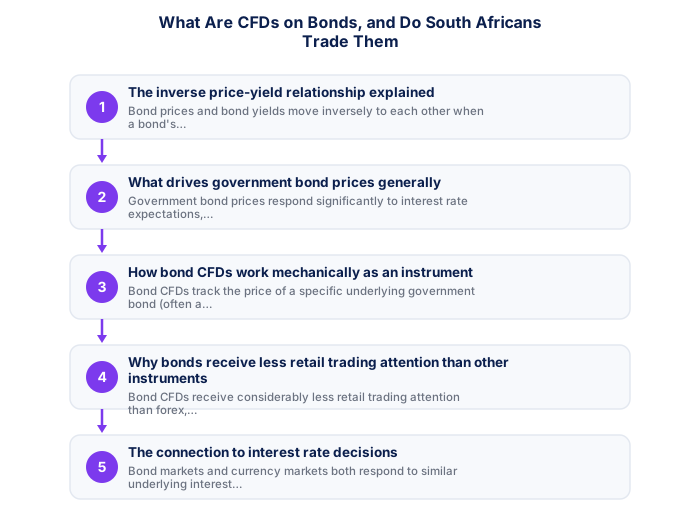
1. The inverse price-yield relationship explained
Bond prices and bond yields move inversely to each other: when a bond's price rises, its effective yield (the return an investor receives relative to the price paid) falls, and vice versa. That inverse relationship is a foundational fixed-income concept, unlike equity and currency instruments, where price and the underlying "return" concept don't have this same inverse structure.
It's worth returning to this relationship whenever it feels confusing, since it genuinely trips up many newer traders initially, a useful mental shortcut: rising rates make newly issued bonds more attractive, pushing down the price of existing, lower-yielding bonds already in the market.
2. What drives government bond prices generally
Government bond prices respond significantly to interest rate expectations, since bond yields need to stay competitive with prevailing interest rates to attract investors. Bond prices also respond to broader economic growth and inflation expectations, and for emerging-market government bonds, to the same credit rating and political risk considerations that affect South African markets more broadly.
It's worth tracking scheduled central bank decisions specifically as your primary research focus if trading bond CFDs, given how directly and immediately these decisions translate into bond price movement compared to some of the more gradual, background factors affecting other instrument categories.
- SARB economic calendar checked for the week
- Next Eskom load shedding schedule reviewed
- GNU stability news reviewed
- Stats SA data releases noted
- Credit agency review dates checked
- US/global events that move EM risk noted
- Leveraged instrument
- Long and short available
- Overnight financing applies
- No ownership of asset
- Typically unleveraged
- Physical currency received
- No daily financing
- Currency ownership
3. How bond CFDs work mechanically as an instrument
Bond CFDs track the price of a specific underlying government bond (often a benchmark bond from a major economy), letting traders speculate on price movement using the same leveraged CFD structure as other instruments, without physical bond ownership or the fixed-income mechanics like coupon payments that genuine direct bond ownership involves.
It's worth confirming the specific underlying bond your broker's CFD actually references, since different providers may track different specific benchmark bonds, worth checking this detail rather than assuming a generic understanding applies uniformly across brokers.
| Event | Frequency | ZAR impact | Source |
|---|---|---|---|
| SARB MPC | 6x per year | High | resbank.co.za |
| Budget Speech | Annual (February) | Very high | treasury.gov.za |
| Credit reviews | Annual each agency | Very high | Agency sites |
| Stats SA CPI | Monthly | Medium | statssa.gov.za |
| Eskom stage | As needed | Low-medium | eskomsepush.com |
- SA context provides genuine informational edge
- ZAR pairs accessible via FSCA brokers in ZAR accounts
- Rand volatility creates larger intraday ranges
- 6 SARB meetings/year create regular macro setups
- Higher geopolitical risk than G10 pairs
- Load shedding creates unique operational disruptions
- SA rand liquidity thinner than major G10 pairs
- SA-specific news requires constant local monitoring
4. Why bonds receive less retail trading attention than other instruments
Bond CFDs get considerably less retail trading attention than forex, indices, or commodities, partly because bond price dynamics are somewhat more specialised and less intuitively familiar to typical retail traders, and partly because broker product availability and marketing focus on this category is more limited than for more heavily promoted instruments.
It's worth being honest with yourself about whether you genuinely have the specific analytical interest and background this instrument category rewards, before assuming bonds are simply an underexplored opportunity, the relative lack of retail attention partly reflects the genuine additional complexity involved.
5. The connection to interest rate decisions
Bond markets and currency markets both respond to similar underlying interest rate and monetary policy dynamics, so traders interested in bond CFDs benefit from the same central bank policy tracking that matters for currencies, just applied to understanding bond price movement rather than currency movement.
South African traders accessing forex and CFD markets should understand that the instruments they trade through FSCA-regulated brokers are derivative contracts rather than ownership of the underlying asset. This means that all profits and losses are settled in cash, position sizes can be adjusted to suit any account size, and the same trading infrastructure provides access to global markets from a ZAR-denominated account. Understanding this fundamental structure helps traders make better decisions about instrument selection, position sizing, and account management.
6. Should South African traders consider this instrument category
For most South African retail traders, especially beginners, more commonly traded instruments, forex, gold, JSE-related products, generally offer a more accessible, better-supported starting point than bond CFDs. Traders with genuine interest in fixed-income dynamics and access to a broker offering this product might reasonably explore it as an additional, more specialised diversification option.
Both bond CFDs and physical bonds move inversely to yields.
Bond CFDs offer leverage and the ability to go short, which physical bond ownership doesn't provide. Both move inversely to yields, a key relationship worth understanding before trading either.
★ Why It Matters
Worth knowing if you're considering this market specifically: bond CFD liquidity through South African retail brokers tends to be considerably thinner than forex or major indices, meaning wider spreads and potentially less reliable execution during volatile moves, worth testing with small size first.
✕ Common mistakes
- Getting the inverse price-yield relationship backwards. Rising bond prices mean falling yields, a common point of confusion.
- Not testing with small size before committing meaningful capital. Thinner liquidity makes initial caution especially worthwhile here.
- Treating bond CFDs as equivalent in risk profile to forex or equity CFDs. The underlying drivers and typical volatility differ meaningfully.
Key Takeaways
- Bond CFDs let traders speculate on government bond price movement, which moves inversely to yield, though they remain less commonly traded than forex or indices.
- Bond CFDs let traders speculate on government bond price movement, which moves inversely to bond yield.
- While available through some brokers, these remain considerably less commonly traded by South African retail traders than forex, indices, or commodities.
- The inverse price-yield relationship explained.
- What drives government bond prices generally.
See also: Why Is SAA Accepting Bitcoin for Flights, and What It Means.
Frequently asked follow-up questions
Do South African FSCA-regulated brokers commonly offer bond CFDs?
Availability varies. Some brokers do offer this product, though it's generally less universally available than forex or major index CFDs.
Is bond CFD trading riskier than forex trading?
It carries a different risk profile tied to interest rate and credit dynamics, rather than being inherently more or less risky in any simple, universal sense.
Does South Africa's own government bond market relate to this discussion?
Yes, South African government bonds are subject to similar dynamics, including credit rating considerations, though CFD trading often focuses on major global benchmark bonds rather than South African-specific issues.
