i Short answer
Load shedding weighs on the Rand primarily by signalling reduced growth potential and operational risk to businesses, affecting broader investor sentiment toward South African assets, though this has genuinely improved recently, see load shedding's 2026 turnaround.
📋 ON THIS PAGE
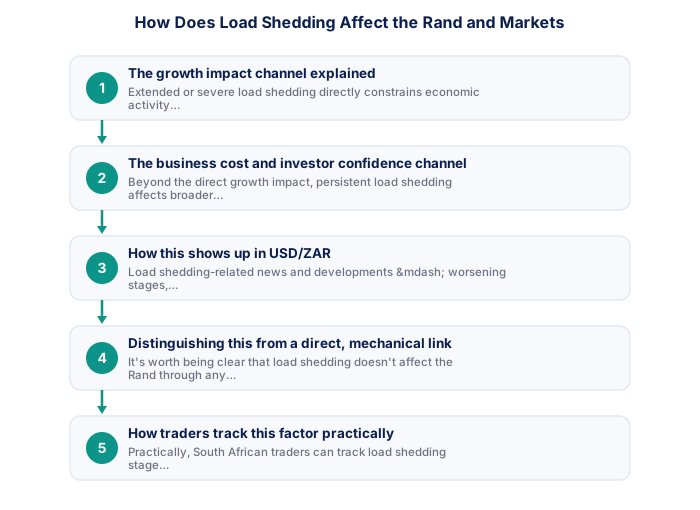
1. The growth impact channel explained
Extended or severe load shedding directly constrains economic activity, businesses unable to operate normally during outages produce less output, face higher operational costs from backup power solutions, and sometimes cannot fulfil orders or serve customers reliably. This direct constraint on economic activity feeds into broader GDP growth figures, with weaker growth typically being one factor among several that can weigh on currency sentiment over time.
This effect compounds across an economy in ways that aren't always immediately visible in headline figures. A single business absorbing higher diesel costs for backup generators, or losing several hours of productive output during an outage, seems modest in isolation, but multiplied across thousands of businesses nationwide over an extended period, these individually small effects add up to a genuinely measurable drag on overall economic output.
For related context, see Transnet's port and rail failures, Transnet creates a parallel logistics risk to Eskom.
2. The business cost and investor confidence channel
Beyond the direct growth impact, persistent load shedding affects broader business and investor confidence in South Africa's operational environment, potentially affecting both domestic business investment decisions and international investor willingness to allocate capital toward South African assets, including Rand-denominated holdings, given the operational uncertainty and added cost burden load shedding represents for businesses operating within this environment.
This confidence effect is worth distinguishing from the direct cost impact, since it operates somewhat independently. Even a business that has successfully adapted to load shedding through backup power investment can still represent a less attractive investment proposition purely because that adaptation itself signals an operating environment with meaningful, ongoing infrastructure risk, a consideration that weighs on investor decisions separately from the immediate financial cost.
- SARB economic calendar checked for the week
- Next Eskom load shedding schedule reviewed
- GNU stability news reviewed
- Stats SA data releases noted
- Credit agency review dates checked
- US/global events that move EM risk noted
3. How this shows up in USD/ZAR specifically
Load shedding-related news and developments, worsening stages, extended outages, or conversely, genuine improvement and stage reductions, can contribute to broader sentiment shifts that show up in USD/ZAR movement, though this typically operates alongside, rather than independently of, the other fundamental factors, including SARB policy and broader global risk sentiment.
This means load shedding-related news is worth watching as context that can amplify or dampen the market's reaction to other, more directly impactful events, rather than as a standalone trigger likely to move USD/ZAR significantly entirely on its own. A worsening load shedding stage announced alongside disappointing economic data, for example, may produce a sharper combined reaction than either piece of news would on its own.
| Event | Frequency | ZAR impact | Source |
|---|---|---|---|
| SARB MPC | 6x per year | High | resbank.co.za |
| Budget Speech | Annual (February) | Very high | treasury.gov.za |
| Credit reviews | Annual each agency | Very high | Agency sites |
| Stats SA CPI | Monthly | Medium | statssa.gov.za |
| Eskom stage | As needed | Low-medium | eskomsepush.com |
- SA context provides genuine informational edge
- ZAR pairs accessible via FSCA brokers in ZAR accounts
- Rand volatility creates larger intraday ranges
- 6 SARB meetings/year create regular macro setups
- Higher geopolitical risk than G10 pairs
- Load shedding creates unique operational disruptions
- SA rand liquidity thinner than major G10 pairs
- SA-specific news requires constant local monitoring
4. Distinguishing this from a direct, mechanical link
It's worth being clear that load shedding doesn't affect the Rand through any single, simple, mechanically direct channel the way, for example, a SARB interest rate change directly affects yield-seeking capital flows. Instead, load shedding's effect operates through the broader, somewhat diffuse growth and confidence channels, making its specific, isolated effect on any given day's currency movement harder to precisely quantify than some other more direct fundamental drivers.
This diffuse quality is worth keeping firmly in mind before assuming a specific Rand move on a given day was clearly caused by load shedding news, when in reality several factors were likely moving simultaneously. Attributing a currency move confidently to a single cause, when the real picture usually involves multiple overlapping influences, is a common analytical shortcut worth resisting.
5. How traders track this factor practically
Practically, South African traders can track load shedding stage announcements and any significant related developments (major infrastructure investment announcements, significant operational changes at Eskom) as one input among the broader South African fundamental picture, rather than treating load shedding in isolation as a standalone, sufficient trading signal on its own.
It's worth paying particular attention to the trend and trajectory of load shedding conditions over time, whether stages are generally worsening or improving over recent months, rather than fixating on any single day's specific stage level, since it's this broader trajectory that tends to matter more for the cumulative growth and confidence effects discussed above.
6. The broader context beyond just load shedding alone
Load shedding exists within a broader South African economic and political context, alongside SARB policy, fiscal and political developments, and broader global risk sentiment, meaning genuinely informed USD/ZAR analysis benefits from considering load shedding as one contributing factor within this fuller picture, rather than as a single, isolated explanation for Rand movement on any given day.
This connects directly to the SARB's Monetary Policy Committee (MPC), which meets several times a year to set the repo rate, decisions that ripple through borrowing costs, the Rand, and market sentiment well beyond the immediate announcement.
Stage escalations and de-escalations tend to matter more.
Stage escalations and de-escalations tend to matter more for the Rand than routine operational loadshedding updates, which usually carry limited market impact.
★ Why It Matters
Worth noting precisely: the Rand's reaction tends to track the announced loadshedding *stage* escalating or de-escalating more than the day-to-day operational details, traders watching for market-relevant news can usually skip the technical updates and focus on stage changes specifically.
✕ Common mistakes
- Reacting to every loadshedding update as equally significant. Stage escalations and de-escalations tend to matter more than routine operational news.
- Ignoring the connection between loadshedding and broader investor confidence. This connection often matters more for the Rand than the immediate operational impact.
- Assuming loadshedding affects all sectors and shares equally. Effects vary considerably depending on a company's specific energy dependence.
- Not having a power and connectivity backup plan for your own trading. This is a more immediate, practical risk than the broader market effect.
How does load shedding affect this?
The outages break your connection rather than the market, so the exposure is being unable to act on an open position rather than the position itself. Trading through load shedding covers it in full.
Key Takeaways
- Load shedding weighs on the Rand by signalling reduced growth potential and operational risk, affecting investor sentiment toward South African assets generally.
- Load shedding weighs on the Rand primarily by signalling reduced growth potential and operational risk to businesses, affecting broader investor sentiment toward South African assets.
- The growth impact channel explained.
- The business cost and investor confidence channel.
- How this shows up in USD/ZAR specifically.
See also: How Does NHI Uncertainty Affect JSE Healthcare Stocks?.
Frequently asked follow-up questions
Does the Rand always weaken immediately when load shedding worsens?
Not mechanically or immediately in every instance; the effect operates through broader sentiment and growth channels discussed in this piece, rather than producing a guaranteed, immediate currency reaction to every specific stage change.
Has load shedding improved or worsened over recent years?
This varies over time and is worth checking through current South African news sources for the most up-to-date picture, given how this situation has evolved.
Are there other African or emerging market currencies facing similar infrastructure challenges?
Yes, various emerging markets face their own specific infrastructure and growth challenges, though the specific details and currency impact vary by country and circumstance.
