i Short answer
Proprietary trading firms let traders pay an upfront fee to attempt a rules-based evaluation challenge, and if passed, trade a simulated "funded" account and keep a share of any profit generated, without the firm's own capital being directly at risk on a retail trader's individual account. If cost is the main barrier, see our breakdown of what a free prop firm challenge actually involves.
Most prop firms operate offshore and outside FSCA oversight, meaning South African traders rely primarily on the firm's own reputation and payout track record rather than local regulatory recourse if a dispute arises. Note that regulation status has no bearing on whether payouts are taxable, SARS taxes this income regardless.
📋 ON THIS PAGE
1. How the evaluation challenge model actually works
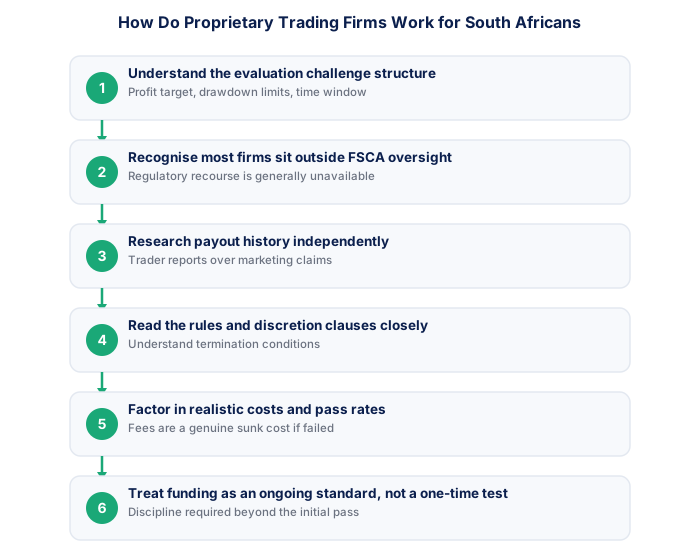
A prop firm evaluation typically involves paying a fee to attempt to hit a specified profit target within a defined time window, while respecting maximum daily loss and overall drawdown limits. Passing the evaluation, sometimes structured as one or two phases, grants access to a "funded" account.
This funded account is typically a simulated environment reflecting live market prices, rather than the firm placing your actual trades into the real market with its own capital tied directly to your account. Profit paid out to successful traders comes from the firm's broader business model, not from a live position mirroring yours in the market.
2. Why most prop firms sit outside FSCA regulation
Most well-known prop firms are registered offshore, commonly in jurisdictions like the UK, US, or various offshore financial centres, and are not FSCA-licensed financial services providers in South Africa. This does not automatically make a firm illegitimate, but it does mean the FAIS Ombud and FSCA complaints process are generally not available if a dispute arises.
This shifts the practical burden of due diligence onto the trader far more heavily than it would sit with a locally regulated broker, since your primary protection is the firm's own reputation, payout history, and terms, rather than an external regulatory backstop.
- SARB economic calendar checked for the week
- Next Eskom load shedding schedule reviewed
- GNU stability news reviewed
- Stats SA data releases noted
- Credit agency review dates checked
- US/global events that move EM risk noted
3. What to verify before paying an evaluation fee
Independently search the firm's name alongside terms like "payout" and "review" across trading forums and communities rather than relying only on testimonials on the firm's own website. A consistent pattern of traders reporting successful payouts over an extended period is a far stronger signal than marketing claims alone.
Read the specific evaluation rules closely, particularly around maximum daily loss definitions, weekend holding restrictions, and any clause allowing the firm discretion to void a passed evaluation for reasons like "inconsistent trading" or "gaming the rules", terms that can sometimes be applied more broadly than a trader initially expects.
| Event | Frequency | ZAR impact | Source |
|---|---|---|---|
| SARB MPC | 6x per year | High | resbank.co.za |
| Budget Speech | Annual (February) | Very high | treasury.gov.za |
| Credit reviews | Annual each agency | Very high | Agency sites |
| Stats SA CPI | Monthly | Medium | statssa.gov.za |
| Eskom stage | As needed | Low-medium | eskomsepush.com |
- SA context provides genuine informational edge
- ZAR pairs accessible via FSCA brokers in ZAR accounts
- Rand volatility creates larger intraday ranges
- 6 SARB meetings/year create regular macro setups
- Higher geopolitical risk than G10 pairs
- Load shedding creates unique operational disruptions
- SA rand liquidity thinner than major G10 pairs
- SA-specific news requires constant local monitoring
4. The genuine costs and risks involved
Evaluation fees are a real, sunk cost if the challenge is failed, and pass rates across the industry are generally low, meaning the realistic expected value of any single evaluation attempt should be considered carefully rather than assumed positive. Some traders attempt multiple evaluations before passing one, meaning cumulative fees can add up quickly.
For South African traders specifically, evaluation fees paid to an offshore firm typically fall under your Single Discretionary Allowance for outward transfer purposes, and any profit share received back should be considered for tax declaration purposes the same as other trading income.
5. Realistic expectations about the profit-sharing model
Profit splits are commonly in the range of 70 to 90 percent to the trader, though this varies by firm and account tier, with the firm retaining the remainder. Reaching a first payout typically requires demonstrating consistent profitability over a minimum period after passing the evaluation, not simply hitting the initial profit target once.
Treat a funded account as requiring the same discipline as your own capital, since most firms retain the right to remove funding for rule violations even after an initial pass, meaning the evaluation is really an entry point to an ongoing performance standard rather than a one-time test.
6. Is this a genuinely good option for South African traders?
For a trader with a demonstrated, consistent edge but limited personal capital, a prop firm can be a legitimate way to trade larger position sizes than personal funds would allow, provided the specific firm has a credible payout track record and the trader fully understands the rules-based constraints involved.
It is generally not a suitable substitute for building genuine trading skill and discipline first on a personal account or demo, since the evaluation's strict drawdown rules are frequently more punishing of inconsistent, undisciplined trading than personal capital would be, given the immediate disqualification risk built into most evaluation structures.
★ Why It Matters
Worth remembering that because most prop firms operate outside FSCA oversight, the usual South African regulatory protections and complaints channels generally do not apply, which shifts real weight onto independent due diligence before paying any evaluation fee.
✕ Common mistakes
- Assuming a funded account means the firm is placing real trades with real capital. Most funded accounts operate in a simulated environment reflecting live prices.
- Not researching payout history before paying an evaluation fee. Independent trader reports are a stronger signal than the firm's own marketing claims.
- Overlooking the firm's discretion clauses around account termination. Terms like 'inconsistent trading' can sometimes be applied more broadly than expected.
- Treating an evaluation pass as the finish line. Most firms require sustained, rule-compliant performance to receive an ongoing payout.
Key Takeaways
- Proprietary trading firms let traders pay an upfront fee to attempt a rules-based evaluation challenge, and if passed, trade a simulated "funded" account and keep a share of any profit generated, without the firm's own capital being directly at risk on a retail trader's individual account.
- How the evaluation challenge model actually works.
- Why most prop firms sit outside FSCA regulation.
- What to verify before paying an evaluation fee.
- The genuine costs and risks involved.
Frequently asked follow-up questions
Are prop firm profits taxable in South Africa?
Yes, profit share received from a prop firm is generally considered income for South African tax purposes and should be declared, similar to other trading-related income.
Can I lose more than my evaluation fee with a prop firm?
Typically no, since your own capital beyond the evaluation fee is not directly at risk in the way it would be trading a personal live account; the maximum loss is generally the fee itself.
Do I need FICA documents for a prop firm the same way as a broker?
Most prop firms require identity verification similar to FICA requirements, though the specific process and documentation standards vary by firm since they are not bound by South African FICA regulation directly.
