ℹ Short answer
A spot bitcoin ETF holds bitcoin and issues shares against it, so you get the exposure through a brokerage account rather than a wallet. South Africans can buy one, and the route you choose changes your tax, your offshore allowance and your estate exposure.
1. What a spot ETF actually holds
A spot bitcoin ETF holds bitcoin with a custodian and issues shares representing a claim on it. The share price tracks the bitcoin price less the fund's annual fee, and authorised participants create and redeem shares to keep the two in line. You never touch a wallet, a recovery phrase or an exchange, which removes custody risk and the entire category of problems the previous page describes, and replaces it with issuer risk, custodian risk and a fee. For most people that is a good trade, because the risk they are actually likely to realise is losing their own keys rather than a large regulated fund failing.
2. Spot against futures
A futures-based product holds derivative contracts rather than the asset and has to roll them as they expire. In a market where longer-dated contracts trade above nearer ones, that rolling has a cost, and over years it compounds into meaningful underperformance against the spot price. The distinction matters because the first bitcoin funds available were futures-based, and some still are. If the objective is to track bitcoin, a spot fund does it more closely.
3. The routes open to a South African
There are four in practice. An offshore brokerage account buying a US-listed spot ETF directly. A South African broker offering international shares, which does the same thing through a local intermediary. A CFD on the ETF, which gives synthetic exposure without owning anything. Or a JSE-listed product where one exists, bought in rand like any other local share. Each has a different cost, a different tax treatment and a different relationship to exchange control, and the right answer depends on which of those you care about most.
4. What it does to your offshore allowance
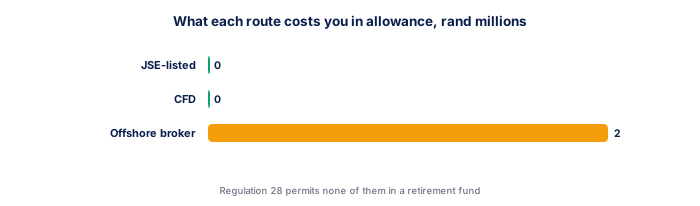
Buying a US-listed ETF through an offshore account moves rand out of the country, so it uses your single discretionary allowance of R2 million a year, or your foreign investment allowance of R10 million with a SARS approval. A CFD on the same ETF generally does not, because the exposure is synthetic and the margin stays in South Africa. A JSE-listed product bought in rand does not either. For someone whose allowance is already committed elsewhere, that distinction decides the route.
5. Regulation 28 and your retirement fund
A South African retirement fund may not hold crypto at all. Regulation 28 sets out the asset classes a pension fund, provident fund or retirement annuity may hold, and crypto is not among them, with a limit of zero rather than a small percentage. Whether a bitcoin ETF counts as crypto for this purpose or as an ordinary listed security has been the subject of argument, and the conservative reading, which most administrators follow, is that it does not belong in a Regulation 28 portfolio. If you want crypto exposure in a tax-advantaged wrapper, the retirement route is closed.
6. The US estate tax exposure almost nobody mentions
A non-resident holding more than USD 60,000 of US-situs assets is exposed to US estate tax at rates up to 40% on death, and a US-listed ETF is a US-situs asset. South Africa has no estate tax treaty with the United States that relieves this. A South African with R2 million in a US-listed bitcoin ETF has an exposure their executor will discover at the worst possible moment. The usual answers are to hold an Irish-domiciled equivalent where one exists, to stay below the threshold, or to use a structure, and all of them need to be decided before rather than after.
7. Tax treatment of the ETF itself
An ETF share is a security, so the familiar test applies: held as a long-term investment a gain is capital, included at 40% with a maximum effective rate of 18%; traded frequently it is revenue at up to 45%. That is more settled than the equivalent question for bitcoin held directly, which is one of the quieter arguments for the ETF route. Distributions, where the fund pays any, are taxed by type. Securities transfer tax applies to a JSE-listed purchase at 0.25% and does not apply to a US-listed one.
★ Why It Matters
The ETF route removes custody risk, which is the risk most people actually realise. What it introduces for a South African is a set of questions no overseas article raises: which allowance it uses, whether Regulation 28 permits it, and whether your estate will meet a US tax bill your executor did not expect.
Where to take this next: the JSE ETF Reference covers the mechanics in detail, and Exchange Control Allowances sets out the rules behind it.
✕ Common mistakes
- Overlooking the US estate tax exposure. US-situs assets above USD 60,000 carry up to 40% estate duty with no South African treaty relief.
- Assuming a retirement annuity can hold one. Regulation 28 sets the crypto limit at zero.
- Treating a futures product as equivalent to spot. Rolling contracts has a cost that compounds over years.
- Forgetting it uses your offshore allowance. Buying US-listed through an offshore account moves rand out of the country.
Frequently asked follow-up questions
Can I hold a bitcoin ETF in a tax-free savings account?
Only if the specific fund is approved for TFSA use. A US-listed ETF is not; a JSE-listed product may be, and the annual limit is R46,000 with a R500,000 lifetime cap.
Does buying one use my offshore allowance?
Through an offshore brokerage, yes. Through a CFD or a JSE-listed product bought in rand, generally not.
Can my retirement annuity hold one?
No. Regulation 28 does not permit crypto, and the conservative reading most administrators follow extends that to crypto ETFs.
What is the US estate tax problem?
US-situs assets above USD 60,000 are exposed to US estate tax of up to 40% on a non-resident's death, with no South African treaty relief.
Is an ETF safer than holding bitcoin?
It removes custody risk and adds issuer and fund risk. The price risk is identical, and bitcoin has fallen more than 70% from a peak four times.
