i Short answer
Index CFDs, like the JSE Top 40, offer broad, diversified exposure to many companies simultaneously through a single position.
Individual share CFDs concentrate both risk and reward on a single company's performance, making company-specific news considerably more impactful.
📋 ON THIS PAGE
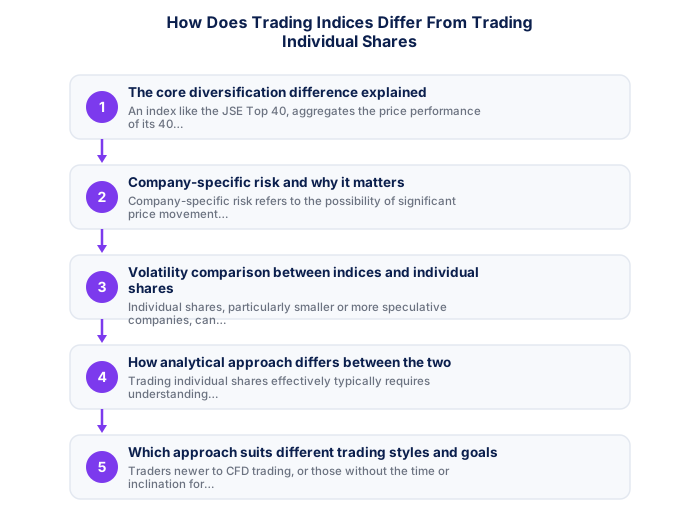
- The core diversification difference explained
- Company-specific risk and why it matters
- Volatility comparison between indices and individual shares
- How analytical approach differs between the two
- Which approach suits different trading styles and goals
- Combining both approaches within a broader trading plan
1. The core diversification difference explained
An index like the JSE Top 40, aggregates the price performance of its 40 constituent companies into a single tracked value, meaning your position's performance reflects the combined, weighted movement of many companies rather than any single one. This built-in diversification means an unexpected, severe decline in any single constituent company typically has a limited, partial effect on the overall index, since other constituents' performance partially offsets this individual impact.
An individual share CFD position, by contrast, has its entire performance tied to that single company alone, there's no offsetting diversification effect, meaning company-specific news, whether positive or negative, translates directly and fully into your position's performance without any moderating influence from other companies.
It's worth actually calculating a concrete example for yourself to make this genuinely tangible, comparing how a single company's 10% single-day drop would affect an index position, diluted across 39 other companies, versus an individual share position in that exact company, the size of the difference tends to be more striking when worked through with real numbers.
See also: How Do I Use the JSE Earnings Calendar as a Trader?
| Feature | Indices | Individual Shares |
|---|---|---|
| Diversification | Built-in across many companies | Single-company exposure |
| Company-specific risk | Diluted | Concentrated |
| Typical volatility | Generally smoother | Can be sharper on company news |
| Analytical approach | Macro, sector-level | Company fundamentals and news |
2. Company-specific risk and why it matters
Company-specific risk refers to the possibility of significant price movement driven by factors unique to that individual company, earnings announcements, management changes, product developments, legal or regulatory issues specific to that business, rather than broader market or sector-wide factors affecting many companies simultaneously. This risk category is essentially eliminated, or at least substantially diluted, when trading a diversified index rather than an individual share.
This means individual share CFD trading requires you to specifically research and understand that particular company's circumstances, upcoming scheduled events like earnings releases, and company-specific risk factors, a more intensive, focused research requirement than index trading typically demands, where broader market and macro analysis matters more than any single company's specific situation.
- FSCA-regulated broker verified at fsca.co.za
- Demo account tested for minimum 60 days
- Trading plan written: entry, exits, position sizing
- Risk per trade defined (1-2% of account)
- Backup internet connection tested for load shedding
- Tax implications understood
It's worth checking a company's upcoming earnings calendar specifically before opening or holding an individual share position through that date, since earnings announcements are a genuinely predictable, scheduled source of this company-specific volatility, worth planning around deliberately rather than being caught by surprise.
4. How analytical approach differs between the two
Trading individual shares effectively typically requires understanding company-specific fundamentals, earnings trends, competitive positioning, management quality, sector-specific dynamics, alongside broader technical analysis. Trading indices, by contrast, typically relies more heavily on broader macroeconomic analysis (interest rates, overall economic growth trends, broad market sentiment) since no single company's specific fundamentals dominate a well-diversified index's overall movement.
This means traders specifically interested in detailed, company-level fundamental analysis may find individual share CFDs a better fit for applying that specific skill set, while traders more interested in broader macro and technical analysis, without wanting to research individual companies in depth, may find index CFDs align better with their particular analytical interests and strengths.
| Item | Detail |
|---|---|
| Regulator | FSCA, fsca.co.za |
| Exchange control | SARB, resbank.co.za |
| Tax authority | SARS, sars.gov.za |
| JSE hours | 09:00-17:00 SAST Mon-Fri |
| Best forex session | 15:00-17:00 SAST |
| CGT annual exclusion | R50,000 (individuals) |
It's worth being honest with yourself about how much genuine time and interest you have for this deeper, company-specific research before committing to individual shares as a primary focus, since doing this analysis properly is a genuinely more demanding undertaking than the broader, more macro-focused approach index trading typically requires.
5. Which approach suits different trading styles and goals
Traders newer to CFD trading, or those without the time or inclination for detailed company-specific research, often find indices a more accessible starting point precisely because of this reduced company-specific risk and the somewhat more macro-focused analytical approach indices generally require. More experienced traders with genuine interest in and capacity for detailed company-level research may find individual shares offer additional opportunity for those willing to invest the additional analytical effort this requires.
Neither approach is inherently superior, they suit different analytical interests, research capacity, and risk tolerance for company-specific concentration, making this a matter of personal fit within your broader trading approach rather than one being objectively the better choice for all traders.
It's worth revisiting this choice periodically as your own skills and interests develop, a trader who started with indices for their relative simplicity may find, as their research capacity and interest grow, that individual shares increasingly appeal, worth reassessing rather than assuming your initial choice remains fixed indefinitely.
6. Combining both approaches within a broader trading plan
Some traders combine both approaches within a broader trading plan, perhaps using index CFDs for a core, longer-term directional view on broad market conditions, while separately allocating a smaller, specifically discretionary portion of capital to individual share CFDs where they've identified a specific company-level opportunity through genuine, detailed research. This combined approach, similar in spirit to the diversification discussion elsewhere regarding multiple instruments generally, can capture benefits from both approaches while managing the specific risks each one carries.
As with any combined approach involving multiple instrument categories, maintaining clear position sizing and risk management discipline across both the index and individual share components, rather than letting either category's risk grow disproportionately within your overall account, remains essential regardless of how you choose to combine these two genuinely different approaches.
An individual share carries full company-specific risk. An index's diversification across many companies dampens the effect of any single company's newsworthy event.
★ Why It Matters
Worth understanding precisely: an index can grind sideways overall while individual constituent shares move sharply in opposite directions and cancel each other out, this diversification effect is exactly the trade-off for the reduced single-company risk an index offers.
✕ Common mistakes
- Assuming an index will move as sharply as its most newsworthy constituent. Diversification across many companies tends to dampen single-company effects.
- Treating index and individual share risk as equivalent. Concentration risk is considerably higher for a single share position.
- Ignoring how constituent weighting affects an index's actual behaviour. A handful of large companies can disproportionately drive the whole index.
- Not adjusting position sizing for the different volatility profiles of each. Indices and individual shares often warrant different risk treatment.
Key Takeaways
- Index CFDs offer broad, diversified exposure to many companies at once, while individual share CFDs concentrate risk and reward on a single company.
- Index CFDs, like the JSE Top 40, offer broad, diversified exposure to many companies simultaneously through a single position.
- Individual share CFDs concentrate both risk and reward on a single company's performance, making company-specific news considerably more impactful.
- The core diversification difference explained.
- Company-specific risk and why it matters.
Frequently asked follow-up questions
Is it possible to lose everything trading an index CFD?
While indices are diversified and generally less volatile than individual shares, leveraged index CFD positions still carry genuine loss risk, including potentially your full deposited margin.
Do individual share CFDs require more time to research than index CFDs?
Generally yes, given the company-specific research typically required, compared to the more macro-focused analytical approach indices generally support.
Can beginners trade individual share CFDs safely?
Beginners can trade individual shares, but given the company-specific risk and research requirements discussed above, starting with indices first, while building broader trading experience, is a reasonable, common approach.
