i Short answer
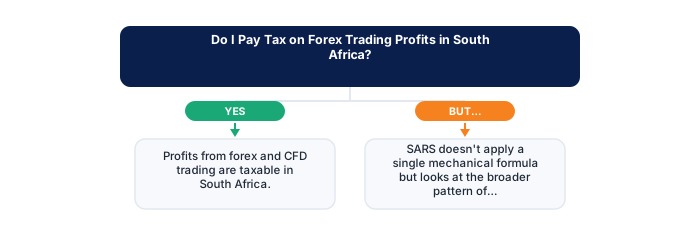
Yes. Profits from forex and CFD trading are taxable in South Africa, treated by SARS as either revenue (taxed at your marginal rate) or capital gains (taxed more favourably).
Which classification applies depends on factors like trading frequency, stated intention, and overall trading pattern, there's no single bright-line test. This same classification question applies to prop firm payout income specifically, and if trading forms a meaningful part of your income, you may also need to register as a provisional taxpayer. Use our Forex Trading Tax Calculator to estimate what this could mean in Rand terms for your specific situation.
📋 ON THIS PAGE
1. Income tax vs. capital gains tax: the core distinction
South African tax law distinguishes between income (money earned through an active trade, business, or employment-like activity, taxed at your marginal income tax rate which can run up to 45% for high earners) and capital gains (profit from the disposal of a capital asset held for investment purposes, of which only a portion, currently 40% for individuals, is included in taxable income, effectively taxing it at a meaningfully lower effective rate). For trading specifically, the question SARS asks is essentially: were you trading as a business activity, or investing as a longer-term capital allocation?
| Classification | What's included in taxable income | Top effective rate |
|---|---|---|
| Income (active trading) | 100% of profit | Up to 45% (marginal rate) |
| Capital gains (investing) | 40% of the gain (individuals) | Lower effective rate than income |
For related context, see the Two-Pot Retirement System, using retirement savings for trading capital.
SARS does not automatically receive your trading profits from your broker. You must declare all trading income on your annual ITR12. Non-disclosure attracts interest, penalties, and potential audit.
See also: How Does SARS Tax Cryptocurrency Gains in South Africa?
See also: What Is Options Trading and How Does It Work in SA?
See also: Can I Trade Forex or Shares in a Tax-Free Savings Account?
If you trade frequently, treat trading as a primary or significant income-generating activity, and actively manage positions with the intention of profiting from short-term price movements, SARS is considerably more likely to classify your gains as revenue, subject to full income tax. If your activity is occasional, longer-term in holding period, and more consistent with a passive investment approach, capital gains treatment becomes more plausible, though this is genuinely a grey area that depends on the specific facts of your situation.
2. Factors SARS considers in classification
SARS doesn't apply a single mechanical formula but looks at the broader pattern of facts, including: the frequency and volume of your transactions (someone executing dozens of trades weekly looks very different from someone making a handful of trades per year), the holding period of typical positions (short-term CFD positions held for hours or days point toward trading-as-business; positions held for years point toward investment), whether trading is your primary source of income or a side activity alongside other employment, how the activity is funded (borrowed capital used specifically to trade can be a factor pointing toward business-like activity), and your own stated intention and how consistently your actual behaviour matches that stated intention.
In practice, most active CFD and forex traders, given the inherently short-term, leveraged nature of these products, are likely to find their gains classified as revenue rather than capital gains, simply because the underlying activity pattern (frequent buying and selling, short holding periods, leverage usage) tends to align more closely with a trading business than a passive long-term investment.
- Download annual trade statement from broker
- Identify all profits and losses with dates
- Determine revenue vs capital gains classification
- Calculate provisional tax liability for both periods
- File ITR12 within the SARS filing season deadline
- Keep all supporting documentation for 5 years
- Capital gains: lower effective rate
- R50,000 annual CGT exclusion
- CGT losses offset future gains
- Only 40% of gain included in taxable income
- Revenue: full marginal rate up to 45%
- No annual exclusion for revenue income
- Must register as provisional taxpayer
- SARS scrutiny on active traders
It's worth reviewing your own trading pattern honestly against these specific factors periodically, rather than assuming a classification once and never revisiting it, since a trading style that genuinely evolves over time, moving from occasional, longer-held positions toward frequent, short-term CFD activity, can shift which classification actually fits your current pattern.
3. What records you need to keep
Regardless of how your gains end up classified, maintaining clean, complete records from the start makes tax filing dramatically simpler and protects you if SARS ever queries your return. At minimum, keep a complete transaction history showing every trade with its date, instrument, position size, entry and exit price, and resulting profit or loss; bank statements showing every deposit into and withdrawal from your trading account, which helps substantiate the actual cash flow involved; and any annual tax statements or summaries your broker provides, since most regulated brokers can export a full account history directly from the platform.
It's worth setting up this record-keeping habit from your very first trade rather than trying to reconstruct a year's worth of activity at tax filing time, most trading platforms make this straightforward through built-in export tools, but only if you think to use them consistently throughout the year.
It's worth treating this record-keeping habit as inseparable from the trading itself, rather than a separate administrative task to handle later, exporting your statements at the same time you conduct your regular strategy review, discussed elsewhere on this site, keeps your tax records current without requiring a separate, dedicated effort.
4. Provisional tax obligations for active traders
If your trading profits are classified as income and you don't have tax automatically withheld through a PAYE employment arrangement covering that income, you may be required to register as a provisional taxpayer with SARS. Provisional tax requires estimating and paying tax in two (sometimes three) instalments during the tax year, rather than settling the full amount only at annual filing, this exists specifically to prevent taxpayers with non-salary income from deferring their entire tax liability to a single year-end payment.
Failing to register as a provisional taxpayer when required, or underestimating provisional payments significantly, can result in penalties and interest charges from SARS, so this is worth addressing proactively, ideally with guidance from a tax practitioner, once your trading activity reaches a scale where it's generating meaningful, regular profit.
| Factor | Revenue trading | Capital gains |
|---|---|---|
| Tax rate | Up to 45% marginal | Effective 18% max |
| Taxable amount | 100% of profit | 40% of gain |
| Annual exclusion | None | R50,000 per year |
| Losses | Offset against income | Offset against capital gains only |
5. How losses and deductions work
Trading losses are also relevant for tax purposes and can, depending on classification, be used to offset gains, if your trading is classified as a revenue-generating business activity, trading losses can generally be deducted against other income in the same way ordinary business losses are treated, subject to specific SARS rules around ring-fencing certain types of losses in some circumstances. If classified as capital in nature, capital losses can typically be offset against capital gains, though not directly against ordinary income.
Costs directly related to your trading activity, platform fees, certain data or research subscriptions, and in some cases a portion of home office costs if trading constitutes a genuine business activity conducted from home, may also be deductible if your trading is classified as a business activity, though the specific rules here are detailed enough that professional guidance is genuinely worthwhile rather than optional.
It's worth discussing your specific deductible expenses explicitly with a tax practitioner rather than assuming a general list applies uniformly, since what genuinely qualifies as a deductible trading-related cost depends closely on your specific classification and the particular facts of how your trading activity is structured.
6. When to get professional tax help
Given the genuinely fact-specific nature of the income-versus-capital classification, and the financial consequences of getting it wrong (either overpaying unnecessarily or underpaying and facing penalties later), engaging a registered tax practitioner becomes worthwhile once your trading activity generates anything beyond minimal, occasional profit. This is particularly true if you're trading as a significant part of your income, using leverage extensively, or unsure how SARS is likely to view your specific pattern of activity.
A practitioner familiar with trading-related tax matters specifically (rather than general tax preparation) can help you build a defensible position on classification from the outset, ensure your record-keeping meets SARS standards, and handle provisional tax registration and filing correctly, the cost of this guidance is typically modest relative to the tax exposure and penalty risk it helps you manage.
It's also worth knowing that any FSCA-regulated broker operating in South Africa is bound by POPIA (the Protection of Personal Information Act), which governs how your personal and financial data must be collected, stored, and protected.
Less frequent, longer-held trading tends toward capital gains.
Frequent, active trading with short holding periods tends toward income classification at a higher marginal rate, while less frequent trading with longer holds tends toward capital gains.
★ Why It Matters
The classification question, income versus capital gains, often only gets seriously tested if SARS ever queries your return, which means many traders are unknowingly relying on a self-assessment that's never actually been validated, getting it reviewed by an accountant once is cheaper than an audit later.
✕ Common mistakes
- Assuming all trading profit is automatically capital gains. Active, frequent trading is more likely to be classified as income.
- Ignoring the specific factors SARS considers in classification. Frequency, intent, and holding period all matter, not just profit size.
- Underestimating the marginal rate impact at higher income levels. Income classification can reach considerably higher effective tax rates than capital gains.
7. What changed for the 2026/27 tax year
Several figures a trader relies on moved from 1 March 2026, and using last year's numbers will produce the wrong answer. The annual capital gains exclusion for individuals rose from R50,000 to R50,000. The tax-free savings account annual contribution limit rose from R46,000 to R46,000, with the R500,000 lifetime cap unchanged. The retirement fund contribution deduction cap rose from R430,000 to R430,000, while the 27.5% rule stayed the same.
The more significant change for anyone trading crypto alongside currencies is reporting rather than rates. CARF, the OECD Crypto Asset Reporting Framework, took effect on 1 March 2026 and requires platforms to collect tax residency details and report transaction data annually to SARS. It created no new taxes, but it closed a visibility gap, which means discrepancies between platform records and declared income are now considerably easier to identify. What CARF changed covers the detail, and the RA versus TFSA comparison covers how the wrapper limits interact.
Key Takeaways
- Yes, forex trading profits are taxable in South Africa as income or capital gains depending on activity level. Learn how SARS classifies trading gains.
- Profits from forex and CFD trading are taxable in South Africa, treated by SARS as either revenue (taxed at your marginal rate) or capital gains (taxed more favourably).
- Which classification applies depends on factors like trading frequency, stated intention, and overall trading pattern, there's no single bright-line test.
- Income tax vs. capital gains tax: the core distinction.
- Factors SARS considers in classification.
Frequently asked follow-up questions
Is there a minimum profit threshold below which trading gains aren't taxed?
There's no specific trading-only exemption threshold; however, general individual tax thresholds and the annual capital gains exclusion (a set amount excluded from capital gains tax each year) may apply depending on your overall tax position and how your gains are classified.
Do I need to declare trading losses even if I made no profit?
Yes, generally you should still declare your trading activity and any losses, as these may be relevant for offsetting future gains or other income depending on classification, and accurate disclosure protects you if SARS ever reviews your filing.
Does it matter if my broker is based outside South Africa for tax purposes?
South African tax residents are generally taxed on worldwide income and gains regardless of where the broker is based; the broker's location affects exchange control and SARB allowance considerations more than your fundamental tax liability.
Can I deduct trading-related expenses like courses or a new laptop?
If your trading activity is classified as a trade or business for tax purposes, certain genuinely incurred expenses may be deductible, though this depends heavily on your specific classification and is worth confirming with a tax practitioner rather than assuming.
Does SARS automatically know about my trading profits?
Not automatically in every case, since SARS doesn't necessarily receive direct broker reporting the way some bank interest is reported, which is exactly why self-declaration on your own return remains your responsibility regardless of whether SARS has independently flagged the activity.
