i Short answer
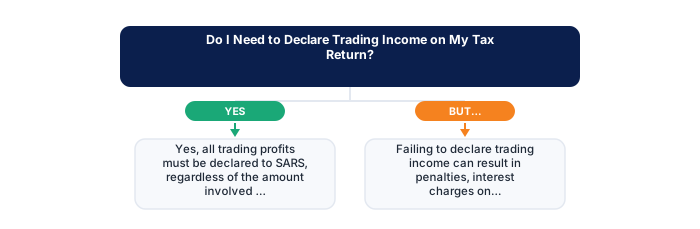
Yes, all trading profits must be declared to SARS, regardless of the amount, there's no minimum threshold below which trading income is exempt.
Whether it's classified as revenue or capital gains affects how it's taxed, but doesn't affect the underlying obligation to declare it, one worth checking specifically if you've received a SARS auto-assessment, since these usually don't capture trading income automatically.
📋 ON THIS PAGE
1. The universal declaration obligation explained
South African tax law requires declaration of all income, including trading profits, regardless of size, there's no de minimis exemption that allows smaller trading profits to go undeclared simply because the amount seems modest. This applies whether your trading profits are ultimately classified as revenue or capital gains, since both classifications still require declaration, just with different resulting tax treatment.
It's worth being especially clear on this point given how common the opposite assumption seems to be among newer traders, the belief that small, occasional profits somehow fall below a reporting threshold simply doesn't reflect how South African tax law actually works, worth correcting this misconception early rather than building a habit around a mistaken assumption.
SARS does not automatically receive your trading profits from your broker. You must declare all trading income on your annual ITR12. Non-disclosure attracts interest, penalties, and potential audit.
For related context, see the Two-Pot Retirement System, Two-Pot withdrawals are taxed as income in the year taken.
| Classification | Tax Treatment | Typically Applies When |
|---|---|---|
| Revenue | Taxed as ordinary income | Frequent, active trading activity |
| Capital Gains | Taxed under CGT rules | Longer-term, less frequent activity |
2. Where this information goes on your tax return
Depending on whether your trading activity is classified as revenue or capital in nature, your trading profits would typically be declared either as ordinary income or under the capital gains tax section of your annual tax return. Given the genuine complexity in this classification, consulting with a tax practitioner about your specific situation is generally advisable rather than guessing at the correct classification independently.
This classification question is worth raising proactively with a tax practitioner well before filing season arrives, rather than scrambling to determine it under deadline pressure, since the revenue-versus-capital distinction genuinely depends on the specific facts of your trading pattern and isn't something a general rule can reliably answer for every individual situation.
- Download annual trade statement from broker
- Identify all profits and losses with dates
- Determine revenue vs capital gains classification
- Calculate provisional tax liability for both periods
- File ITR12 within the SARS filing season deadline
- Keep all supporting documentation for 5 years
- Capital gains: lower effective rate
- R50,000 annual CGT exclusion
- CGT losses offset future gains
- Only 40% of gain included in taxable income
- Revenue: full marginal rate up to 45%
- No annual exclusion for revenue income
- Must register as provisional taxpayer
- SARS scrutiny on active traders
3. What records you need to support your declaration
Maintaining complete, accurate trading records, account statements from your broker, and your own trading journal, supports accurate tax declaration and provides necessary documentation should SARS request supporting evidence for your declared figures.
It's worth building this record-keeping into your ongoing trading routine rather than treating it as a once-a-year task, exporting and saving statements regularly, discussed elsewhere on this site regarding broker switching specifically, means you're never scrambling to reconstruct a full year's trading history under tax season time pressure.
4. The consequences of not declaring trading income
Failing to declare trading income can result in penalties, interest charges on unpaid tax, and in more serious cases, broader compliance consequences, since SARS has increasing capability to identify undeclared income through various data-sharing and verification mechanisms. The genuine risk of non-compliance considerably outweighs any perceived short-term benefit of non-declaration.
It's worth taking this risk seriously even for modest amounts, since the consequences compound over time exactly as described elsewhere on this site regarding trading debts owed to SARS, a small undeclared amount left unaddressed for years can grow into something considerably more burdensome than simply declaring it accurately from the start would have been.
| Factor | Revenue trading | Capital gains |
|---|---|---|
| Tax rate | Up to 45% marginal | Effective 18% max |
| Taxable amount | 100% of profit | 40% of gain |
| Annual exclusion | None | R50,000 per year |
| Losses | Offset against income | Offset against capital gains only |
5. Provisional tax considerations for active traders
Traders with substantial trading income, particularly those whose activity is classified as revenue given its frequency, may need to register for provisional tax, requiring periodic estimated tax payments throughout the year rather than a single annual settlement. Understanding whether this applies to your specific situation is an important part of overall compliance beyond simply the annual declaration itself.
It's worth checking your provisional taxpayer status honestly as your trading activity grows, rather than assuming your current status remains fixed indefinitely, since crossing from occasional, modest trading into more frequent, substantial activity can shift which category genuinely applies to you, worth reassessing periodically rather than only once at the very outset.
6. Getting professional help with this specific declaration
Given the genuine complexity in correctly classifying trading income and ensuring complete, accurate declaration, particularly for more active traders, consulting a qualified tax practitioner familiar with trading-related tax matters specifically is generally a sound investment, helping ensure compliance while also potentially identifying any legitimately available deductions or considerations relevant to your specific situation.
It's also worth knowing that any FSCA-regulated broker operating in South Africa is bound by POPIA (the Protection of Personal Information Act), which governs how your personal and financial data must be collected, stored, and protected.
South African traders face a tax environment that is more nuanced than most international trading guides acknowledge. SARS classifies trading income based on the totality of facts rather than a single bright-line test. The key factors include trading frequency, position holding periods, the sophistication of the approach, whether trading represents a primary or significant secondary income source, and whether the trader has demonstrated a consistent profit-seeking intent. Two traders with identical profit amounts can receive different tax treatment depending on these broader contextual factors. Maintaining a detailed trading journal that documents intent, strategy, and approach from the outset creates contemporaneous evidence that supports your preferred classification if SARS ever raises a query. Annual review with a registered tax practitioner who has experience in trading income matters is the most reliable approach as your activity evolves.
Whether trading profit amounts to R500 or R50,000, the declaration obligation is the same. There's no informal threshold below which trading income becomes exempt.
★ Why It Matters
Something we think is underappreciated: SARS increasingly receives data directly from South African banks about large international transfers, so the assumption that small trading profits will simply go unnoticed is a considerably weaker bet than it used to be.
✕ Common mistakes
- Assuming small profits fall below some informal threshold. There is no minimum amount exempt from declaration.
- Mixing up income tax and capital gains treatment. Misclassifying profits can lead to incorrect declarations.
- Not keeping organised records throughout the tax year. Reconstructing a year's trading activity at filing time is unnecessarily difficult.
- Assuming SARS won't cross-reference bank transfer data. Increasing data sharing between banks and SARS makes this assumption weaker each year.
Key Takeaways
- Yes, all trading profits must be declared to SARS regardless of amount, with the specific classification as revenue or capital gains affecting how it's taxed.
- Yes, all trading profits must be declared to SARS, regardless of the amount, there's no minimum threshold below which trading income is exempt.
- Whether it's classified as revenue or capital gains affects how it's taxed, but doesn't affect the underlying obligation to declare it.
- The universal declaration obligation explained.
- Where this information goes on your tax return.
Frequently asked follow-up questions
Does this apply even if I made an overall loss for the year?
Yes, declaration obligations generally apply regardless of overall profit or loss; a tax practitioner can advise on how losses specifically should be treated and potentially offset.
Can SARS actually find out about undeclared trading income?
SARS has increasing data access and verification mechanisms, making non-declaration a genuinely risky approach rather than a realistic way to avoid detection.
Is there a minimum trading profit below which I don't need to declare?
No, there's no minimum threshold exemption for trading income; all profits should be declared regardless of size.
Do I need to declare income from a demo account?
No, demo account activity involves no real money and produces no genuine income or loss, so it carries no tax declaration implications whatsoever.
Should I declare trading income even in the year I'm just starting out and learning?
Yes, the declaration obligation applies from your very first year of genuine trading activity with real funds, regardless of how new or experimental that activity might feel to you personally.
