i Short answer
The JSE is South Africa's primary stock exchange, where investors buy and genuinely own shares through traditional stockbroking.
CFD trading offers leveraged speculation on price movement, including the JSE Top 40 index, without actual ownership.
📋 ON THIS PAGE
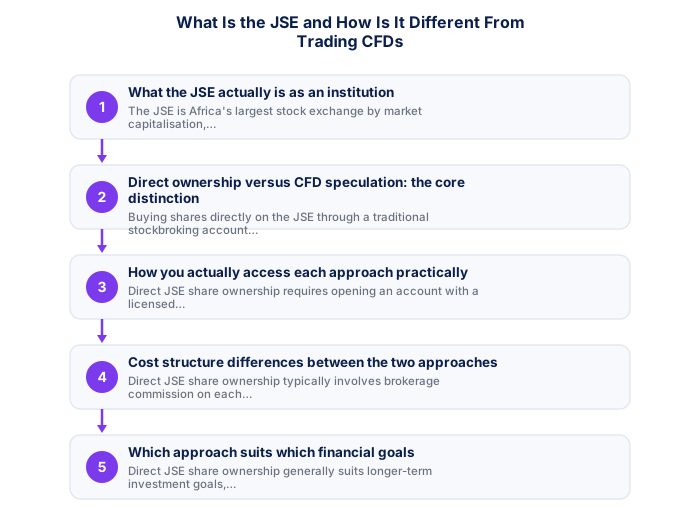
- What the JSE actually is as an institution
- Direct ownership versus CFD speculation: the core distinction
- How you actually access each approach practically
- Cost structure differences between the two approaches
- Which approach suits which financial goals
- Can you use both approaches together
- What it costs to actually own the shares instead
1. What the JSE actually is as an institution
The JSE is Africa's largest stock exchange by market capitalisation, providing the regulated infrastructure through which South African and some international companies list their shares for public trading. It operates under its own regulatory framework, overseen by the FSCA among other bodies, governing how listed companies must disclose information and how trading on the exchange must be conducted fairly.
Companies listed on the JSE span the full range of major South African industries, financial services, resources, retail, telecommunications, and more, making it the primary venue through which South African businesses raise capital from public investors, and through which those investors gain direct ownership stakes in these companies.
2. Direct ownership versus CFD speculation: the core distinction
Buying shares directly on the JSE through a traditional stockbroking account makes you a genuine, registered shareholder, entitled to any dividends the company declares, voting rights at shareholder meetings (depending on share class), and a direct ownership stake whose value rises and falls with the company's actual share price over whatever horizon you choose to hold it, typically without leverage unless your brokerage arrangement includes margin lending.
CFD trading on JSE-related instruments, by contrast, means speculating on price movement without that ownership relationship, typically with leverage applied, and with the ability to go short (profiting from a falling price) in ways direct share ownership through a standard account typically doesn't support.
See also: What Is a Multi-Broker Monitoring Tool?
See also: What Are CFDs on Bonds, and Do South Africans Trade Them?
See also: What Does Pending Order Mean in Trading?
- SARB economic calendar checked for the week
- Next Eskom load shedding schedule reviewed
- GNU stability news reviewed
- Stats SA data releases noted
- Credit agency review dates checked
- US/global events that move EM risk noted
3. How you actually access each approach practically
Direct JSE share ownership requires opening an account with a licensed stockbroker specifically authorised to trade on the JSE, a different category of financial services relationship than FSCA-regulated CFD and forex brokers. That stockbroking relationship typically has its own account opening process, fee structure, and trading platform, separate from CFD-focused broker platforms.
CFD-based exposure to JSE-related instruments, by contrast, runs through the same FSCA-regulated CFD brokers, using the same platforms and account structures that cover forex, commodities, and other CFD instruments. If you already have a CFD trading account for other purposes, accessing JSE Top 40 CFD exposure typically doesn't need an entirely separate broker relationship.
| Event | Frequency | ZAR impact | Source |
|---|---|---|---|
| SARB MPC | 6x per year | High | resbank.co.za |
| Budget Speech | Annual (February) | Very high | treasury.gov.za |
| Credit reviews | Annual each agency | Very high | Agency sites |
| Stats SA CPI | Monthly | Medium | statssa.gov.za |
| Eskom stage | As needed | Low-medium | eskomsepush.com |
- SA context provides genuine informational edge
- ZAR pairs accessible via FSCA brokers in ZAR accounts
- Rand volatility creates larger intraday ranges
- 6 SARB meetings/year create regular macro setups
- Higher geopolitical risk than G10 pairs
- Load shedding creates unique operational disruptions
- SA rand liquidity thinner than major G10 pairs
- SA-specific news requires constant local monitoring
4. Cost structure differences between the two approaches
Direct JSE share ownership typically involves brokerage commission on each transaction, alongside other potential costs like custody fees for holding shares electronically, but doesn't involve the spread and overnight financing costs that come with CFD trading, since there's no leverage and no ongoing leveraged position to finance. CFD trading instead involves that spread and financing cost structure, without typically adding a separate commission in many account structures.
Comparing the realistic total cost of each approach for your intended holding period and trading frequency, rather than assuming one is universally cheaper, helps clarify which structure actually suits your situation and goals best.
5. Which approach suits which financial goals
Direct JSE share ownership generally suits longer-term investment goals, where you want genuine ownership exposure to specific companies' long-term growth and dividend potential, are comfortable with a longer holding horizon, and don't need leverage or short-selling. CFD-based JSE exposure suits more active, shorter-to-medium-term trading, where leverage, the ability to go short, and flexible, frequent position adjustment matter more than genuine ownership and dividends.
Neither approach is universally better, they serve genuinely different goals and time horizons, and knowing which goal you're actually pursuing helps clarify which approach, or combination of both, fits your situation.
6. Can you use both approaches together
Many South African investors and traders use both approaches for different purposes: a longer-term direct JSE share portfolio for genuine investment and dividend income, alongside separate CFD trading, including on JSE Top 40 or other instruments, for more active, shorter-term activity using a separate pool of genuinely discretionary trading capital.
This combined approach lets you pursue both long-term wealth building through direct ownership and more active trading through CFDs, provided you keep a clear separation and appropriate capital allocation between these genuinely different activities and their correspondingly different risk profiles.
CFD trading gives price exposure with leverage but no ownership rights.
Buying JSE shares directly gives you actual ownership, voting rights, and dividends without leverage. CFD trading on the same shares gives leveraged price exposure without ownership, dividends paid synthetically.
★ Why It Matters
Worth being precise about: genuine JSE share ownership carries shareholder voting rights and dividend entitlement that a CFD position tracking the same share's price simply doesn't include. These aren't just different wrappers around identical exposure.
✕ Common mistakes
- Confusing direct JSE share investing with leveraged CFD speculation. These involve genuinely different mechanics, risk profiles, and account types.
- Treating the JSE Top 40 CFD as identical in every respect to owning the underlying shares. The CFD tracks price movement without the ownership dimension.
- Not considering which approach actually suits your investment versus trading goals. These serve different purposes and warrant different consideration.
Key Takeaways
- The JSE is South Africa's stock exchange for direct share ownership, while CFDs offer leveraged price speculation without ownership. Learn the key differences.
- The JSE is South Africa's primary stock exchange, where investors buy and genuinely own shares through traditional stockbroking.
- CFD trading offers leveraged speculation on price movement, including the JSE Top 40 index, without actual ownership.
- What the JSE actually is as an institution.
- Direct ownership versus CFD speculation: the core distinction.
Frequently asked follow-up questions
Do I need a different account to buy JSE shares directly versus trading JSE Top 40 CFDs?
Generally yes. Direct share ownership needs a licensed stockbroking account, while CFD exposure runs through FSCA-regulated CFD brokers, two distinct types of financial services relationships.
Can I lose more than I invest by buying JSE shares directly without leverage?
No. Unleveraged direct share ownership caps your maximum loss at your invested amount, unlike the leveraged risk profile of CFD trading.
Is one approach more regulated than the other?
Both direct JSE stockbroking and FSCA-regulated CFD trading operate under regulatory oversight, though the specific frameworks and licensing categories differ between the two.
