i Short answer
A trading API lets software programmatically interact with your broker account: placing orders, retrieving price data, or checking account status.
This is primarily used for automated strategies and custom tools, and generally requires some programming capability.
📋 ON THIS PAGE
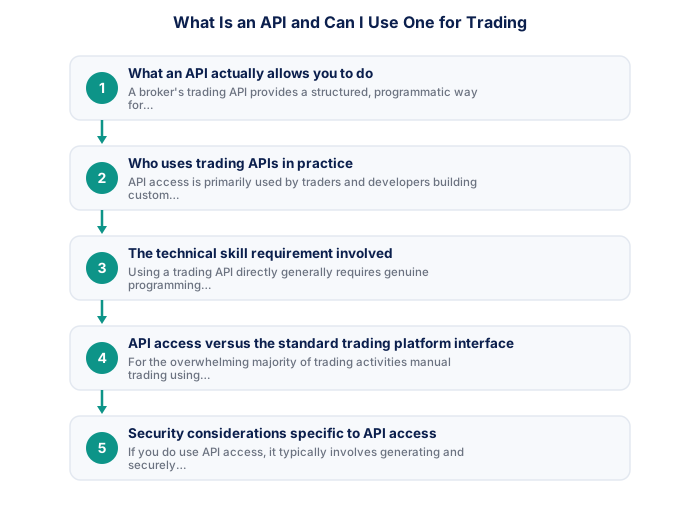
1. What an API actually allows you to do
A broker's trading API provides a structured, programmatic way for custom-written software to perform the same kinds of actions you'd otherwise do manually through the standard trading platform interface, submitting orders, retrieving real-time or historical price data, checking account balance and open positions, and other similar account-related functions, all without requiring a human to click through the standard graphical interface for each individual action.
This programmatic access is what makes the automated trading bots and Expert Advisors technically possible, these systems work by using an API (or, in MetaTrader's specific case, its own built-in scripting environment that serves a similar function) to execute trading logic automatically without requiring manual interface interaction for each individual trade decision.
2. Who genuinely uses trading APIs in practice
API access is primarily used by traders and developers building custom automated trading systems beyond what standard platform tools like MetaTrader's Expert Advisor system already support, those building custom analysis or monitoring tools that need to pull real-time account or price data into their own separate software, or those integrating trading functionality with other broader software systems or workflows beyond standard trading platform usage.
This represents a specialised use case relative to the broader retail trading population, most traders, including those running standard automated strategies through MetaTrader's built-in Expert Advisor system, don't need to interact with a broker's API directly, since MetaTrader's own built-in systems already provide this kind of programmatic automation capability without requiring separate, direct API usage.
- FSCA-regulated broker verified at fsca.co.za
- Demo account tested for minimum 60 days
- Trading plan written: entry, exits, position sizing
- Risk per trade defined (1-2% of account)
- Backup internet connection tested for load shedding
- Tax implications understood
3. The technical skill requirement involved
Using a trading API directly generally requires genuine programming capability, writing code, typically in a language like Python or another general-purpose programming language, that correctly interacts with the API's specific technical requirements and documentation. This is a meaningfully higher technical bar than using MetaTrader's MQL scripting environment, which is itself already a specialised skill beyond standard manual trading.
For traders without this kind of programming background, direct API usage generally isn't a practical or necessary avenue to pursue, particularly given that the standard platform tools already provide sufficient capability for the vast majority of both manual and automated trading approaches most retail traders actually need.
4. API access versus the standard trading platform interface
For the overwhelming majority of trading activities, manual trading using standard charting and order placement, or automated trading using MetaTrader's built-in Expert Advisor system, the standard trading platform interface already provides everything genuinely needed, without requiring the additional technical complexity of direct API integration.
Direct API access becomes relevant specifically when your needs extend beyond what these standard platform tools support, for example, wanting to integrate trading functionality with a completely custom, broader software system you're building for other purposes beyond trading alone, which is a specialised, less common scenario among typical retail traders.
| Item | Detail |
|---|---|
| Regulator | FSCA, fsca.co.za |
| Exchange control | SARB, resbank.co.za |
| Tax authority | SARS, sars.gov.za |
| JSE hours | 09:00-17:00 SAST Mon-Fri |
| Best forex session | 15:00-17:00 SAST |
| CGT annual exclusion | R50,000 (individuals) |
5. Security considerations specific to API access
If you do use API access, it typically involves generating and securely storing API keys or credentials, similar in security sensitivity to your account password, that grant programmatic access to your account. Protecting these API credentials with the same seriousness as your standard login credentials, including never sharing them or embedding them insecurely within publicly accessible code, is essential given the direct account access these credentials provide.
This security consideration adds an additional layer of responsibility beyond standard account security, specifically relevant only to the subset of traders actually using direct API access for custom development purposes.
6. Whether typical retail traders genuinely need this
For the substantial majority of retail traders, particularly those following the swing trading, position trading, and manual analysis approaches generally recommended as accessible and sustainable, direct API access provides no meaningful benefit beyond what standard platform tools already offer, while introducing additional technical complexity and security considerations without a corresponding genuine need.
This is a clear case, similar to the VPS discussion elsewhere, where a specific technical tool serves a specialised subset of traders (those building custom automated systems or integrations) without providing meaningful value to the broader retail trading population this site's content is primarily addressing.
API trading automates rule execution but requires programming knowledge.
Manual trading requires no coding and suits most retail traders. API trading automates rule execution with far greater speed, but requires programming knowledge and a broker that supports API access.
★ Why It Matters
Something worth testing extensively on a demo account first if you're building anything API-based: a coding error in an automated system executes at machine speed and volume, the same mistake that might cost one manual trade's worth of loss can compound rapidly before a human would even notice something was wrong.
✕ Common mistakes
- Assuming API access requires no real programming capability. Meaningful technical skill is generally required to use this safely and effectively.
- Not building in safeguards like maximum daily loss limits within the automated system itself. Automation should include its own risk controls, not rely solely on manual oversight.
- Testing only under calm market conditions before going live. Volatile conditions often reveal flaws calm-market testing doesn't expose.
Key Takeaways
- Trading APIs let software programmatically interact with your broker account, mainly used for automated strategies. Learn what's involved and required.
- A trading API lets software programmatically interact with your broker account: placing orders, retrieving price data, or checking account status.
- This is primarily used for automated strategies and custom tools, and generally requires some programming capability.
- What an API actually allows you to do.
- Who genuinely uses trading APIs in practice.
See also: What Is a VPS and Do I Need One for Trading?.
Frequently asked follow-up questions
Do I need an API to use MetaTrader's automated trading features?
No, MetaTrader's Expert Advisor system uses its own built-in MQL scripting environment, which doesn't require separate, direct broker API access.
Is API access more expensive than standard platform access?
This varies by broker; some offer API access as a standard feature, while others may have specific requirements or tiers for this more specialised functionality.
Can I learn to use a trading API without prior programming experience?
This would require first learning general programming fundamentals, a substantial undertaking beyond typical trading education, making it a less practical near-term path for most traders without this existing background.
