What this page covers
Bank charges in South Africa are among the highest in comparable economies, and the structure varies enough that the right account depends on how you actually use it.
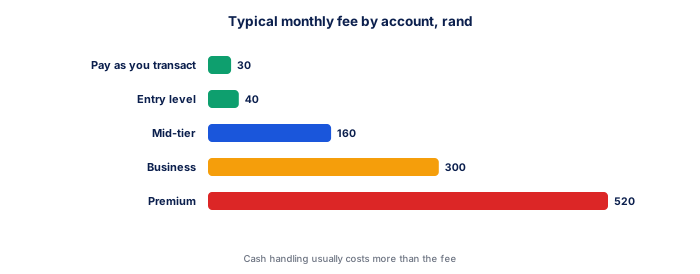
| Account type | Monthly fee | EFT | Cash deposit | Suits |
|---|---|---|---|---|
| Entry level, bundled | R6 to R70 | Included or R1 | 1% to 2% | Low volume, low balance |
| Mid-tier bundled | R100 to R220 | Included | Included to a limit | Regular use |
| Premium bundled | R350 to R700 | Included | Included | High balance, travel benefits |
| Pay as you transact | R0 to R60 | R1 to R15 each | 1% to 2% | Very low volume |
| Business account | R100 to R500 | R2 to R20 each | Negotiated | A trading company |
| Item | Typical charge |
|---|---|
| International transfer out | R300 to R600 |
| International transfer in | R100 to R250 |
| Cash deposit at a branch | 1% to 2% of the amount |
| Immediate payment, RTC | R40 to R60 |
| Unpaid debit order | R100 to R180 |
| Provisional statement or letter | R30 to R100 |
| Replacement card | R100 to R200 |
| Pattern | Approximate monthly cost |
|---|---|
| Bundled account, electronic only | R100 to R180 |
| Pay as you transact, 20 transactions | R80 to R200 |
| Bundled account with branch cash deposits | R300 to R500 |
| One international transfer a month | Add R300 to R600 |
How these figures work
The figures on this page come from the body that publishes them and change on a schedule rather than continuously, which is what makes them worth keeping in one place. Cash is the expensive part of South African banking. Depositing cash at a branch costs a percentage, and that single habit usually exceeds the whole monthly fee.
Fee schedules change annually, usually in the first quarter. The figures here are typical ranges rather than any one bank's pricing, and the pricing guide on each bank's site is the authority.
★ What this means in practice
A business account for a trading company costs more than a personal account and is not optional once the company is the account holder.
✕ Common mistakes
- Cash is the expensive part of South African banking. Cash is the expensive part of South African banking. Depositing cash at a branch costs a percentage, and that single habit usually exceeds the whole monthly fee.
- Fee schedules change annually, usually in the first quarter. Fee schedules change annually, usually in the first quarter. The figures here are typical ranges rather than any one bank's pricing, and the pricing guide on each bank's site is the authority.
- A business account for a trading company costs more than a personal acco. A business account for a trading company costs more than a personal account and is not optional once the company is the account holder.
- Taking a figure without its date. A number from a reference page is only as good as when it was last checked, which is why the date sits at the top of this one.
Notes on reading these figures
- Cash is the expensive part of South African banking. Depositing cash at a branch costs a percentage, and that single habit usually exceeds the whole monthly fee.
- Fee schedules change annually, usually in the first quarter. The figures here are typical ranges rather than any one bank's pricing, and the pricing guide on each bank's site is the authority.
- A business account for a trading company costs more than a personal account and is not optional once the company is the account holder.
To put this into practice, the South African Payment Methods runs the arithmetic on your own numbers; Forex Transfer Costs covers the same ground in ordinary language; South African Bank Account Types goes into the detail this page only summarises; Broker Deposits and Withdrawals is the related figure worth reading beside it; and Prime Lending Rate History covers what this page leaves out.
Terms used on this page
Frequently asked questions
Which account type is cheapest?
It depends on volume. Pay as you transact wins at very low volume; a bundled account wins once you make more than about fifteen transactions a month.
Why is cash so expensive?
Handling notes carries real cost and the fee is a percentage. One habit of depositing cash at a branch usually costs more than the monthly fee.
When do bank fees change?
Annually, usually in the first quarter. Each bank publishes a pricing guide, which is the authority rather than any comparison.
What does an international transfer cost at a bank?
Typically R300 to R600 in fees, plus a rate margin of 1.5% to 3% that does not appear as a charge.
Do I need a business account for a trading company?
Yes. Once the company is the account holder a personal account is not an option.
What is the most expensive routine charge?
An unpaid debit order, at R100 to R180, followed by cash handling.
 Download this data