i Short answer
Base targets on your strategy's verified historical performance through genuine backtesting and forward testing, not arbitrary aspiration disconnected from actual results.
Accept genuine month-to-month variance even within a fundamentally sound strategy, rather than expecting smooth, consistent returns. Try our free Profit Path Calculator to work through the numbers yourself.
📋 ON THIS PAGE
- Why arbitrary targets create genuine behavioural problems
- Basing targets on verified historical performance instead
- Understanding genuine month-to-month variance
- The relationship between targets and overtrading
- Setting a realistic range rather than a single fixed number
- Revisiting targets as your track record grows
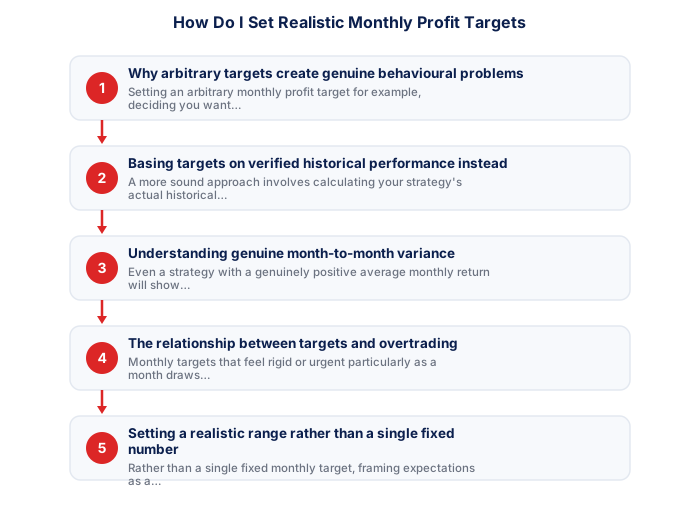
1. Why arbitrary targets create genuine behavioural problems
Setting an arbitrary monthly profit target, for example, deciding you want to make R10,000 monthly without any connection to your strategy's actual, demonstrated capability, creates a genuine risk of the overtrading pattern, as you might feel pressure to force additional trades or take on excessive risk to hit this predetermined figure, regardless of whether genuine, criteria-meeting opportunities actually present themselves during that period.
It's worth checking honestly whether your own current target was actually derived from your strategy's verified performance, or whether it was chosen first based on a desired income figure, with the strategy then expected to simply deliver it, the second approach is precisely the arbitrary pattern this section is warning against.
2. Basing targets on verified historical performance instead
A more sound approach involves calculating your strategy's actual historical average monthly return through the backtesting and forward-testing processes, using this verified figure as the foundation for realistic target-setting, rather than working backward from a desired income figure to an assumed, unverified return rate.
It's worth actually running this calculation explicitly from your own trading journal data, rather than estimating roughly, seeing your genuine, calculated average monthly return gives you a considerably more defensible, realistic target than any figure chosen for how appealing it sounds.
- FSCA-regulated broker verified at fsca.co.za
- Demo account tested for minimum 60 days
- Trading plan written: entry, exits, position sizing
- Risk per trade defined (1-2% of account)
- Backup internet connection tested for load shedding
- Tax implications understood
3. Understanding genuine month-to-month variance
Even a strategy with a genuinely positive average monthly return will show considerable month-to-month variation, some months meaningfully exceeding the average, others falling short or even producing a loss, purely due to normal statistical variance rather than any change in underlying strategy quality.
Expecting every single month to hit or exceed your target, rather than accepting this normal variance around a longer-term average, sets an unrealistic standard that even a sound strategy cannot reliably meet every single period.
It's worth calculating your own strategy's actual historical variance alongside its average, not just the average figure alone, knowing both the typical return and the realistic range around it gives you a genuinely complete picture of what to expect in any individual month, rather than an incomplete, potentially misleading single number.
4. The relationship between targets and overtrading
Monthly targets that feel rigid or urgent, particularly as a month draws toward its end without yet reaching the target, can create exactly the kind of psychological pressure that leads to deviating from disciplined, criteria-based trading specifically to chase an arbitrary number, undermining the very discipline that produces genuine, sustainable results in the first place.
It's worth noticing this specific pressure building as a month draws to a close, particularly if you're behind your target, that felt urgency is worth treating as a warning sign in itself, exactly the kind of psychological pressure that tends to produce exactly the criteria-violating trades discussed elsewhere on this site.
| Item | Detail |
|---|---|
| Regulator | FSCA, fsca.co.za |
| Exchange control | SARB, resbank.co.za |
| Tax authority | SARS, sars.gov.za |
| JSE hours | 09:00-17:00 SAST Mon-Fri |
| Best forex session | 15:00-17:00 SAST |
| CGT annual exclusion | R50,000 (individuals) |
5. Setting a realistic range rather than a single fixed number
Rather than a single fixed monthly target, framing expectations as a realistic range, based on your verified historical performance and its observed variance, provides a more accurate, psychologically healthier framework than a rigid figure that any individual month might reasonably fall short of or exceed, without this representing any meaningful problem with your underlying strategy or discipline.
It's worth communicating this range explicitly to yourself, and to anyone else aware of your trading, family members discussed elsewhere on this site regarding financial transparency, rather than a single number, framing expectations as a range from the outset helps prevent the disappointment or pressure that a single, missed target figure can otherwise create.
6. Revisiting targets as your track record grows
As your verified track record grows through continued disciplined trading and journaling, periodically revisiting and refining your realistic target range based on this accumulating evidence provides an increasingly accurate, well-grounded framework, rather than relying on an early, necessarily limited initial estimate indefinitely without ever updating it against your own genuine, accumulating results.
Setting an arbitrary monthly target disconnected from real data tends to feel rigid and urgent. A realistic range based on your strategy's actual historical average return holds up far better.
★ Why It Matters
A distortion worth avoiding deliberately: setting your target based on your single best historical month rather than your genuine average, traders consistently anchor on their peak performance when setting forward targets, which sets up disappointment against an unrepresentative benchmark.
✕ Common mistakes
- Setting targets without reference to verified backtested results. Targets disconnected from real data tend to be arbitrary.
- Expecting smooth, consistent returns every month. Genuine month-to-month variance is normal even within a sound strategy.
- Treating a missed target as proof the strategy has failed. A single month is rarely a large enough sample to draw that conclusion.
Key Takeaways
- Base monthly targets on your strategy's verified historical performance rather than arbitrary aspiration, accepting genuine month-to-month variance.
- Base targets on your strategy's verified historical performance through genuine backtesting and forward testing, not arbitrary aspiration disconnected from actual results.
- Accept genuine month-to-month variance even within a fundamentally sound strategy, rather than expecting smooth, consistent returns.
- Why arbitrary targets create genuine behavioural problems.
- Basing targets on verified historical performance instead.
Frequently asked follow-up questions
Is it ever appropriate to have no specific target at all?
Some traders prefer focusing purely on disciplined process and letting results follow naturally, rather than tracking specific targets at all; this is a reasonable alternative approach for some personalities.
Should I adjust my target if I have an exceptionally good month?
Be cautious about anchoring future expectations to an unusually strong month, since this may reflect favourable variance rather than a genuine, sustainable shift in your strategy's underlying performance.
How much historical data do I need before setting a realistic target?
More data generally produces more reliable estimates. The same sample-size guidance that applies to edge verification applies similarly here.
