What this page covers
Which account you hold decides what you can do across a border. A customer foreign currency account in particular changes how a trader handles dollars, and most people do not know it exists.
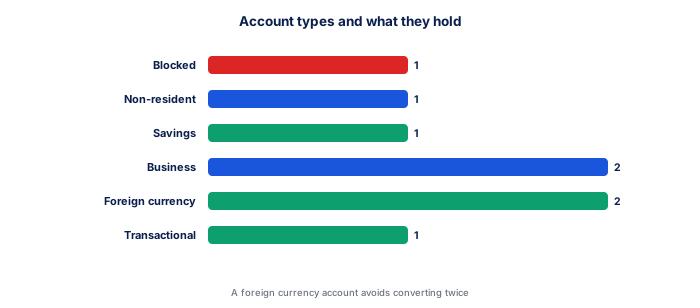
| Account | Holds | Who may open it | Main use |
|---|---|---|---|
| Transactional | Rand | Residents and non-residents | Day to day |
| Savings or notice | Rand | Residents and non-residents | Interest, limited access |
| Customer foreign currency | Foreign currency | Residents, with conditions | Holding dollars without converting |
| Non-resident | Rand | Non-residents | Freely transferable abroad |
| Blocked | Rand | Former residents, historic | Largely replaced by the AIT process |
| Business | Rand or foreign currency | Registered entities | A trading company |
| Item | Rule |
|---|---|
| What it is | A rand-bank account denominated in a foreign currency |
| Who may hold one | Residents, subject to the conditions in the Currency and Exchanges Manual |
| What it avoids | Converting back to rand and out again on every round trip |
| When it helps | Regular offshore income or regular trading in dollars |
| Limits | Funds must have a permitted source, and the account is reported |
| Requirement | Resident | Non-resident |
|---|---|---|
| Identity | SA ID or passport | Passport |
| Proof of address | Three months | Local or foreign, bank dependent |
| Tax number | Required | Not always |
| Proof of income or source | For higher risk | Usually required |
| Visa or permit | Not applicable | Usually required |
How these figures work
The figures on this page come from the body that publishes them and change on a schedule rather than continuously, which is what makes them worth keeping in one place. A customer foreign currency account is the quiet answer for someone trading in dollars regularly. Every conversion back to rand and out again costs the spread twice.
A non-resident rand account is freely transferable abroad, which is what distinguishes it from a resident account rather than any difference in how it works day to day.
★ What this means in practice
The blocked account regime was largely superseded when the AIT process replaced the emigration route in 2023.
✕ Common mistakes
- A customer foreign currency account is the quiet answer for someone trad. A customer foreign currency account is the quiet answer for someone trading in dollars regularly. Every conversion back to rand and out again costs the spread twice.
- A non-resident rand account is freely transferable abroad, which is what. A non-resident rand account is freely transferable abroad, which is what distinguishes it from a resident account rather than any difference in how it works day to day.
- The blocked account regime was largely superseded when the AIT process r. The blocked account regime was largely superseded when the AIT process replaced the emigration route in 2023.
- Taking a figure without its date. A number from a reference page is only as good as when it was last checked, which is why the date sits at the top of this one.
Notes on reading these figures
- A customer foreign currency account is the quiet answer for someone trading in dollars regularly. Every conversion back to rand and out again costs the spread twice.
- A non-resident rand account is freely transferable abroad, which is what distinguishes it from a resident account rather than any difference in how it works day to day.
- The blocked account regime was largely superseded when the AIT process replaced the emigration route in 2023.
To put this into practice, the South African Bank Charges runs the arithmetic on your own numbers; Non-Resident Banking covers the same ground in ordinary language; Exchange Control Allowances goes into the detail this page only summarises; Forex Transfer Costs is the related figure worth reading beside it; and Trading through a company covers what this page leaves out.
Terms used on this page
Frequently asked questions
What is a customer foreign currency account?
A local bank account denominated in a foreign currency, so dollars can be held without converting back to rand.
Who can open one?
Residents, subject to the conditions in the Currency and Exchanges Manual. The funds must have a permitted source.
Why would a trader want one?
Every conversion back to rand and out again costs the spread twice. Holding the currency avoids that.
What is a non-resident account?
A rand account whose balance may be transferred abroad freely. That transferability is what distinguishes it.
Do blocked accounts still exist?
Largely superseded when the AIT process replaced the emigration route in 2023.
Can a non-resident open an account in South Africa?
Usually yes, with a passport, proof of address and typically a visa or permit.
 Download this data