What this page covers
The advertised fee on a cross-border transfer is rarely the main cost. The exchange rate margin usually is, and it is not shown as a charge anywhere on the statement.
| Component | Typical level | Visible on the statement |
|---|---|---|
| Exchange rate margin, major bank | 1.5% to 3.0% | No |
| Exchange rate margin, specialist provider | 0.3% to 1.0% | No |
| SWIFT transfer fee | R300 to R600 | Yes |
| Correspondent bank fee | USD 15 to USD 40 | Sometimes, deducted in transit |
| Receiving bank fee | USD 0 to USD 25 | At the far end |
| Commission | 0% to 0.5% | Yes |
| Route | Rate margin | Fees | Total cost | Received at R16.40 mid |
|---|---|---|---|---|
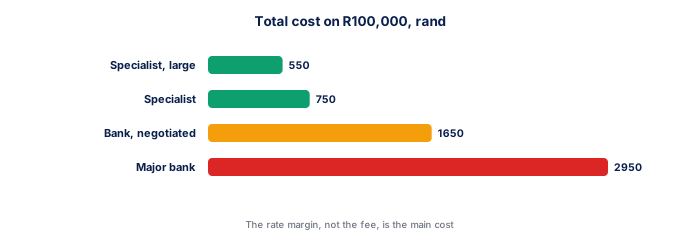
| Major bank | 2.5% | R450 | R2,950 | USD 5,918 |
| Bank, negotiated | 1.2% | R450 | R1,650 | USD 5,997 |
| Specialist provider | 0.5% | R250 | R750 | USD 6,052 |
| Specialist, larger amount | 0.3% | R250 | R550 | USD 6,064 |
| Question | Why it matters |
|---|---|
| What rate am I getting, against the mid-market rate | The margin is the real cost |
| Is the fee deducted here or at the other end | OUR, SHA or BEN changes who pays |
| Which correspondent banks are in the chain | Each one can deduct a fee |
| How long will it take | Two to five business days is normal |
| Does this use my SDA or my FIA | It decides whether a PIN is needed |
How these figures work
The figures on this page come from the body that publishes them and change on a schedule rather than continuously, which is what makes them worth keeping in one place. Compare the rate you are quoted against the mid-market rate on the day, not against another provider's quote. The gap between those two numbers is what you are paying.
A transfer sent SHA means shared charges, and an intermediary can still deduct from the amount in transit. Sending OUR costs more up front but the recipient gets the full amount.
★ What this means in practice
On amounts above about R250,000 the margin dominates the fixed fees entirely, so a provider with a higher fee and a tighter rate is usually cheaper.
✕ Common mistakes
- Compare the rate you are quoted against the mid-market rate on the day, . Compare the rate you are quoted against the mid-market rate on the day, not against another provider's quote. The gap between those two numbers is what you are paying.
- A transfer sent SHA means shared charges, and an intermediary can still . A transfer sent SHA means shared charges, and an intermediary can still deduct from the amount in transit. Sending OUR costs more up front but the recipient gets the full amount.
- On amounts above about R250,000 the margin dominates the fixed fees enti. On amounts above about R250,000 the margin dominates the fixed fees entirely, so a provider with a higher fee and a tighter rate is usually cheaper.
- Taking a figure without its date. A number from a reference page is only as good as when it was last checked, which is why the date sits at the top of this one.
Notes on reading these figures
- Compare the rate you are quoted against the mid-market rate on the day, not against another provider's quote. The gap between those two numbers is what you are paying.
- A transfer sent SHA means shared charges, and an intermediary can still deduct from the amount in transit. Sending OUR costs more up front but the recipient gets the full amount.
- On amounts above about R250,000 the margin dominates the fixed fees entirely, so a provider with a higher fee and a tighter rate is usually cheaper.
To put this into practice, the Currency Converter runs the arithmetic on your own numbers; Offshore Transfer Process covers the same ground in ordinary language; SWIFT and Correspondent Banking goes into the detail this page only summarises; Rand Exchange Rate History is the related figure worth reading beside it; and Broker Deposits and Withdrawals covers what this page leaves out.
Terms used on this page
Frequently asked questions
What is the real cost of a transfer?
Almost always the exchange rate margin rather than the fee. A bank margin of 2.5% on R100,000 is R2,500, against a fee of a few hundred rand.
How do I compare providers?
Against the mid-market rate on the day, not against each other's quotes. The gap between the two is what you pay.
What does SHA mean on a transfer?
Shared charges: you pay your bank and intermediaries deduct from the amount in transit. OUR means you pay everything and the recipient gets the full amount.
Is a specialist provider always cheaper?
On larger amounts, usually. On very small amounts the fixed fee can outweigh the tighter margin.
Why did less arrive than I sent?
A correspondent bank deducted a fee in transit, which happens under SHA and BEN but not under OUR.
How long does a transfer take?
Two to five business days is normal. Compliance screening at a correspondent is the usual reason for longer.
 Download this data