i Short answer
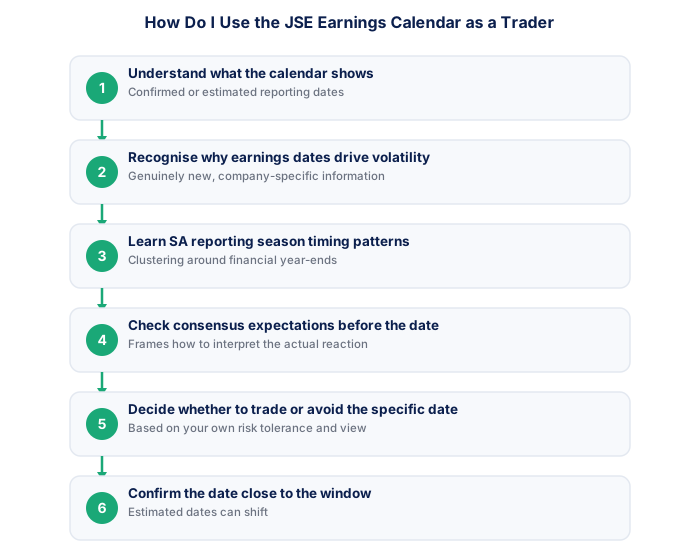
The JSE earnings calendar lists scheduled reporting dates for listed companies, letting traders anticipate periods of potentially higher volatility around a specific share's results release rather than being caught unaware by an unscheduled-feeling price move.
South African reporting seasons cluster around specific periods tied to companies' financial year-ends, with many JSE-listed companies reporting interim and annual results at broadly similar times, creating identifiable higher-volatility windows across the market.
📋 ON THIS PAGE
- What the JSE earnings calendar actually shows
- Why earnings dates matter for volatility specifically
- South African reporting season timing patterns
- What to check before a specific earnings date
- Trading around earnings versus avoiding the date entirely
- Where to find a reliable, current JSE earnings calendar
1. What the JSE earnings calendar actually shows
The calendar lists the scheduled or expected date for a listed company's financial results announcement, distinguishing between interim (half-year) and final (full-year) results, along with the specific reporting period each release covers. Some entries show a confirmed date, others show an estimated window based on the company's historical reporting pattern.
Beyond the date itself, many calendar sources also indicate consensus analyst expectations for key metrics ahead of the release, giving a benchmark against which the actual results can be assessed once published.
2. Why earnings dates matter for volatility specifically
A results release is one of the more reliable, predictable sources of potential sharp price movement for an individual share, since it delivers actually new information, actual financial performance, forward guidance, dividend decisions, that the market did not previously have with certainty.
This differs from macro-driven volatility in that it is company-specific rather than market-wide, meaning a share can move sharply on its own results even while the broader JSE Top 40 or All Share Index remains comparatively calm on the same day.
- SARB economic calendar checked for the week
- Next Eskom load shedding schedule reviewed
- GNU stability news reviewed
- Stats SA data releases noted
- Credit agency review dates checked
- US/global events that move EM risk noted
| Results Type | Common Window |
|---|---|
| Interim results | August to September |
| Final results | February to March |
3. South African reporting season timing patterns
Many JSE-listed companies operate on a financial year aligned to either the calendar year or a year ending in February or March, meaning interim results commonly cluster in the August to September period and final results in the February to March period, though this varies by company and sector.
Mining and resource companies, a significant component of the JSE, sometimes follow slightly different reporting patterns tied to production reporting cycles, so check individually rather than assuming a uniform calendar pattern applies across every sector.
| Event | Frequency | ZAR impact | Source |
|---|---|---|---|
| SARB MPC | 6x per year | High | resbank.co.za |
| Budget Speech | Annual (February) | Very high | treasury.gov.za |
| Credit reviews | Annual each agency | Very high | Agency sites |
| Stats SA CPI | Monthly | Medium | statssa.gov.za |
| Eskom stage | As needed | Low-medium | eskomsepush.com |
- SA context provides genuine informational edge
- ZAR pairs accessible via FSCA brokers in ZAR accounts
- Rand volatility creates larger intraday ranges
- 6 SARB meetings/year create regular macro setups
- Higher geopolitical risk than G10 pairs
- Load shedding creates unique operational disruptions
- SA rand liquidity thinner than major G10 pairs
- SA-specific news requires constant local monitoring
4. What to check before a specific earnings date
Reviewing consensus analyst expectations ahead of a release helps frame how a genuine market reaction should be interpreted, since a result that beats expectations but still shows declining performance year-on-year can still produce a positive price reaction if it beats a pessimistic consensus.
Checking whether the specific share has a history of large post-earnings price gaps is also worth doing individually, since this varies considerably by company, some consistently show minimal reaction while others are known for sharp moves, informing how much you might want to adjust position size or stops heading into that specific date.
5. Trading around earnings versus avoiding the date entirely
Some traders deliberately trade the anticipated volatility around a results release, while others deliberately close or reduce positions ahead of an earnings date specifically to avoid the less predictable, headline-driven price action that can occur in the minutes following a release.
Neither approach is inherently correct, the decision depends on your own risk tolerance, strategy, and whether you have a genuine view on the likely outcome versus simply wanting to avoid unpredictable, gap-like movement in a position you are otherwise holding for unrelated reasons.
6. Where to find a reliable, current JSE earnings calendar
The JSE's own website (SENS announcements) provides the most authoritative source, alongside major South African financial news platforms and most trading platforms, which commonly integrate an earnings calendar feature directly, allowing you to filter specifically for shares you hold or are watching.
Given that expected dates can shift, particularly for smaller or less liquid counters, confirming the specific date close to the anticipated window, rather than relying on a date checked weeks in advance, avoids being caught by an unexpected shift in the actual announcement timing.
★ Why It Matters
Worth checking a specific share's historical pattern of post-earnings price reaction individually before its next reporting date, since some JSE-listed companies consistently show minimal movement on results day while others are known for sharp, sustained reactions, and this pattern is a more useful individual planning input than any general market-wide assumption.
✕ Common mistakes
- Assuming every JSE-listed company reports on the same schedule. Reporting timing varies meaningfully by company and sector, particularly for mining and resource counters.
- Not checking consensus expectations before assessing a results reaction. A result can beat or miss expectations independent of its year-on-year performance direction.
- Holding a large, unadjusted position through an earnings date without a specific view. Post-earnings price gaps can move faster than standard risk management tools comfortably absorb.
- Relying on a date checked weeks in advance without reconfirming closer to the window. Expected dates, particularly for smaller counters, can shift.
Key Takeaways
- The JSE earnings calendar lists scheduled reporting dates for listed companies, letting traders anticipate periods of potentially higher volatility around a specific share's results release rather than being caught unaware by an unscheduled-feeling price move.
- What the JSE earnings calendar actually shows.
- Why earnings dates matter for volatility specifically.
- South African reporting season timing patterns.
- What to check before a specific earnings date.
Frequently asked follow-up questions
Does the JSE earnings calendar cover every listed company?
Most calendar sources aim for broad coverage of the JSE, though smaller or less liquid counters are sometimes covered less comprehensively than JSE Top 40 constituents.
Can earnings season affect the broader JSE index, not just individual shares?
Yes, during periods when multiple large index constituents report in a similar window, the cumulative effect of several significant individual reactions can contribute to broader index-level movement.
Is trading around earnings suitable for beginner traders?
The less predictable, gap-like nature of post-earnings price action generally carries elevated risk, and many beginner traders choose to avoid holding significant positions through a specific earnings date until more experienced.
