i Short answer
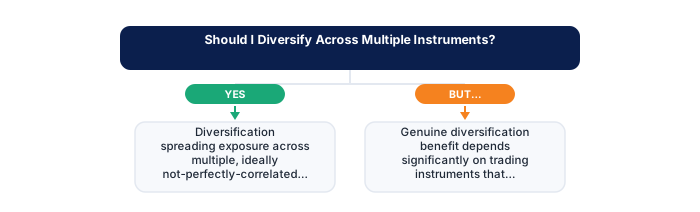
Diversification can genuinely reduce concentration risk compared to putting all your capital into a single instrument.
However, for most beginning and intermediate traders, trading too many instruments at once often spreads attention too thin to trade any one genuinely well.
📋 ON THIS PAGE
- The genuine case for diversification
- Why correlation matters for genuine diversification benefit
- The beginner overextension problem specifically
- Depth versus breadth: a genuine trade-off
- A practical progression for gradually expanding instruments
- Diversification within a single instrument versus across many
1. The genuine case for diversification
The core argument for diversification is reducing how much a single instrument's adverse, idiosyncratic move can hurt your overall results. If your entire trading activity sits in one instrument and that instrument has an unusual, severe adverse event, your whole account bears the full impact. Spreading exposure across several genuinely different instruments means no single bad outcome can hit your entire account the same way.
This mirrors the broader investment diversification principle used across finance, though applying it to active trading, as opposed to passive long-term investing, carries its own nuances and trade-offs covered in the rest of this piece.
It's worth being precise about what this diversification actually protects against, it reduces the impact of any single instrument's idiosyncratic, instrument-specific move, but it doesn't protect against broader, correlated market-wide events affecting all your positions simultaneously, worth understanding this genuine limitation clearly.
2. Why correlation matters for genuine diversification benefit
Real diversification benefit depends heavily on trading instruments that aren't highly correlated, meaning they don't tend to move the same direction at the same time for the same reasons. Trading several forex pairs all heavily driven by general USD strength or weakness gives you far less real diversification than it might look like, since an adverse USD-driven move can hit all those positions at once.
Real benefit comes from combining instruments with meaningfully different underlying drivers, a forex pair, a commodity like gold, and an equity index, each responding to at least somewhat different fundamentals, rather than just trading more instruments that happen to share very similar drivers and move together regardless.
- FSCA-regulated broker verified at fsca.co.za
- Demo account tested for minimum 60 days
- Trading plan written: entry, exits, position sizing
- Risk per trade defined (1-2% of account)
- Backup internet connection tested for load shedding
- Tax implications understood
It's worth checking actual correlation data for your specific instrument combination, using the correlation tools discussed elsewhere on this site, rather than assuming diversification simply because the instruments have different names, genuine diversification benefit depends on this concrete, verifiable data rather than a surface-level impression.
3. The beginner overextension problem specifically
For beginners, trying to actively trade many instruments at once, each with its own typical volatility, fundamental drivers, and technical behaviour, often means only a surface-level grasp of each, rather than the deep, specific familiarity that supports sound trading decisions.
This overextension is one of the more common, avoidable mistakes among newer traders, who sometimes assume trading more instruments at once shows greater skill, when in practice it usually just dilutes the depth of analysis and attention any single instrument gets, hurting rather than improving overall results.
It's worth being honest with yourself about whether adding another instrument reflects genuine analytical readiness or simply restlessness with your current focus, the second motivation is worth resisting specifically, since it tends to produce exactly the shallow, overextended coverage this section describes.
4. Depth versus breadth: a genuine trade-off
There's a genuine trade-off between depth (deep understanding of a small number of instruments) and breadth (spreading attention across many for diversification benefit). For most beginning and intermediate traders, prioritising depth first tends to produce better results, since real skill and pattern recognition develop more effectively through concentrated, repeated exposure to fewer instruments than diffuse, superficial exposure across many.
That doesn't mean diversification is never worthwhile, it means sequencing matters: build real depth and competence with one or two instruments first, then gradually expand once that depth is genuinely established, which tends to produce a more sustainable skill trajectory overall.
| Item | Detail |
|---|---|
| Regulator | FSCA, fsca.co.za |
| Exchange control | SARB, resbank.co.za |
| Tax authority | SARS, sars.gov.za |
| JSE hours | 09:00-17:00 SAST Mon-Fri |
| Best forex session | 15:00-17:00 SAST |
| CGT annual exclusion | R50,000 (individuals) |
5. A practical progression for gradually expanding instruments
A practical approach for traders wanting to eventually diversify: start with a single instrument category you have real interest in and reasonable access to understanding well. For many South African traders that's USD/ZAR, given its direct local relevance. Spend enough time building real, demonstrated competence (through backtesting and forward-testing) before gradually adding a second, ideally low-correlation instrument once the first is genuinely well understood.
This gradual, sequential expansion, rather than attempting broad diversification as a beginner straight away, lets real skill and understanding compound progressively with each addition, instead of spreading thin attention across many instruments from the start.
It's worth documenting this progression explicitly in your trading plan, discussed elsewhere on this site, having a written, deliberate sequence for expanding your instrument coverage keeps the process disciplined rather than opportunistic or impulsive.
6. Diversification within a single instrument versus across many
It's worth separating diversification across instruments from a related but distinct idea: diversification across strategies or timeframes on even a single instrument, combining a longer-term position-trading approach with a smaller-allocation swing-trading approach on the same underlying instrument, for instance, which can offer some of the same smoothing benefit without needing expertise across entirely different instrument categories.
This kind of within-instrument diversification can be a useful middle step for traders wanting some diversification benefit while still keeping the depth-of-understanding advantage of focusing mainly on instruments they already know well, rather than immediately expanding into entirely new, unfamiliar categories.
Over-diversification spreads attention too thin without adding protection.
Genuine diversification across genuinely uncorrelated instruments reduces concentration risk. Adding more instruments without understanding their correlations doesn't add meaningful protection.
★ Why It Matters
Worth checking specifically before assuming diversification is working: calculate the actual correlation between your chosen instruments during a recent volatile period, two seemingly different instruments (gold and ZAR pairs, for instance) sometimes move together far more than their surface-level difference suggests.
✕ Common mistakes
- Spreading attention too thin across too many instruments at once. This can mean trading none of them particularly well.
- Not checking actual correlation data before assuming diversification benefit. Calculated correlation, not assumption, should guide this decision.
- Treating diversification as a substitute for sound risk management. It reduces concentration risk but doesn't replace position sizing discipline.
Key Takeaways
- Diversification can reduce concentration risk, but trading too many instruments without sufficient understanding of each often backfires for beginners.
- Diversification can genuinely reduce concentration risk compared to putting all your capital into a single instrument.
- However, for most beginning and intermediate traders, trading too many instruments at once often spreads attention too thin to trade any one genuinely well.
- The genuine case for diversification.
- Why correlation matters for genuine diversification benefit.
See also: How Do Investment Stokvels Work, and Can a Stokvel Buy Shares?.
Frequently asked follow-up questions
How many instruments should a beginner trade at once?
Many experienced traders suggest starting with just one or two closely followed instruments, expanding gradually only once real competence and understanding are well established.
Does diversification eliminate trading risk entirely?
No. It reduces concentration risk specifically, but doesn't remove broader market risk, leverage risk, or the psychological and strategy execution risks that come with trading generally.
Is trading correlated instruments ever useful?
Yes, in some strategies built around correlation relationships themselves, though that's a more advanced approach generally better suited to traders who already have solid foundational experience.
Does adding more instruments automatically improve my overall results?
Not necessarily. Spreading attention across too many instruments can dilute the focused analysis that comes from deeply understanding a smaller, well-chosen set, sometimes hurting overall quality rather than helping it.
Should my diversification approach differ between day trading and longer-term positions?
Often yes. Day traders frequently benefit from staying narrowly focused on one or two highly liquid instruments, while longer-term position traders may have more natural room for broader diversification.
