What this page covers
The JSE publishes several indices from the same market, and they differ mainly in how they handle the shares held offshore in dual listed companies. That single choice explains most of the gap between them.
| Index | Code | What it measures |
|---|---|---|
| All Share | ALSI, J203 | Substantially all eligible listed companies by market capitalisation |
| Top 40 | J200 | The forty largest by market capitalisation |
| SWIX All Share | J403 | Weighted by shares held on the South African register |
| Top 40 SWIX | J400 | The Top 40 on the same SWIX weighting |
| Capped SWIX | J433 | SWIX with a cap on any single constituent |
| Mid Cap | J201 | The next tier below the Top 40 |
| Small Cap | J202 | Below the Mid Cap |
| Item | Detail |
|---|---|
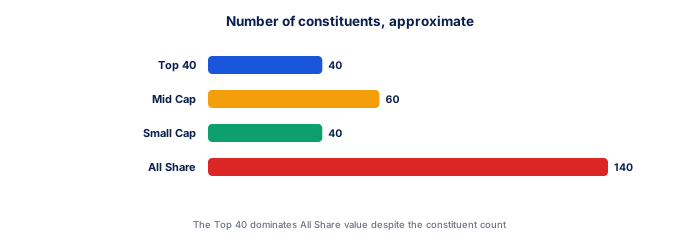
| Concentration | The Top 40 makes up the large majority of All Share value |
| Resources | A heavy weight, so commodity prices move the index |
| Dual listings | Companies listed here and abroad distort a plain market cap weighting |
| SWIX correction | Counts only shares on the South African register |
| Capping | Limits how far one company can dominate |
| Fund type | Usual benchmark | Why |
|---|---|---|
| Broad local equity tracker | Capped SWIX All Share | Limits single-name concentration |
| Top 40 tracker | Top 40 SWIX | Reflects locally held shares |
| Actively managed local fund | Capped SWIX All Share | The common performance benchmark |
| Property fund | SA Listed Property | A separate sector index |
| Retirement fund reporting | Capped SWIX | Concentration limits apply |

Download this data
Every table on this page as a spreadsheet, with the source and the date it was checked in the header rows.
⬇ Download CSVHow these figures work
An index is a weighted average. The weighting decides what it actually measures, and the JSE publishes several versions of the same market because the obvious weighting produces a misleading result here.
Several of the largest companies on the JSE are dual listed, with most of their shares held abroad. Weighting by total market capitalisation gives those companies an influence far beyond the South African money actually invested in them. The SWIX versions correct for this by counting only shares held on the South African register.
★ A worked example
A dual listed company has a market capitalisation of R500 billion, but only 20% of its shares sit on the South African register.
In the plain All Share, it is weighted on the full R500 billion. In the SWIX version it is weighted on R100 billion, a fifth of the influence.
For a South African fund tracking the index, the SWIX weighting is the honest one: it reflects the shares that South African investors can actually buy. This is why most local index funds track a SWIX or capped SWIX version rather than the plain index.
✕ Common mistakes
- Comparing a fund to the wrong index. A SWIX tracker measured against the plain All Share will look like it is under or outperforming when it is doing exactly what it should.
- Assuming the All Share is diversified. The Top 40 dominates it, and resources dominate the Top 40. It is far more concentrated than the number of constituents suggests.
- Ignoring rebalances. Composition is reviewed quarterly. Tracking funds must trade, which is why volume spikes around those dates.
- Treating an index level as a return. Most quoted index levels are price indices and exclude dividends. Total return versions include them.
Notes on reading these figures
- The All Share and the Top 40 move almost together because the forty largest companies dominate the total. Divergence between them is a signal about smaller companies, not about the market as a whole.
- Most South African index funds track a SWIX or capped SWIX version rather than the plain index, because the plain version overweights companies whose shares mostly sit offshore.
- Index composition is reviewed quarterly. A company entering or leaving forces tracking funds to trade, which is why volume spikes around a rebalance.
To put these figures to work, the JSE Trading Hours and Holidays runs the arithmetic on your own numbers, and All Share vs Top 40 covers the same ground in ordinary language. Which ETF should a beginner buy? and Beta Calculator go into the detail this table only summarises.
Terms used on this page
Put this table on your own site
The table below can sit on your own page and stays current without you editing anything.
- Preview the embeddable table as it will appear on your site
Place this snippet on your page and the table is embedded live, rather than copied and left to age.
<iframe src="https://www.tradeanswers.co.za/embed/ref-jse-indices-reference.html" width="100%" height="620" style="border:0" title="JSE Indices Reference"></iframe>Free to use with attribution. The link back to this page is built into the embed.
Frequently asked questions
What is the difference between the ALSI and the Top 40?
The All Share covers substantially all eligible companies; the Top 40 covers the forty largest. They move almost together because the largest dominate.
What does SWIX mean?
Shareholder weighted index. It weights by shares held on the South African register rather than by total market capitalisation.
Why cap an index?
To limit how far a single company can dominate. A capped SWIX restricts any one constituent's weight.
How often does composition change?
Quarterly, at the scheduled review. Entries and exits force tracking funds to trade.
Which index should I track?
Most South African index funds use a SWIX or capped SWIX version, because it reflects what local investors actually hold.
Does the index include dividends?
The commonly quoted level does not. Total return versions do, and the difference over long periods is substantial.