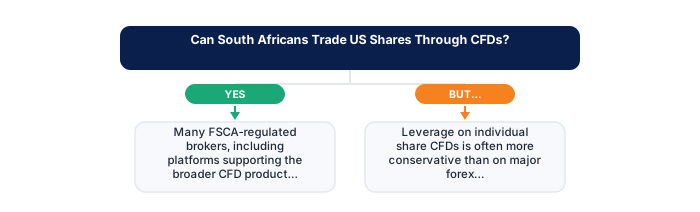
Yes. Many FSCA-regulated brokers offer CFDs on major US-listed shares, companies like Apple, Tesla, and Amazon.
This gives South African traders exposure to these companies' share price movement without requiring direct share ownership or a separate US brokerage account.
A share CFD tracks the price movement of an individual company's stock without granting actual ownership of shares, voting rights, or direct dividend entitlement. You're speculating on the share's price direction through a contract with your broker, who prices the CFD against the underlying stock's live market price.
This structure removes several practical frictions associated with direct foreign share ownership: no need to open a separate foreign brokerage account, no foreign tax reporting requirements for share ownership itself, no complications from US estate tax rules that apply to non-US persons owning US securities, and no currency conversion at the portfolio level unless you specifically choose a non-ZAR account.
6/yrSARB MPC meetings affecting ZAR
3credit agencies reviewing SA annually
Februarybudget speech month
3-5 pipstypical USD/ZAR retail spread
ZA
SA market context: USD/ZAR is driven by both global EM risk appetite and SA-specific factors. Separating these two drivers produces more precise ZAR analysis than treating the pair as a single signal.
It's worth being clear about which outcome you're actually seeking before choosing this approach. If you want price exposure to Apple's or Tesla's stock performance, a share CFD provides that efficiently. If you want actual ownership: direct participation in the company's long-term growth, shareholder status, and genuine dividend income, a CFD doesn't provide those things and a different route is needed.
The leverage available on share CFDs adds another dimension absent from direct ownership: you can take a position significantly larger than your deposited capital, amplifying both potential gains and losses. This changes the fundamental risk profile of the investment relative to directly owning shares at full value, and needs to be consciously accounted for rather than treated as a free enhancement.
Share CFDs vs direct foreign share ownership
Feature
Share CFD
Direct Ownership
Uses SARB foreign investment allowance
No
Yes
Leverage available
Yes
No
Dividend treatment
Cash adjustment, not a real dividend
Genuine dividend received
Shareholder voting rights
No
Yes
Can go short
Yes
Not directly
2. What companies are typically available to trade
Most brokers offering US share CFDs provide access to a substantial range of major, liquid companies from the NYSE and NASDAQ: typically including the S&P 500's most prominent members and popular technology, consumer, and financial sector names. Coverage of the most widely traded US shares is broadly consistent across major brokers; coverage of smaller or less liquid companies varies more.
Checking your specific broker's available share CFD list directly is worth doing rather than assuming universal coverage. Some brokers offer hundreds of US shares; others focus on a more selective set of the most actively traded names. If your interest centres on particular companies or sectors rather than the most prominent names, confirming availability before choosing a broker prevents discovering constraints after the account is open.
Weekly SA Market Monitoring Checklist
SARB economic calendar checked for the week
Next Eskom load shedding schedule reviewed
GNU stability news reviewed
Stats SA data releases noted
Credit agency review dates checked
US/global events that move EM risk noted
SA Market Calendar Reference
SARB MPC
6 meetings/year, rate decision
Budget Speech
Late February, fiscal signal
Moody's review
Typically October/November
S&P Fitch review
Typically October/November
Stats SA CPI
3rd week of each month
Eskom stages
Real-time, check eskomsepush.com
~R16-22USD/ZAR typical trading range 2022-2025
6/yearSARB MPC meetings that can move the rand
3major credit agencies reviewing SA annually
Februaryhighest SA market volatility month (budget + tax year-end)
note that that availability can also vary based on the regulatory treatment of specific instruments in different jurisdictions. Some US-listed instruments: particularly certain ETFs that are classified as UCITs in Europe but not available to all non-European retail clients, may have restricted availability depending on your broker's specific licence structure and regulatory environment.
3. Dividend considerations specific to share CFDs
Unlike direct share ownership, where dividends are paid directly to you as a registered shareholder, share CFD positions typically receive a dividend adjustment rather than a formal dividend payment. When a constituent company goes ex-dividend, your broker adjusts the cash balance of your account to reflect the dividend amount: typically crediting long positions and debiting short positions for the dividend-equivalent amount.
The specific timing and mechanics of these adjustments vary by broker and are detailed in their product documentation. The adjustment amount may also differ from the gross dividend: tax withholding treatment, broker processing, and the specific dividend adjustment policy can all affect the exact amount you receive or pay.
SA ZAR Event Calendar
Event
Frequency
ZAR impact
Source
SARB MPC
6x per year
High
resbank.co.za
Budget Speech
Annual (February)
Very high
treasury.gov.za
Credit reviews
Annual each agency
Very high
Agency sites
Stats SA CPI
Monthly
Medium
statssa.gov.za
Eskom stage
As needed
Low-medium
eskomsepush.com
Pros
SA context provides genuine informational edge
ZAR pairs accessible via FSCA brokers in ZAR accounts
SA-specific news requires constant local monitoring
It's worth reading your broker's specific dividend adjustment documentation carefully if dividend income is a meaningful consideration for your strategy. The amount you receive through a CFD dividend adjustment, and how it's taxed in your hands under SARS rules, may differ from what a direct shareholder would receive: making this a relevant consideration for any strategy that factors dividend income into its return profile.
For short CFD positions, dividend adjustments work in reverse: your account is debited when a company you're short goes ex-dividend, reflecting the notional dividend payment you'd have made as a borrower of shares in the underlying market. This cost is automatic and needs to be factored into the economics of maintaining short positions through dividend dates.
4. Trading hours and US market timing for South Africans
US share markets generally operate during US Eastern Time business hours, translating to approximately 15:00-22:00 SAST during standard time and approximately 16:00-23:00 during US Daylight Saving Time (which differs from South Africa's daylight saving schedule). This means US market activity falls in the South African late afternoon and evening: accessible for traders who have finished their working day but potentially late for those with early morning schedules.
This timing aligns well for South African traders who prefer an evening trading session. The overlapping period between the JSE's afternoon close, the London session's late trading, and the US open: around 15:00-17:00 SAST, is often one of the most active and well-distributed volatility windows of the South African trading day.
!
Load shedding during 15:00-17:00 SAST is a specific risk
This timing is worth factoring honestly into your broader trading routine and time commitment planning. The US regular session runs for over six hours, and while you don't need to be present for the full session, understanding when key events: earnings releases, Fed communications, major economic data, typically occur within the US session helps you allocate your limited attention time more effectively.
Extended-hours US market trading: pre-market from approximately 13:00 SAST and after-hours until around 01:00 SAST, is available through some brokers, but liquidity in these sessions is typically much lower than during regular hours. Spreads are wider, price movements can be less representative of sustained direction, and individual earnings announcements that sometimes happen in extended hours can create sharp, fast moves.
5. Leverage considerations specific to individual shares
Leverage on individual share CFDs is typically more conservative than on major forex pairs or broad indices, reflecting the higher company-specific risk that individual shares carry. A single company can gap sharply on an earnings miss, regulatory action, executive departure, or unexpected news in ways that a broadly diversified index can't, justifying a lower maximum leverage limit.
Checking your broker's leverage terms for individual share CFDs specifically, rather than assuming the leverage available on forex or index CFDs applies equally, is worth doing before planning your position sizing. The difference between 1:30 forex leverage and 1:5 or 1:10 individual share leverage affects your capital requirements and risk calculations significantly.
This more conservative leverage approach is worth appreciating as sound risk management rather than an inconvenient restriction. Individual shares can move more sharply and unpredictably than diversified indices, and the gap risk on individual shares: particularly around earnings announcements, is meaningfully higher. The lower leverage cap reduces the scale of loss that a gap move can create in your account.
Position sizing for individual share CFDs should also account for the specific volatility characteristics of the company you're trading. A high-volatility growth stock has different typical daily ranges than a mature, dividend-paying utility company, and appropriate stop-loss placement and position sizing should reflect those different volatility profiles rather than applying a uniform approach across all share CFDs.
6. Comparing this approach to direct foreign share investment
South Africans seeking direct, unleveraged ownership of US shares: as opposed to CFD-based price exposure, would need to open a brokerage account specifically set up for direct international share dealing, use their SARB discretionary or foreign investment allowance to transfer funds offshore, and manage the tax reporting requirements that come with holding foreign securities directly.
This direct ownership path offers genuine shareholder status and dividend entitlement without leverage risk, but involves more operational complexity than a CFD through a locally FSCA-regulated broker. The choice between the two comes down to whether actual ownership matters for your goals: it doesn't matter for pure price exposure, but it matters considerably for anyone seeking long-term compounding of both price and dividend returns within an actual share ownership structure.
A timing detail many South African traders miss initially: US share CFDs only show meaningful price movement during US market hours, which for South Africa falls in the afternoon and evening. Outside those hours, prices may move slightly on pre-market or after-hours activity, but the primary price discovery for US shares happens during the regular US trading session. Positions held through the South African daytime experience relatively little movement until the US session opens.
✕ Common mistakes
Checking charts during South African daytime and seeing no movement. US shares only show real activity during US market hours, in the evening locally.
Assuming US share CFDs carry the same spread as forex majors. Costs and liquidity profiles differ meaningfully between asset classes.
Ignoring earnings season volatility for individual US shares. Company-specific news can move a single share sharply.
Forgetting that CFDs don't include shareholder voting rights. This is a genuine ownership difference, not just a technical detail.
Are CFDs available on JSE-listed shares for South African traders?
Yes. Most major FSCA-regulated CFD brokers offer contracts on JSE-listed shares and the JSE Top 40 index. These allow leveraged trading on SA equities without needing a separate JSE stockbroker account.
Key Takeaways
Yes, many FSCA-regulated brokers offer CFDs on major US shares, giving exposure without direct ownership or US brokerage account requirements.
Many FSCA-regulated brokers offer CFDs on major US-listed shares, companies like Apple, Tesla, and Amazon.
This gives South African traders exposure to these companies' share price movement without requiring direct share ownership or a separate US brokerage account.
Can I take physical delivery of US shares through a CFD?
No, as with other CFD instruments, share CFDs are cash-settled contracts and don't involve or allow actual delivery of underlying shares.
Do I pay US withholding tax on share CFD dividend adjustments?
Generally, CFD dividend adjustments are structured differently from direct share dividend payments and may not carry the same US withholding tax treatment, though this can vary by broker and product structure, worth clarifying directly if it matters significantly to you.
Are US share CFDs riskier than forex or index CFDs?
Individual shares can sometimes show higher idiosyncratic volatility tied to company-specific news than broader index or major forex pairs, which makes instrument-specific risk management particularly important.
Trading Industry Analyst | Specializing in Forex & CFDs
Last reviewed: 25 June 2026
Giancarlo writes on forex and CFD markets, with a background in business development and partnerships across the online trading industry. He focuses on making market mechanics and trader protections easier to understand for a South African audience.
This article draws on general information published by the South African regulators and established financial education resources listed below. Always check each source directly for the most current detail.