i Short answer
Indices like Germany's DAX, France's CAC 40, and the Euro Stoxx 50 are available as CFDs through some FSCA-regulated brokers.
Each tracks a different major European economy or regional market grouping.
📋 ON THIS PAGE
1. What each of these specific indices tracks
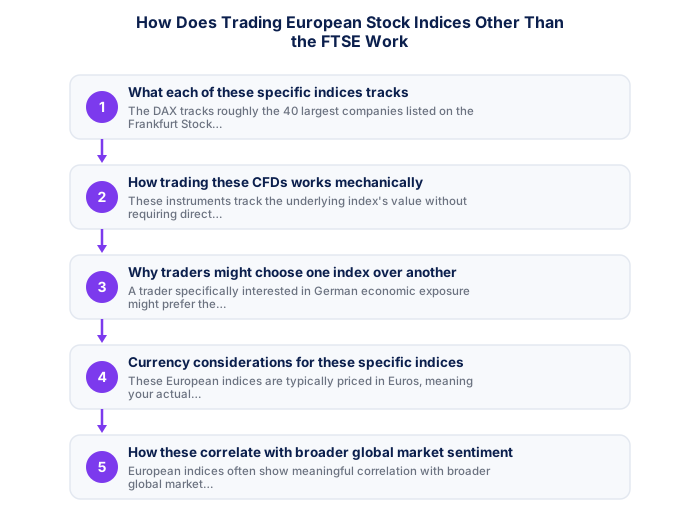
The DAX tracks roughly the 40 largest companies listed on the Frankfurt Stock Exchange, representing Germany's broader economy specifically; the CAC 40 tracks the 40 largest French listed companies; and the Euro Stoxx 50 provides broader exposure across major companies throughout the Eurozone rather than any single specific country.
It's worth researching each index's specific sector composition individually rather than assuming they're broadly interchangeable, the DAX's industrial and automotive weighting, for example, gives it a genuinely different character and set of relevant news drivers than a more diversified pan-European index would have.
2. How trading these CFDs works mechanically
These instruments track the underlying index's value without requiring direct ownership of the constituent shares, using the same margin and leverage mechanics as other CFD products.
It's worth confirming the specific contract value and margin requirements for each individual index directly with your broker, rather than assuming identical terms across all European indices, since these details can differ meaningfully even among indices that seem broadly similar in structure.
- FSCA-regulated broker verified at fsca.co.za
- Demo account tested for minimum 60 days
- Trading plan written: entry, exits, position sizing
- Risk per trade defined (1-2% of account)
- Backup internet connection tested for load shedding
- Tax implications understood
3. Why traders might choose one index over another
A trader specifically interested in German economic exposure might prefer the DAX specifically, while someone wanting broader, more diversified Eurozone exposure might prefer the Euro Stoxx 50 instead, reflecting genuinely different underlying economic exposure despite both representing European equity markets broadly.
It's worth being explicit with yourself about which specific economic exposure you're actually trying to express before choosing between these options, a genuinely deliberate choice based on your actual analytical view tends to produce more coherent trading decisions than defaulting to whichever index happens to be more prominently discussed in general financial media.
4. Currency considerations for these specific indices
These European indices are typically priced in Euros, meaning your actual Rand-denominated profit or loss reflects both the index's own movement and Euro-Rand exchange rate movement during your holding period.
It's worth tracking EUR/ZAR movement, or the relevant cross, separately from the index's own performance in your trading journal, since a genuinely strong index performance can still produce a disappointing Rand-denominated result if the Euro weakens meaningfully against the Rand during your specific holding period.
| Item | Detail |
|---|---|
| Regulator | FSCA, fsca.co.za |
| Exchange control | SARB, resbank.co.za |
| Tax authority | SARS, sars.gov.za |
| JSE hours | 09:00-17:00 SAST Mon-Fri |
| Best forex session | 15:00-17:00 SAST |
| CGT annual exclusion | R50,000 (individuals) |
5. How these correlate with broader global market sentiment
European indices often show meaningful correlation with broader global market sentiment and major US index movement, though each also responds to its own specific regional economic and political developments.
It's worth checking this correlation directly using the tools and thinking discussed elsewhere on this site regarding currency and instrument correlation generally, understanding how closely a specific European index tends to move alongside broader global sentiment helps you judge how much genuine diversification benefit it actually offers relative to instruments you're already trading.
6. Checking availability with your specific broker
Availability of these specific European indices varies by broker, making it worthwhile to check your specific broker's instrument list directly if you have particular interest in any of these specific markets.
Domestic German news is one factor among several, not always dominant.
The DAX's export-heavy constituents often react more to Chinese demand data than to purely domestic German news, despite being commonly thought of as a German indicator.
The difference between traders who improve systematically and those who plateau for extended periods is typically not natural talent or market insight but the quality of their record-keeping and review process. Traders who maintain a detailed journal, review every trade against their original rationale, and update their trading plan based on accumulated evidence rather than gut feeling develop a feedback loop that continuously improves their decision quality. This structured approach is available to every trader regardless of experience level and costs nothing except the discipline to apply it consistently.
★ Why It Matters
Worth tracking: the DAX's heavy weighting toward export-oriented industrial and automotive companies means it often reacts more sharply to Chinese economic data than to purely domestic German news, despite being a German index.
✕ Common mistakes
- Assuming all European indices share the same sector composition. Sector weighting varies meaningfully and affects each index's specific sensitivities.
- Trading outside the relevant exchange's actual operating hours. Spreads widen and liquidity drops once the underlying market is closed.
- Not checking each index's specific constituent weighting before trading it. A few heavily weighted companies can dominate an index's overall movement.
Key Takeaways
- Indices like the DAX, CAC 40, and Euro Stoxx 50 are available through some brokers, each tracking a different major European economy or regional market.
- Indices like Germany's DAX, France's CAC 40, and the Euro Stoxx 50 are available as CFDs through some FSCA-regulated brokers.
- Each tracks a different major European economy or regional market grouping.
- What each of these specific indices tracks.
- How trading these CFDs works mechanically.
Frequently asked follow-up questions
Is the DAX more volatile than the FTSE 100?
Volatility characteristics can vary by current market conditions rather than following a fixed, permanent pattern; checking current volatility data for each specific index provides the most accurate comparison.
Can I trade multiple European indices simultaneously through one broker?
Many brokers offering one European index typically offer several together, though checking your specific provider's exact range confirms this.
Does Brexit affect how the FTSE relates to these continental European indices?
The UK's departure from the EU has introduced some structural differences in how UK and continental European markets relate, though both remain meaningfully connected to broader global market sentiment.
Are these indices available with the same leverage as major forex pairs?
Leverage limits often differ between forex and index instruments, making this worth checking specifically for your broker.
Do these indices trade during South African daytime hours?
European market hours generally align reasonably well with South African daytime given the relatively modest time zone difference.
