i Short answer
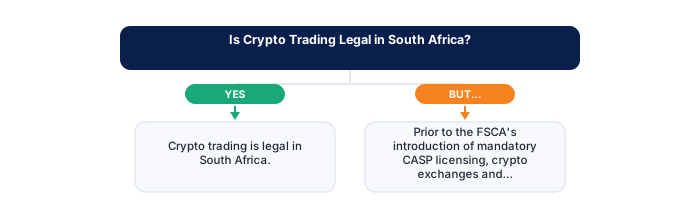
Yes. Crypto trading is legal in South Africa, and since 2023 the FSCA requires Crypto Asset Service Providers to hold a formal licence.
This brought a previously unregulated sector under genuine regulatory oversight for the first time. Two further developments in 2026 tightened this further: the CARF reporting framework gave SARS direct visibility into transaction data, and the new Capital Flow Management Regulations brought crypto within exchange control for the first time, ending the grey area that had previously supported activity like crypto arbitrage.
📋 ON THIS PAGE
1. What changed with FSCA crypto licensing in 2023
Prior to the FSCA's introduction of mandatory CASP licensing, crypto exchanges and trading platforms serving South African clients operated in a genuine regulatory grey area, there was no dedicated financial services regulator with clear authority over how these platforms handled client funds, executed trades, or disclosed risks, leaving clients with considerably less formal protection than they'd have with a traditionally regulated forex or CFD broker.
The introduction of CASP licensing changed this materially: platforms now must apply for and maintain an FSCA licence specifically covering crypto asset services, subjecting them to many of the same categories of obligation that apply to other licensed financial services providers, including fit-and-proper standards for key individuals, certain operational and conduct requirements, and a formal pathway for client complaints and regulatory recourse that simply didn't exist in any structured form before this licensing regime was introduced.
It's worth understanding what this regulatory shift genuinely means for you as a South African crypto trader, platforms serving you today operate under a formal, enforceable licensing framework, unlike the largely unregulated environment that existed previously, a meaningful improvement in the baseline protection available.
See also: How Does SARS Tax Cryptocurrency Gains in South Africa?
2. What a CASP licence actually requires
A CASP licence obligates the platform to meet specific FSCA requirements around fit-and-proper standards for the individuals operating the business, certain operational systems and controls (including measures addressing money laundering and terrorist financing risks, which crypto platforms have historically been seen as particularly exposed to given the pseudonymous nature of some crypto transactions), and ongoing compliance reporting that the FSCA can review and audit.
This is a meaningfully lighter-touch regime in some respects compared to the full prudential and conduct requirements applied to traditional banks or established forex brokers, reflecting the relatively newer regulatory approach to this asset class globally, but it nonetheless represents genuine regulatory oversight where previously there was effectively none, and platforms operating without this licence after the relevant compliance deadlines are doing so in violation of South African financial services law.
- SARB economic calendar checked for the week
- Next Eskom load shedding schedule reviewed
- GNU stability news reviewed
- Stats SA data releases noted
- Credit agency review dates checked
- US/global events that move EM risk noted
- Client funds segregated
- Formal FSCA complaints process
- SA consumer protections apply
- ZAR account available
- Fund safety not guaranteed
- Overseas disputes only
- SA law does not apply
- Currency conversion costs
It's worth understanding this lighter-touch framing specifically, since it means CASP-licensed platforms, while genuinely regulated, may not carry quite the same depth of protection as a full FSP licence covering traditional forex and CFD trading, worth keeping this distinction in mind rather than assuming identical protection levels across both categories.
3. Buying actual crypto versus trading crypto CFDs
It's worth being clear about two distinct ways South Africans can gain exposure to cryptocurrency price movement, since they carry different risk profiles and fall under somewhat different regulatory considerations. Buying actual cryptocurrency through a licensed exchange means you directly own the underlying digital asset, typically held either in the exchange's custody or in a personal wallet you control, with no leverage involved unless you separately choose to use margin trading features some exchanges offer.
Trading crypto CFDs through a broker, by contrast, means you're speculating on crypto price movement without ever owning the underlying coin or token, you hold a contract tracking the price, often with leverage applied, similar in structure to how gold or forex CFDs work. Crypto CFDs typically fall under the same broader CFD-related FSCA licensing and disclosure framework that applies to other CFD products, including the high-risk classification and associated loss-percentage disclosure requirements, layered on top of crypto's own inherent price volatility.
| Event | Frequency | ZAR impact | Source |
|---|---|---|---|
| SARB MPC | 6x per year | High | resbank.co.za |
| Budget Speech | Annual (February) | Very high | treasury.gov.za |
| Credit reviews | Annual each agency | Very high | Agency sites |
| Stats SA CPI | Monthly | Medium | statssa.gov.za |
| Eskom stage | As needed | Low-medium | eskomsepush.com |
- SA context provides genuine informational edge
- ZAR pairs accessible via FSCA brokers in ZAR accounts
- Rand volatility creates larger intraday ranges
- 6 SARB meetings/year create regular macro setups
- Higher geopolitical risk than G10 pairs
- Load shedding creates unique operational disruptions
- SA rand liquidity thinner than major G10 pairs
- SA-specific news requires constant local monitoring
It's worth applying the same distinction discussed elsewhere on this site regarding Bitcoin CFDs specifically, whichever crypto asset you're considering, being clear with yourself about whether you want genuine ownership or pure price speculation should guide which of these two fundamentally different paths you actually choose.
4. How to check a crypto platform's licence status
Before depositing funds or buying crypto through any specific platform claiming to serve South African clients, checking the FSCA's public register for either a CASP licence (for direct crypto exchange and custody services) or a standard FSP licence covering derivative instruments (for crypto CFD trading specifically) is the same fundamental due diligence step that applies to any other financial services provider in this market.
Given that crypto platforms have historically attracted a meaningful share of fraudulent and unlicensed operators globally, including in South Africa , this verification step is arguably even more important in the crypto space than in more established, longer-regulated categories like traditional forex and CFD brokers, where regulatory frameworks have had more time to mature and enforcement patterns have had longer to develop.
It's worth treating this verification as absolutely non-negotiable given crypto's particularly elevated fraud history, the consequences of skipping this check with a crypto platform specifically can be considerably more severe than with a more established, traditional forex broker.
5. How SARS treats crypto gains for tax purposes
SARS has clarified its general approach to crypto assets for tax purposes, treating gains from crypto transactions as either revenue (taxed as ordinary income) or capital gains, following broadly similar principles to how trading gains in other asset classes are classified, frequency of transactions, holding period, and overall pattern of activity all factor into this determination, much as they do for forex and CFD trading profits.
Crypto-specific complexities can arise around accurately tracking cost basis across multiple transactions, particularly if you've moved crypto between different wallets or exchanges, or engaged in more complex activities like staking or earning crypto rewards, which may have their own specific tax treatment considerations, given this complexity, consulting a tax practitioner familiar with crypto-specific guidance is particularly worthwhile for anyone with meaningful crypto trading activity.
6. Risks specific to crypto beyond general market risk
Beyond the general market volatility and (where leverage is used) leverage risk that crypto shares with other speculative instruments, crypto carries some risk dimensions that are more specific to the asset class itself. Bitcoin's own 45% decline from its October 2025 record high is a concrete recent illustration of this volatility in practice. These include the technical risk of losing access to crypto holdings through lost private keys or wallet credentials (a risk that doesn't have a direct equivalent in traditional brokerage account structures, where the broker maintains custody and account access recovery processes), the relative immaturity of some exchange platforms compared to long-established traditional financial institutions, and crypto's historically extreme price volatility, which can exceed even the elevated volatility seen in instruments like USD/ZAR by a considerable margin during certain periods.
These additional risk dimensions are worth weighing specifically when considering crypto exposure, separate from and in addition to the standard considerations that apply to any leveraged or speculative financial instrument, given that crypto's combination of technical custody risk and extreme price volatility creates a genuinely distinct risk profile from more traditional asset classes.
Direct exchange trading is legal but outside FSCA oversight.
Crypto CFDs through FSCA-regulated brokers sit within the regulated framework. Direct exchange trading is legal but outside FSCA supervision, with different practical implications.
★ Why It Matters
Something worth checking before depositing with any crypto platform: verify the entity holds the newer FSCA Crypto Asset Service Provider licence , not just a general financial services licence, this is a distinct, more recent authorisation category that many platforms still lack.
✕ Common mistakes
- Confusing crypto CFD trading with using an unregulated crypto exchange. These are different activities with different regulatory frameworks.
- Not checking when a specific platform's licence was actually granted. This is a relatively recent licensing category worth confirming directly.
- Treating crypto's legal status as settled and unchanging. Regulatory frameworks in this space continue to evolve.
How do I check the broker behind this?
Search the FSCA register by the company's registered name, not its brand, and confirm the FSP number is current and covers the product. Verifying a licence covers it in full.
Where do I find the FSP number?
A licensed provider shows it in the site footer, and the FSCA register confirms it against the registered company name. FSP numbers covers it in full.
Key Takeaways
- Yes, crypto trading is legal. Since 2023, the FSCA requires Crypto Asset Service Providers to be licensed. Learn what changed and how to trade safely.
- Crypto trading is legal in South Africa, and since 2023 the FSCA requires Crypto Asset Service Providers to hold a formal licence.
- This brought a previously unregulated sector under genuine regulatory oversight for the first time.
- What changed with FSCA crypto licensing in 2023.
- What a CASP licence actually requires.
Frequently asked follow-up questions
Do all crypto exchanges serving South Africans need a CASP licence?
Platforms offering crypto asset services to South African clients are required to hold appropriate FSCA licensing; verifying this status directly on the FSCA register before using any specific platform is the recommended due diligence step.
Is crypto CFD trading covered by the same rules as crypto exchange trading?
Crypto CFD trading typically falls under the broader CFD and derivative instrument licensing framework, while direct crypto buying and custody falls under the CASP licensing category specifically, these are related but distinct regulatory pathways.
Can I lose more than I deposit trading crypto CFDs?
The same leverage and negative balance protection considerations that apply to other CFD instruments apply to crypto CFDs ; check your broker's negative balance protection policy for crypto instruments directly.
