i Short answer
Bond CFDs let traders speculate on government bond price movements without direct ownership.
These typically reflect interest rate expectations and broader economic sentiment rather than company-specific risk.
📋 ON THIS PAGE
1. What a bond CFD actually tracks
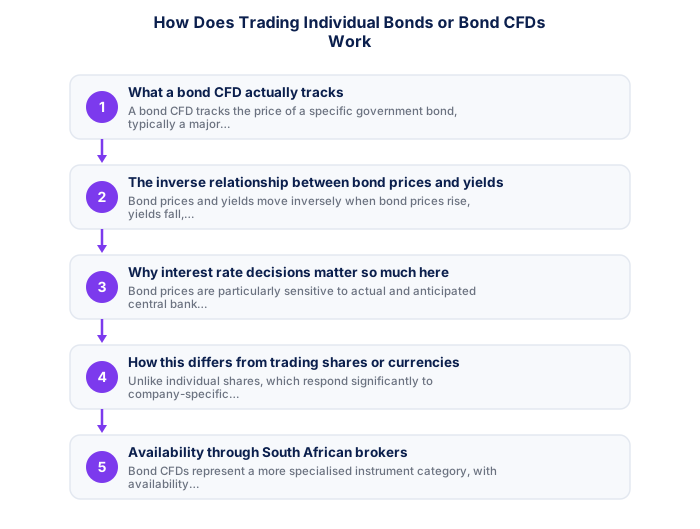
A bond CFD tracks the price of a specific government bond, typically a major economy's benchmark bond, allowing traders to speculate on price movements through the same underlying CFD mechanics used across other instruments, without requiring direct bond ownership or the larger capital typically required for direct bond market participation.
It's worth checking exactly which specific bond or bond index your broker's CFD actually references, since 'bond CFD' can refer to different specific underlying instruments depending on the provider, worth confirming the exact specification rather than assuming a generic understanding applies universally.
| Scenario | Bond Price | Bond Yield |
|---|---|---|
| Interest rates rise | Falls | Rises |
| Interest rates fall | Rises | Falls |
2. The inverse relationship between bond prices and yields
Bond prices and yields move inversely, when bond prices rise, yields fall, and vice versa, meaning trading a bond CFD effectively means taking a view on this price-yield relationship, often connected directly to broader interest rate expectations.
It's worth practising this inverse relationship until it feels genuinely intuitive, since it initially trips up many newer traders, a useful way to internalise it: a bond promising a fixed future payment becomes less valuable, in price terms, when newer bonds start offering higher yields, making the existing bond comparatively less attractive.
| Lot type | Size | USD/ZAR pip value | Min recommended account |
|---|---|---|---|
| Standard | 100,000 units | ~R1.00 | R100,000+ |
| Mini | 10,000 units | ~R0.10 | R10,000+ |
| Micro | 1,000 units | ~R0.01 | R1,000+ |
| Nano | 100 units | ~R0.001 | R100+ |
- V = Pip value in account currency
- E = Current exchange rate of quote vs account currency
- L = Lot size (100,000 standard / 10,000 mini / 1,000 micro)
- USD/ZAR example = 1 pip = R1 per standard lot
- Leveraged instrument
- Long and short available
- Overnight financing applies
- No ownership of asset
- Typically unleveraged
- Physical currency received
- No daily financing
- Currency ownership
3. Why interest rate decisions matter so much here
Bond prices are particularly sensitive to actual and anticipated central bank policy decisions, since these directly influence the broader interest rate environment bonds operate within, making economic calendar awareness particularly relevant for this specific instrument category.
It's worth treating scheduled central bank decisions with even more attention when trading bond CFDs specifically than you might for other instruments, given how directly and immediately these decisions translate into bond price movement, discussed elsewhere on this site regarding interest rate effects generally.
5. Availability through South African brokers
Bond CFDs represent a more specialised instrument category, with availability varying considerably by broker, checking your specific provider's instrument list confirms whether this particular category is genuinely available to you.
It's worth contacting your broker's support directly to confirm bond CFD availability and specific terms, rather than assuming based on their broader product marketing, since this specialised instrument category isn't always prominently featured even when technically available.
South African traders accessing forex and CFD markets should understand that the instruments they trade through FSCA-regulated brokers are derivative contracts rather than ownership of the underlying asset. This means that all profits and losses are settled in cash, position sizes can be adjusted to suit any account size, and the same trading infrastructure provides access to global markets from a ZAR-denominated account. Understanding this fundamental structure helps traders make better decisions about instrument selection, position sizing, and account management.
6. Risk considerations specific to bond trading
Bond CFDs still carry genuine leveraged trading risk despite their connection to typically lower-volatility government debt instruments, making the same position sizing and risk management principles used elsewhere equally important here.
For South African traders, it's worth keeping the JSE's own trading hours in mind too, 09:00 to 17:00 SAST on business days, since local shares and indices only move actively within that window regardless of what's happening in global markets overnight.
Going long on a bond price is a bet on falling yields.
Bond prices and yields move inversely. Betting on rising bond prices is functionally a bet on falling yields, a common point of confusion worth getting right.
★ Why It Matters
Worth being precise about: bond prices and yields move inversely, so a bond CFD position betting on rising bond prices is functionally a bet on falling yields. Traders sometimes get the direction backwards on their first few bond trades simply from this inverse relationship.
✕ Common mistakes
- Assuming bond CFD liquidity matches forex or major indices. Retail bond CFD liquidity tends to be considerably thinner.
- Treating bond price moves as purely about company or government risk. Interest rate expectations are usually the dominant driver.
- Not checking specific contract details before trading an unfamiliar bond CFD. Terms can vary more between providers than for more standardised instruments.
Key Takeaways
- Bond CFDs let traders speculate on government bond price movements, typically reflecting interest rate expectations rather than corporate-style risk factors.
- Bond CFDs let traders speculate on government bond price movements without direct ownership.
- These typically reflect interest rate expectations and broader economic sentiment rather than company-specific risk.
- What a bond CFD actually tracks.
- The inverse relationship between bond prices and yields.
Frequently asked follow-up questions
Are South African government bonds available as CFDs?
Availability varies by broker; checking your specific provider's instrument range clarifies whether South African or only major international government bonds are offered.
Is bond CFD trading less risky than share or forex trading?
Bonds often show lower typical volatility than some other instruments, though this varies by specific conditions, and leveraged trading still carries genuine risk regardless of the underlying instrument's typical characteristics.
Does a bond's maturity date affect CFD trading?
Bond CFDs typically reference the underlying bond's current market price without you needing to manage an actual maturity date the way direct bond ownership would involve.
Can I use bond CFDs as a hedge against other positions?
Some traders use this instrument category for this purpose, given its distinct interest-rate-driven behaviour, though this requires careful, considered analysis of the specific relationship you're aiming to hedge.
Do bond CFDs pay anything resembling coupon interest?
Generally no, since CFD trading reflects price speculation rather than the coupon-payment structure direct bond ownership would involve; checking your specific broker's product specification confirms this.
