i Short answer
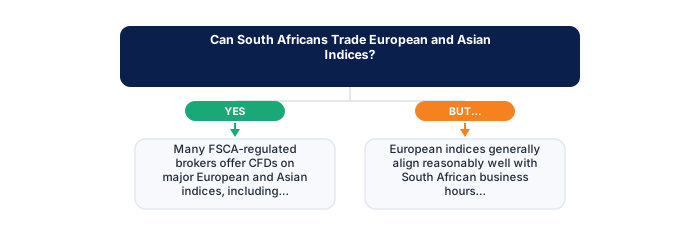
Yes. Many FSCA-regulated brokers offer CFDs on major European and Asian indices, including Germany's DAX and Japan's Nikkei, alongside the JSE Top 40 and US indices.
This expands genuine diversification opportunities beyond purely South African and US market exposure.
📋 ON THIS PAGE
- Common European and Asian indices typically available
- Trading hours considerations for these specific markets
- What drives these indices differently from JSE or US markets
- Currency considerations when trading these foreign indices
- How this fits into a genuinely diversified approach
- Checking availability with your specific broker
1. Common European and Asian indices typically available
The most commonly available European index CFDs are Germany's DAX, the UK's FTSE 100, and France's CAC 40. On the Asian side, Japan's Nikkei 225 and Hong Kong's Hang Seng are most widely offered, with some brokers also including China A50 index instruments. These are among the most liquid global indices outside the US, which translates to competitive spreads and reliable execution.
It's worth spending time understanding each index's specific composition and sector weighting before trading it, rather than treating all major indices as interchangeable. The DAX's heavy weighting toward German industrial and automotive companies creates different driver dynamics than the FTSE 100's significant financial services and commodities exposure. These compositional differences affect which economic events move each index most sharply.
Regional indices also have distinct volatility characteristics. The Nikkei is known for larger intraday swings than its European counterparts on many days, partly reflecting the Bank of Japan's unconventional monetary policy environment and the yen's role as a global risk-sentiment barometer. The DAX tends to be highly reactive to European manufacturing and industrial data. Understanding these personalities before trading them is as important as understanding their trading hours.
| Index | Region | Typical Broker Availability |
|---|---|---|
| DAX 40 | Germany | Widely available |
| FTSE 100 | United Kingdom | Widely available |
| CAC 40 | France | Widely available |
| Nikkei 225 | Japan | Common |
| Hang Seng | Hong Kong | Common |
2. Trading hours considerations for these specific markets
European indices align reasonably well with South African business hours, given the modest time difference. The London and continental European market sessions open from approximately 09:00-10:00 SAST and run through approximately 17:30-18:30 SAST, a substantial overlap with a standard South African working day, particularly for the afternoon portion of the session.
Asian indices like the Nikkei present a genuinely more challenging scheduling question. Tokyo's market opens at approximately 02:00-03:00 SAST and closes by approximately 11:00 SAST. Actively trading the Nikkei during its primary session means either very early mornings or disrupted sleep schedules, a real practical constraint worth weighing honestly before building a strategy around it.
- SARB economic calendar checked for the week
- Next Eskom load shedding schedule reviewed
- GNU stability news reviewed
- Stats SA data releases noted
- Credit agency review dates checked
- US/global events that move EM risk noted
This early Asian session timing is worth assessing against your actual schedule rather than treating as a minor inconvenience. Many South African traders who are drawn to Asian indices find that the Nikkei's hours genuinely don't fit a working schedule, which steers them toward either European indices (better timing) or US indices (evening hours that fit post-work routines). Neither alternative is inferior, they're just different timing solutions for different life circumstances.
Cash index CFDs typically have specific trading hours that match the underlying exchange, while index futures CFDs may have extended trading hours. Confirming which product type your broker offers, and its specific trading hours, avoids the frustrating experience of trying to trade an index during an extended-hours period and finding prices are either unavailable or particularly illiquid.
3. What drives these indices differently from JSE or US markets
Each major index responds primarily to its own region's economic data, central bank policy, and sector-specific news. The DAX is heavily influenced by ECB policy decisions and European industrial output data. The FTSE 100 responds to Bank of England policy and is notably influenced by sterling's movements, since many large FTSE constituents earn revenues internationally in currencies that translate back to pounds.
The Nikkei's key drivers include Bank of Japan policy, which has involved unusually accommodative, and at times unconventional, approaches that have had distinctive effects on Japanese equity prices, and the yen's exchange rate. The inverse relationship between yen strength and Nikkei performance has been a notable feature of Japanese markets over extended periods: yen weakness tends to support exporting company valuations, driving the index higher.
| Event | Frequency | ZAR impact | Source |
|---|---|---|---|
| SARB MPC | 6x per year | High | resbank.co.za |
| Budget Speech | Annual (February) | Very high | treasury.gov.za |
| Credit reviews | Annual each agency | Very high | Agency sites |
| Stats SA CPI | Monthly | Medium | statssa.gov.za |
| Eskom stage | As needed | Low-medium | eskomsepush.com |
- SA context provides genuine informational edge
- ZAR pairs accessible via FSCA brokers in ZAR accounts
- Rand volatility creates larger intraday ranges
- 6 SARB meetings/year create regular macro setups
- Higher geopolitical risk than G10 pairs
- Load shedding creates unique operational disruptions
- SA rand liquidity thinner than major G10 pairs
- SA-specific news requires constant local monitoring
This sector concentration is worth researching specifically for whichever index you're considering, since it directly affects which economic events are most relevant to monitor and which data releases create the most significant moves. A trader focused on the DAX needs to follow European manufacturing PMIs closely; a FTSE 100 trader watches UK economic data alongside sterling movements; a Nikkei trader tracks both BOJ communications and yen dynamics.
Correlations between these indices and the JSE or US markets also matter for portfolio-level risk management. European and Asian indices may move differently from US markets during specific periods, providing genuine diversification, but can also correlate strongly during global risk-off episodes when broad market sentiment overrides regional factors. Understanding when correlations are high versus when they diverge is part of using multiple indices productively.
4. Currency considerations when trading these foreign indices
Trading indices priced in euros, pounds, or yen through a ZAR account brings in a currency conversion layer on top of the index's own price movement. Your rand-denominated P&L reflects both how the index itself moved and how the relevant foreign currency moved against the rand during your holding period.
It's worth tracking this currency component separately from the index's own performance in your trading journal, since a position that's profitable in DAX terms can produce a neutral or negative rand result if the euro weakened meaningfully against the rand during the same period. Conversely, rand weakness during a holding period amplifies the rand value of a profitable position denominated in foreign currency.
For South African traders, this currency interaction has particular relevance during periods when rand volatility is elevated, around SARB policy decisions, political developments, credit rating reviews, or commodity price shocks. During these periods, the currency component of a foreign index position can sometimes be larger than the index movement itself.
Some traders deliberately factor this currency dynamic into their approach, using a European or Japanese index position partly as a currency hedge, or combining index direction with a complementary currency view. This can be a legitimate approach, but it adds an analytical layer that should be explicitly incorporated into the position rationale rather than treated as a secondary consideration.
5. How this fits into a genuinely diversified approach
Adding different regional indices can provide more meaningful diversification than trading multiple instruments that share the same underlying drivers. A portfolio that includes the DAX alongside US equities has different regional exposure and different central bank sensitivities than one concentrated entirely in US indices, during periods when European and US economic cycles diverge, this regional diversification has genuine risk-reduction value.
It's worth verifying this diversification benefit rather than assuming it. During global market sell-offs driven by risk aversion, correlations between major equity indices tend to rise significantly, the diversification benefit that exists during normal conditions may reduce sharply exactly when you most want it. Understanding the correlation behaviour of your chosen indices during both calm and stressed market conditions gives you a realistic picture of the diversification you're actually getting.
For South African traders, the JSE's own distinctive driver profile, resource sector sensitivity, rand exposure, emerging market classification, means that European and Asian indices can provide diversification away from South Africa-specific risk factors as well as US-specific ones. A broader multi-regional index approach may provide more stable overall exposure than any single international index combined with domestic South African exposure.
6. Checking availability with your specific broker
Not every broker offers the full range of European and Asian indices. Most FSCA-regulated brokers with broad instrument sets include the major European indices and at least the Nikkei and Hang Seng. Smaller or more focused brokers may carry a narrower selection. Confirming your broker's specific offering before planning a strategy around an index you haven't verified is available saves discovering the gap at the point of trade.
A scheduling detail that catches South African traders off guard: Asian index sessions like the Nikkei open in the very early hours of the South African morning. If you're considering these markets, planning honestly around that timing before starting, rather than after you've already developed a strategy, produces more sustainable outcomes.
✕ Common mistakes
- Trading Asian indices without adjusting for the time difference. active sessions often fall in the very early hours South African time.
- Assuming all regional indices have similar liquidity. Liquidity and spread quality vary meaningfully between indices.
- Ignoring the specific economic drivers behind each index. European and Asian indices respond to different regional catalysts.
- Not checking trading hours specific to each index. Each market has its own open and close times, not a shared schedule.
Can I reach JSE shares this way?
Some brokers do, as CFDs. That is exposure to the price without owning the share, so no voting and no dividend in the usual sense. JSE shares through a forex broker covers it in full.
Key Takeaways
- Yes, many FSCA-regulated brokers offer CFDs on major European and Asian indices, expanding diversification beyond the JSE Top 40 and US markets.
- Many FSCA-regulated brokers offer CFDs on major European and Asian indices, including Germany's DAX and Japan's Nikkei, alongside the JSE Top 40 and US indices.
- This expands genuine diversification opportunities beyond purely South African and US market exposure.
- Common European and Asian indices typically available.
- Trading hours considerations for these specific markets.
Frequently asked follow-up questions
Do European indices trade on South African public holidays?
European markets follow their own regional holiday schedules, which can differ from South African public holidays, worth checking if timing matters for your specific plans.
Is the Nikkei harder to trade given the time difference?
The early morning South African time requirement may not suit traders preferring a more typical evening-focused routine.
Does diversifying into these indices reduce my overall risk?
It can provide some diversification benefit, though this depends on the actual correlation between these markets and your other holdings, rather than diversification being automatically guaranteed simply by adding more instruments.
