ℹ Short answer
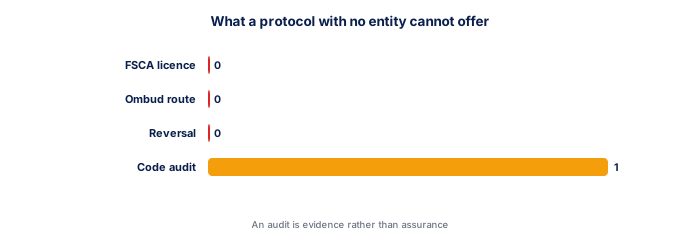
South Africans can use DeFi and many do. Using it is not illegal, but a protocol with no entity cannot hold an FSCA licence, cannot be complained about, and cannot be compelled to do anything. The protections you are used to are replaced by an assumption that the code is correct.
1. What DeFi replaces, and what goes with it
A bank matches lenders and borrowers, holds the collateral, sets the rate and bears the consequences of getting it wrong. A DeFi protocol performs the same functions in a smart contract with no entity in the middle. Nobody can freeze your position, which is the feature. Nobody can reverse a mistake, unwind an exploit, or answer a complaint, which is the same property seen from the other side. Every protection in the regulated system exists because an entity can be held responsible, and removing the entity removes all of them at once.
2. Over-collateralised lending
The dominant pattern is lending that is over-collateralised: you deposit an asset worth more than you borrow, and a liquidation is triggered automatically if the collateral falls below a threshold. The liquidation is instant, executed by anyone who spots it, and takes a penalty on top. That mechanism is what lets the system operate without credit checks or identity, and it is also why a sharp fall in collateral value produces cascades of forced selling that make the fall worse.
3. Liquidity pools and impermanent loss
Providing liquidity to a decentralised exchange earns a share of trading fees and exposes you to impermanent loss: as the two pooled assets move apart in price, the pool rebalances and you end up holding more of whichever fell. It is called impermanent because it reverses if prices return, and it becomes entirely permanent the moment you withdraw. The fee income has to exceed that drag for the position to be worth holding, and on a volatile pair it frequently does not.
4. Smart contract risk is the counterparty risk
The code is the counterparty. A bug, a flawed economic design, or an exploit of an interaction between two protocols can drain a pool in a single transaction, and billions of dollars have been lost exactly that way. An audit reduces the probability and does not remove it; several audited protocols have been exploited, sometimes shortly after the audit. Bridges between chains have been the single worst category, because they concentrate value and are complex.
5. Where South African regulation actually sits
The FSCA licences crypto asset service providers, and a provider is an entity. A protocol governed by token holders with no registered company anywhere is not a provider and cannot be licensed. Using it is not prohibited; it simply sits outside the system. The front-end website you interact with may be operated by an entity, and that entity may be reachable, but the protocol holding your funds usually is not. The FAIS Ombud has no jurisdiction over code.
6. Exchange control applies to value, not currency
The Reserve Bank's position is that exchange control covers value moved offshore rather than only currency. Moving rand into crypto and then into a protocol operating outside South Africa is moving value, and the single discretionary and foreign investment allowances apply. This is widely ignored and it is not ambiguous. Someone building a large DeFi position without regard to their allowances is accumulating a problem that surfaces when they try to bring the proceeds back through a bank.
7. The tax volume problem
Every swap is a disposal, every deposit into a pool may be a disposal, every reward is a receipt, and every rebalance generates both. An active DeFi strategy can produce several hundred taxable events in a year with no rand ever touching a bank account. SARS does not reduce the obligation because the activity was complicated. Anyone doing this at scale needs transaction-level records exported continuously, because a year of on-chain activity reconstructed afterwards is both expensive to produce and easy to get wrong.
★ Why It Matters
Everything that makes DeFi work also removes the parts of the system you would reach for when something fails. There is no entity, so no licence, no ombud and no counterparty to pursue. That is a defensible trade if you have priced it, and most people have not.
Where to take this next: the Crypto Asset Regulation Reference covers the mechanics in detail.
✕ Common mistakes
- Assuming an audit means safety. Several audited protocols have been exploited, sometimes soon after the audit.
- Treating impermanent loss as temporary. It becomes permanent the moment you withdraw.
- Ignoring exchange control. The Reserve Bank treats value moved offshore as subject to the allowances.
- Underestimating the tax volume. An active strategy can produce several hundred taxable events in a year.
Frequently asked follow-up questions
Is DeFi legal in South Africa?
Using it is not illegal. It is unregulated, so no FSCA licence applies, the FAIS Ombud has no jurisdiction, and no entity is answerable.
What is impermanent loss?
The drag a liquidity provider takes when the two pooled assets move apart in price. It becomes permanent when you withdraw.
Can I lose everything in a DeFi protocol?
Yes, through a smart contract exploit, a liquidation cascade, or an economic design that fails under stress.
Does an audit make a protocol safe?
It reduces the risk. Several audited protocols have still been exploited, so an audit is evidence rather than assurance.
Does exchange control apply to DeFi?
The Reserve Bank treats value moved offshore as subject to the allowances, whether the destination is a foreign bank or a smart contract.
