i Short answer
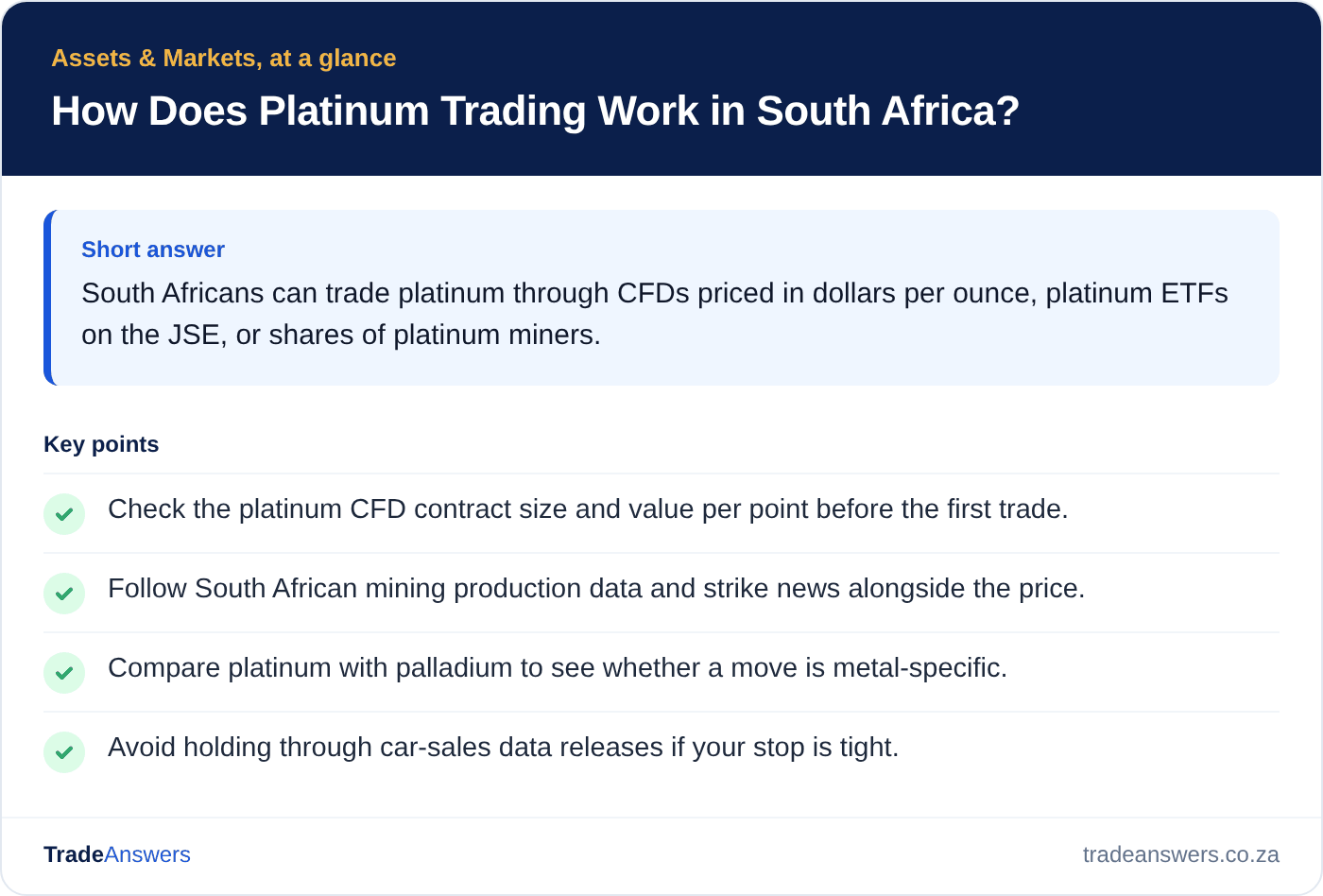
South Africans can trade platinum through CFDs priced in dollars per ounce, platinum ETFs on the JSE, or shares of platinum miners. Platinum matters more here than almost anywhere: South Africa mined about 120 of the world’s roughly 170 tonnes in 2025, around 70%, according to US Geological Survey estimates (USGS, Mineral Commodity Summaries 2026). Prices react to supply problems at local mines as well as to demand from car catalysts, industry and investors. In the worked example, a 0.1-lot CFD trade with a $40 stop risked R3,300 to make R6,600.
The position size calculator turns a stop in dollars per ounce into a lot size for your rand risk.
📋 ON THIS PAGE
1. How can South Africans trade platinum?
| Route | What you hold | Main points |
|---|---|---|
| CFD | A contract on the dollar price | Leverage, overnight financing, no ownership |
| JSE platinum ETF | Units backed by physical metal | No leverage, priced in rand |
| Platinum mining shares | Part of a mining company | Also exposed to costs, labour and the rand |
| Futures via a broker | Exchange contracts | Large contract sizes |
CFDs are offered by FSCA-authorised brokers (FSCA, regulated entities) (FSCA FSP search); ETFs and shares trade on the JSE (JSE). Other platinum group metals are covered in trading other PGMs.
2. Why does South African supply matter so much?
Because most of the world’s mined platinum comes from the Bushveld Complex in North West, Limpopo and Mpumalanga. US Geological Survey estimates put South African output at about 120 tonnes of a world total near 170 tonnes in 2025, with Russia and Zimbabwe the next largest producers (USGS, South Africa minerals). Strikes, power cuts, safety stoppages and mine closures in South Africa can move the global price, and the link between mining and the rand is covered in mining, the economy and the rand.
⬇ Download this summary (PNG) · Free to share with the credit “Source: TradeAnswers” (CC BY 4.0).
3. How does a platinum CFD trade work? A worked example
Assumptions (hypothetical example): platinum CFD at $1,500 an ounce; one lot = 50 ounces, so 0.1 lots = 5 ounces (check your broker’s contract size); USD/ZAR 16.50; stop $40 below entry; target $80 above.
| Price | On 5 ounces | In rand | |
|---|---|---|---|
| Entry | $1,500 | ||
| Stop | $1,460 | −$200 | −R3,300 |
| Target | $1,580 | +$400 | +R6,600 |
| Reward to risk | 2 : 1 |
A $40 move is under 3% at $1,500, which platinum can travel in a day or two. Size from the rand risk at the stop rather than from the margin required.
4. What drives the platinum price?
Demand from catalytic converters in petrol and diesel vehicles, industrial uses in chemicals, glass and electronics, jewellery, investment demand, and expectations for hydrogen fuel cells. Supply comes mainly from South African mines and recycled catalysts. Because supply is concentrated, disruptions matter more than for gold, which is covered in how gold trading works. Load-shedding history shows how power cuts can hit output, as covered in load-shedding and markets. Silver behaves differently again; see silver compared with gold.
- Check the contract size and rand value of $1 an ounce
- Watch South African mine news, strikes and power supply
- Note overnight financing on CFDs
- Expect wider spreads than gold
- Remember the rand moves the rand value of the trade
5. How does platinum affect the rand?
Platinum group metals are among South Africa’s largest exports, so stronger prices raise export earnings and tend to support the rand, while weaker prices do the reverse. The link is loose and often outweighed by global risk appetite and the dollar, as explained in commodity currencies. Export earnings feed the current account, covered in the current account and the rand.
6. How are platinum trading profits taxed?
Frequent CFD trading is usually taxed as income; ETF units and shares held as long-term investments usually fall under capital gains tax. The tests are explained in tax on trading profits.
★ Why It Matters
Platinum is a global metal with a South African supply story. Local mine news can move the world price, which gives South African traders an information edge in understanding the drivers, though not in timing them. Platinum producers form part of the mining sector in the JSE sectors reference.
✕ Common mistakes
- Assuming platinum behaves like gold. Its demand is more industrial and its supply more concentrated.
- Ignoring the contract size. Check the rand value of $1 an ounce first.
- Holding CFDs for months. Financing builds up; ETFs may suit long holdings.
- Forgetting the rand effect. A rand move changes the rand value of the trade.
Key Takeaways
- Check the platinum CFD contract size and value per point before the first trade.
- Follow South African mining production data and strike news alongside the price.
- Compare platinum with palladium to see whether a move is metal-specific.
- Avoid holding through car-sales data releases if your stop is tight.
Frequently asked follow-up questions
How can I trade platinum in South Africa?
Through CFDs with FSCA-authorised brokers, platinum ETFs on the JSE, mining shares or futures.
How much of the world’s platinum comes from South Africa?
About 70% of mined output in 2025, roughly 120 of 170 tonnes, according to USGS estimates.
What drives the platinum price?
Car catalyst and industrial demand, investment demand, and supply from South African mines.
Is platinum more volatile than gold?
Usually, because its market is smaller and supply is more concentrated.
Does platinum affect the rand?
Yes, loosely. Higher platinum prices raise export earnings, which tends to support the rand.
