i Short answer
Spot price reflects an instrument's current, immediate value; futures price reflects an agreed price for delivery at a specified future date.
Most CFD trading tracks spot price movement rather than futures pricing specifically.
📋 ON THIS PAGE
1. What spot price actually represents
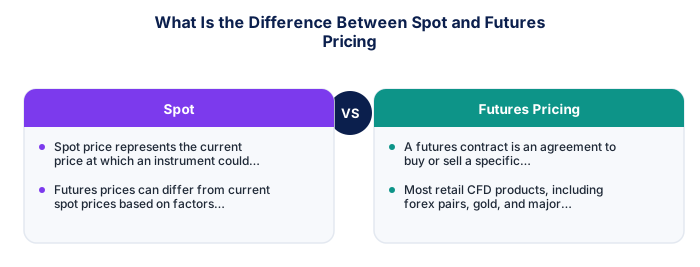
Spot price represents the current price at which an instrument could be bought or sold for immediate (or near-immediate) settlement, reflecting the market's present, real-time valuation without any forward-looking delivery commitment attached. This is the pricing concept most directly relevant to immediate, current-market trading.
It's worth understanding this as the genuine, current market consensus for immediate value, discussed elsewhere on this site regarding execution price, this is typically the reference price your platform displays and the basis for most CFD pricing you'll actually trade against.
2. What futures contracts and their pricing involve
A futures contract is an agreement to buy or sell a specific instrument at a predetermined price on a specified future date, with futures pricing reflecting this forward-looking delivery commitment rather than immediate, current value. Futures contracts trade on dedicated futures exchanges and are widely used by both speculators and entities seeking to hedge future price risk, such as a mining company wanting to lock in a future gold sale price.
It's worth appreciating why this forward-looking pricing genuinely differs from current spot value, discussed elsewhere on this site regarding CFDs versus futures generally, a futures price incorporates the market's expectation of value at that specific future date, not simply today's current price.
- FSCA-regulated broker verified at fsca.co.za
- Demo account tested for minimum 60 days
- Trading plan written: entry, exits, position sizing
- Risk per trade defined (1-2% of account)
- Backup internet connection tested for load shedding
- Tax implications understood
3. Why futures and spot prices can differ from each other
Futures prices can differ from current spot prices based on factors including prevailing interest rates (since holding the underlying asset versus holding cash until the future delivery date carries different opportunity costs) and storage costs for physical commodities, alongside broader market expectations about future supply and demand. This creates what's sometimes called the futures "basis", the gap between spot and futures pricing for the same underlying instrument.
It's worth researching the specific factors driving this gap for any instrument you're genuinely curious about, storage costs, expected interest rates, and anticipated supply-demand shifts between now and the contract's expiry all factor into this pricing difference.
| Feature | Spot Price | Futures Price |
|---|---|---|
| Definition | Current market price for immediate delivery | Agreed price for delivery at a future date |
| Settlement | Immediate (T+2 for most forex) | On contract expiry date |
| Includes carry costs? | No | Yes: interest rates and storage built in |
| What retail CFDs track | Usually spot price | May track near-month futures (e.g. oil, gold) |
| Influenced by | Current supply/demand | Spot price + cost of carry + expectations |
| Expiry | No expiry | Fixed expiry per contract |
| Practical implication | What you see is current value | Slight premium or discount vs spot is normal |
4. Which pricing most CFDs track
Most retail CFD products, including forex pairs, gold, and major indices, are typically priced based on spot price movement (or a close proxy reflecting current market value), rather than tracking a specific futures contract's pricing directly. Some brokers' CFD products may reference futures pricing for certain instrument categories, so it's worth confirming your specific product's exact pricing basis.
It's worth confirming this directly for any specific CFD you trade, rather than assuming universally, checking your broker's specific contract specifications tells you definitively whether you're trading against spot or futures-referenced pricing.
| Item | Detail |
|---|---|
| Regulator | FSCA, fsca.co.za |
| Exchange control | SARB, resbank.co.za |
| Tax authority | SARS, sars.gov.za |
| JSE hours | 09:00-17:00 SAST Mon-Fri |
| Best forex session | 15:00-17:00 SAST |
| CGT annual exclusion | R50,000 (individuals) |
5. Why this distinction matters practically for traders
Understanding whether your specific CFD product tracks spot or futures-based pricing matters because futures contracts have specific expiration dates requiring "rollover" to a new contract, which can sometimes introduce small pricing adjustments or gaps at rollover points, distinct from the more continuous pricing typically associated with spot-based CFD products.
It's worth understanding this distinction specifically if you ever compare a CFD's price against a different source quoting the same underlying instrument, discrepancies between sources can sometimes reflect exactly this spot-versus-futures pricing difference rather than any genuine error.
6. Checking which pricing your specific instrument uses
Checking your specific broker's product documentation for any given instrument clarifies whether it tracks spot or futures-based pricing, and if futures-based, what the specific rollover schedule and process involves, ensuring you understand any periodic adjustments this might introduce to your specific trading experience with that particular instrument.
Futures price includes a cost of carry and converges to spot at expiry.
Spot pricing reflects the current exchange rate for immediate delivery. Futures pricing builds in a cost of carry for a future delivery date, with the two prices converging as expiry approaches.
★ Why It Matters
Worth knowing: the gap between spot and futures pricing (the basis) for a given commodity often reflects storage costs and interest rates, not just market sentiment about future price direction, worth understanding before reading too much directional meaning into the difference.
✕ Common mistakes
- Reading too much directional meaning into the basis without understanding its components. A more complete understanding avoids drawing the wrong conclusion from this figure.
- Treating spot and futures prices as interchangeable for analysis purposes. They reflect genuinely different things and shouldn't be used interchangeably.
- Not checking which pricing convention a specific CFD product actually tracks. This affects how to correctly interpret the instrument's price behaviour.
Key Takeaways
- Spot price reflects current immediate value, while futures price reflects an agreed future delivery price, with CFDs typically tracking spot price movement.
- Spot price reflects an instrument's current, immediate value; futures price reflects an agreed price for delivery at a specified future date.
- Most CFD trading tracks spot price movement rather than futures pricing specifically.
- What spot price actually represents.
- What futures contracts and their pricing involve.
Frequently asked follow-up questions
Does USD/ZAR trading involve spot or futures pricing?
USD/ZAR CFD trading typically tracks spot price movement, consistent with most retail forex CFD products generally.
Can I trade futures contracts directly rather than CFDs?
Some specialised brokers offer direct futures trading, though this is a different product structure from typical CFD trading, often involving different account types and requirements.
