i Short answer
Currency ETFs provide exposure to a specific currency or basket of currencies through an exchange-traded fund structure, available to South Africans through certain investment platforms.
This is distinct from direct forex CFD trading.
📋 ON THIS PAGE
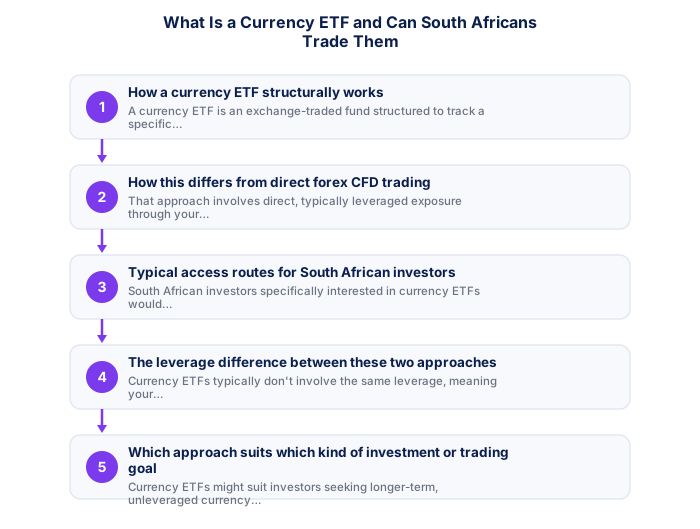
- How a currency ETF structurally works
- How this differs from direct forex CFD trading
- Typical access routes for South African investors
- The leverage difference between these two approaches
- Which approach suits which kind of investment or trading goal
- Practical considerations before choosing between them
1. How a currency ETF structurally works
A currency ETF is an exchange-traded fund that tracks a specific currency's value or a basket of currencies, traded on a stock exchange like any other ETF. The fund typically holds the target currency directly or uses derivative instruments to replicate its price exposure, and the ETF's own share price moves in line with the tracked currency's value against the fund's base currency.
Currency ETFs were designed primarily as a way for equity investors to add currency exposure to a portfolio without opening a separate forex or derivatives account. An investor who wants exposure to a strengthening Swiss franc or Japanese yen can hold a currency ETF through their existing stockbroking account rather than managing a separate CFD platform.
The mechanics vary by fund structure. Some currency ETFs hold physical currency deposits in foreign bank accounts. Others use forward contracts or other derivatives to replicate currency exposure. The specific structure affects the fund's tracking precision, costs, and tax treatment, worth understanding for any fund you're considering.
See also: How Can SA Investors Use Forex to Hedge Rand Risk?
| Feature | Currency ETF | Forex CFD |
|---|---|---|
| Leverage | No | Yes |
| Trading style suited | Longer-term positioning | Active, short-term trading |
| Access route | Stock exchange | CFD broker |
2. How this differs from direct forex CFD trading
Direct forex CFD trading involves opening a position with leverage through a broker's platform, where your exposure to currency movement is a multiple of your deposited margin. A currency ETF typically involves no leverage, you buy ETF shares up to the full value of your investment, and your exposure to the currency's movement is generally one-to-one with your investment.
This absence of leverage is a fundamental difference that affects both the risk profile and the cost structure. CFD trading can magnify gains and losses substantially; ETF currency exposure is more modest and more predictable. The same currency move that produces a 10% gain on a leveraged CFD position might produce a 1% gain on an ETF position, and vice versa for losses.
- SARB economic calendar checked for the week
- Next Eskom load shedding schedule reviewed
- GNU stability news reviewed
- Stats SA data releases noted
- Credit agency review dates checked
- US/global events that move EM risk noted
ETF currency exposure also operates through completely different infrastructure: you hold fund shares through a stockbroker or investment platform, benefiting from the regulatory protections applicable to listed securities. CFD positions are held with a CFD broker and involve the counterparty relationship specific to that broker's terms.
3. Typical access routes for South African investors
South African investors interested in currency ETFs would typically access them through investment platforms or stockbroking services, either locally through JSE-listed ETF products where available, or internationally through platforms that provide access to US or European-listed currency ETFs.
Local JSE-listed currency ETFs have existed in South Africa, though the product range is narrower than in larger markets. International platforms that South African residents can access under SARB exchange control allowances (single discretionary allowance or foreign investment allowance) provide access to broader ranges of currency ETFs listed in the US or UK.
| Event | Frequency | ZAR impact | Source |
|---|---|---|---|
| SARB MPC | 6x per year | High | resbank.co.za |
| Budget Speech | Annual (February) | Very high | treasury.gov.za |
| Credit reviews | Annual each agency | Very high | Agency sites |
| Stats SA CPI | Monthly | Medium | statssa.gov.za |
| Eskom stage | As needed | Low-medium | eskomsepush.com |
- SA context provides genuine informational edge
- ZAR pairs accessible via FSCA brokers in ZAR accounts
- Rand volatility creates larger intraday ranges
- 6 SARB meetings/year create regular macro setups
- Higher geopolitical risk than G10 pairs
- Load shedding creates unique operational disruptions
- SA rand liquidity thinner than major G10 pairs
- SA-specific news requires constant local monitoring
The exchange control implications of accessing foreign-listed currency ETFs are worth understanding. Using your single discretionary allowance (currently R2 million per year) or the larger foreign investment allowance (R10 million per year) for this purpose consumes capacity that might otherwise be used for other offshore investment purposes. The administrative process for these transfers is more involved than a simple bank transfer.
4. The leverage difference between these two approaches
Currency ETFs are typically unleveraged: your exposure to the underlying currency movement reflects your actual capital invested. A R10,000 investment in a ETF tracking USD appreciation against ZAR will move by roughly the same percentage as the USD/ZAR exchange rate itself, not a multiple of it.
Standard forex CFD trading involves leverage that amplifies this exposure significantly. The same R10,000 deployed as margin in a leveraged USD/ZAR CFD position might control exposure to USD/ZAR movement worth many times that amount. The potential gains are correspondingly larger, but so are the potential losses, and the risk of the position being closed out by a margin call exists.
For investors seeking currency exposure as part of a longer-term portfolio strategy, perhaps as a hedge against rand weakness, the unleveraged, exchange-traded ETF structure may be more appropriate than a leveraged CFD position. For active traders seeking short-term directional exposure with risk management through stop-losses, the CFD structure may better match their operational needs.
5. Which approach suits which kind of investment or trading goal
Currency ETFs suit investors seeking unleveraged, medium to long-term currency exposure as part of a broader portfolio, perhaps as a hedge against domestic currency risk, or as a way to hold foreign currency assets within a regulated investment account. The structure is straightforward, the costs are transparent through the fund's expense ratio, and the risk is limited to the capital invested.
Direct forex CFD trading suits active traders who want leveraged, short-term directional exposure with precise entry and exit control, tight spreads during active market hours, and the ability to be short currencies directly without needing to own an inverse fund.
Some investors use both approaches for different purposes: longer-term structural currency hedging through ETFs, and active shorter-term trading through CFDs. Understanding the distinct structural characteristics of each prevents using the wrong tool for a given purpose.
6. Practical considerations before choosing between them
The costs of each approach are structured differently. Currency ETF costs are primarily the fund's annual expense ratio (typically a fraction of a percent per year) plus any trading commission on the ETF shares themselves. CFD trading costs are primarily the spread on each trade plus overnight financing charges on positions held beyond the daily rollover.
The regulatory protections are also different. Currency ETFs held through a registered stockbroker carry the protections applicable to listed securities, the fund's underlying assets are held in custody separate from the broker's own balance sheet. CFD positions are held directly with the CFD broker under that broker's specific terms and FSCA requirements.
Understanding both approaches as distinct structures, rather than viewing one as simply a safer or riskier version of the other, produces better decisions about which fits your specific situation. A currency ETF held through an investment platform carries different counterparty and custody considerations from a CFD position at a leveraged trading broker, and both carry different risks from holding physical foreign currency in a bank account.
✕ Common mistakes
- Assuming a currency ETF and a CFD position offer identical exposure. They carry genuinely different counterparty, custody, and risk structures.
- Not understanding the platform and account type required for ETF access. This typically differs from a standard CFD trading account.
- Treating ETF and CFD currency exposure as interchangeable for tax purposes. The underlying legal structure can affect how gains are treated.
- Ignoring the cost structure differences between these two approaches. Fee and spread structures can differ meaningfully between the two.
Key Takeaways
- Currency ETFs provide exposure to a specific currency or basket through an exchange-traded fund structure, available to South Africans through certain platforms.
- Currency ETFs provide exposure to a specific currency or basket of currencies through an exchange-traded fund structure, available to South Africans through certain investment platforms.
- This is distinct from direct forex CFD trading.
- How a currency ETF structurally works.
- How this differs from direct forex CFD trading.
Frequently asked follow-up questions
Are currency ETFs available on the JSE specifically?
Some currency-related exchange-traded products may be available through South African exchanges or international platforms. Checking current offerings through your investment platform confirms specific availability.
Can I use the same account for currency ETFs and forex CFD trading?
Generally not the same account, since these typically require separate platform relationships, given their genuinely different underlying structures.
Do currency ETFs pay any form of yield or interest?
This depends on the specific ETF's structure. Some currency ETFs may involve interest-rate-related components, worth checking the fund's documentation directly.
Is currency ETF trading subject to the same FSCA oversight as forex brokers?
Investment platforms and ETFs fall under their own relevant regulatory oversight, which may differ somewhat from the specific FSCA forex and CFD framework.
Which approach has lower ongoing costs?
Cost structures differ meaningfully between these approaches, making direct comparison of specific fees important before choosing.
