i Short answer
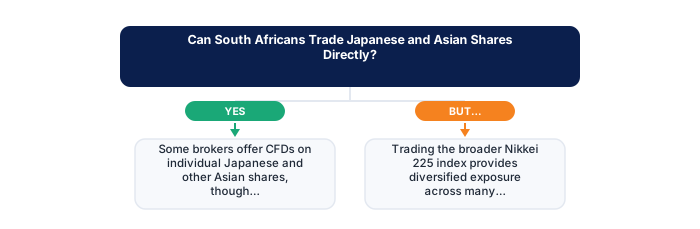
Some brokers offer CFDs on individual Japanese and other Asian shares, though availability is generally less widespread than for US and European companies.
📋 ON THIS PAGE
- Availability of individual Asian shares through retail brokers
- How this compares to trading the Nikkei index
- The trading hours challenge specifically
- Currency considerations for Japanese shares specifically
- Why this is less commonly traded by South Africans
- Checking specific availability with your broker
| Feature | Individual Japanese Shares | Nikkei 225 Index |
|---|---|---|
| Broker availability | Limited | Common |
| Diversification | Single company risk | Broad exposure |
| Trading hours overlap with SA | Poor, early SA morning | Same as individual shares |
| Typical liquidity | Varies by stock | High |
2. How this compares to trading the Nikkei index
Trading the broader Nikkei 225 index provides diversified exposure across 225 Japanese companies simultaneously, while individual Japanese shares concentrate exposure on specific companies. For most South African traders, the Nikkei index CFD is a more accessible and more practical entry point to Japanese market exposure than individual share selection.
Given the narrower availability of individual Asian shares and the scheduling challenge their trading hours create, it's worth weighing honestly whether the specific company-level exposure justifies the additional complexity relative to the index. The case for individual share selection, expressing a view on a specific company rather than the broad Japanese market, requires both availability and a genuine company-specific analytical edge.
- SARB economic calendar checked for the week
- Next Eskom load shedding schedule reviewed
- GNU stability news reviewed
- Stats SA data releases noted
- Credit agency review dates checked
- US/global events that move EM risk noted
For South African traders who want exposure to Japan's equity market without the company-specific complexity, the Nikkei index CFD is typically the cleaner choice. It's more widely available, typically more liquid, and requires only a directional view on Japanese equities generally rather than on specific corporate performance.
3. The trading hours challenge specifically
Japanese market hours are a genuine scheduling challenge for South African traders. Tokyo's exchange opens at approximately 02:00 SAST and closes by approximately 11:00 SAST, requiring either very early morning trading sessions or an acceptance that you won't be actively monitoring the market during its primary session.
This scheduling challenge compounds with the narrower broker availability to create a meaningfully higher barrier to actively trading individual Japanese shares. Traders who approach this market often discover that the hours are impractical for regular active management and transition to either accepting a passive hold through the Tokyo session or focusing on the Nikkei index CFD during extended trading hours when more flexible timing is available.
| Event | Frequency | ZAR impact | Source |
|---|---|---|---|
| SARB MPC | 6x per year | High | resbank.co.za |
| Budget Speech | Annual (February) | Very high | treasury.gov.za |
| Credit reviews | Annual each agency | Very high | Agency sites |
| Stats SA CPI | Monthly | Medium | statssa.gov.za |
| Eskom stage | As needed | Low-medium | eskomsepush.com |
- SA context provides genuine informational edge
- ZAR pairs accessible via FSCA brokers in ZAR accounts
- Rand volatility creates larger intraday ranges
- 6 SARB meetings/year create regular macro setups
- Higher geopolitical risk than G10 pairs
- Load shedding creates unique operational disruptions
- SA rand liquidity thinner than major G10 pairs
- SA-specific news requires constant local monitoring
Hong Kong's Hang Seng market has only slightly more convenient hours from South Africa's perspective, opening at approximately 03:00 SAST, which presents a similar early-morning challenge. Singapore's market runs approximately 03:00-11:00 SAST. None of these Asian sessions fall naturally within South African working hours or a typical evening trading routine.
Some brokers offer extended trading hours on Asian index CFDs that allow trading outside the primary market session, though liquidity and spreads in these extended hours typically differ from the primary session. Understanding the liquidity characteristics of Asian instrument CFDs outside their local market hours is important if you're relying on outside-hours trading to sidestep the scheduling problem.
5. Why this is less commonly traded by South Africans
The combination of narrower broker availability and genuine scheduling challenges makes individual Japanese and broader Asian share trading less common among South African retail traders than US or European alternatives. This isn't because the underlying companies lack interest, companies like Toyota, Sony, Samsung (Korea), and Alibaba (Hong Kong) are globally significant, it's because the structural barriers are higher.
It's worth being honest with yourself about whether pursuing this less common category reflects a genuine, well-researched interest in specific Asian companies or a general desire for diversification that could be achieved more simply through an Asian index CFD. The former justifies the additional research and operational complexity; the latter probably doesn't.
6. Checking specific availability with your broker
If you have specific interest in particular Japanese or Asian companies, checking your broker's instrument list directly, or contacting support, is the only reliable way to confirm availability. General instrument lists on broker websites are sometimes incomplete or not updated in real time, making a direct inquiry more reliable than website browsing.
A liquidity nuance worth knowing: even where Japanese share CFDs are offered, spreads tend to widen noticeably outside the Tokyo session. If you're planning to trade these instruments from South Africa during South African daytime hours, well after the Tokyo close, checking the typical spread during those hours specifically, rather than the advertised spread during primary Tokyo hours, gives you a more accurate picture of actual trading costs.
✕ Common mistakes
- Trading outside the Tokyo session's actual active hours. Spreads widen considerably once the underlying exchange is closed.
- Assuming liquidity matches major US or European shares. Japanese and Asian share CFDs are typically less liquid through retail brokers.
- Ignoring yen-specific currency exposure. A position denominated in yen adds its own exchange-rate risk.
- Not checking availability before assuming a specific share is tradeable. Coverage is narrower than for more commonly traded markets.
Can I reach JSE shares this way?
Yes, but as a derivative. For actual ownership you need a JSE-registered broker. JSE shares through a forex broker covers it in full.
Key Takeaways
- Some brokers offer CFDs on individual Japanese and other Asian shares, though availability is generally less widespread than for US and European companies.
- Availability of individual Asian shares through retail brokers.
- How this compares to trading the Nikkei index.
- The trading hours challenge specifically.
- Currency considerations for Japanese shares specifically.
Frequently asked follow-up questions
Are Chinese shares available through South African brokers?
Some brokers may offer this, though availability and specific access methods vary considerably; checking your specific broker's instrument range clarifies what's genuinely available.
Is it worth the early morning commitment to trade Japanese shares specifically?
This depends on your specific interest and schedule flexibility, weighed against more conveniently-timed alternatives.
Does this market behave differently from US or European shares?
Each market responds to its own region-specific economic and political factors, alongside broader global sentiment shared across markets generally.
