i Short answer
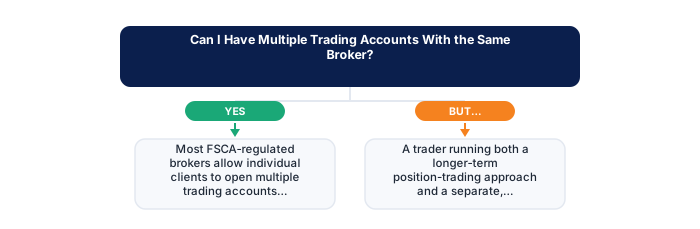
Yes. Most FSCA-regulated brokers allow individual clients to open multiple trading accounts under the same verified identity, useful for separating strategies, currencies, or risk levels.
Each account typically requires its own funding and is managed independently within the broker's platform, even though they share the same underlying verified client identity.
📋 ON THIS PAGE
- Why traders commonly use multiple accounts
- Separating different strategies into distinct accounts
- Using multiple accounts for currency denomination flexibility
- Practical considerations for managing multiple accounts
- Verification requirements and any account number limits
- When multiple accounts genuinely aren't necessary
1. Why traders commonly use multiple accounts
There are a few genuinely practical reasons traders run multiple accounts with the same broker: keeping a tested, disciplined strategy separate from a newer, experimental approach; holding different base currencies for different trading contexts; or maintaining a distinct allocation for a specific instrument class or market.
The real benefit shows up at review time. Keeping distinct strategies in separate accounts makes it far easier to honestly assess how each one is performing, without the muddying effect of combining their results into a single equity curve. A strategy that looks broadly positive in a combined account might be consistently losing while another consistently wins, and separating them makes that visible.
Using an unregulated offshore broker means SA law does not apply. SARS, FSCA, and SA courts have no jurisdiction. Disputes must go through the overseas regulator only.
It's worth being honest with yourself about which of these reasons genuinely applies to your situation before adding an additional account, since the overhead of running multiple accounts, separate journals, separate monitoring, separate mental compartments, is real and increases with each account added.
Multiple accounts also serve a useful purpose for traders who want to maintain a consistent track record of their primary strategy while separately testing variations or new approaches. Running experiments in a dedicated secondary account prevents an inconclusive test from contaminating the performance record of an established approach that's been working.
2. Separating different strategies into distinct accounts
Running a longer-term position-trading approach alongside a shorter-term swing allocation in separate accounts keeps the distinct performance of each strategy visible and clean. It prevents the cognitive and analytical error of attributing one strategy's results to another, which is surprisingly common when multiple approaches are blended into a single account.
Separate accounts also keep your position sizing maths clean, since each account's balance and risk percentage operate independently of whatever the other account is doing. A position that represents two percent of one account's balance should be calculated from that account's specific balance, not from a combined figure that blends two strategies' risk profiles.
- Search FSP name or number at fsca.co.za
- Confirm licence is current and not suspended
- Check scope covers forex and CFD activity
- Confirm client funds in segregated accounts
- Read FSCA enforcement actions history
- Test customer support before depositing
- Client funds legally segregated
- FSCA complaints process available
- SA consumer protections apply
- ZAR account, no FX conversion costs
- Some offshore brokers offer wider instruments
- Regulatory overhead passed on in spreads
- Stricter position limits for retail clients
- FICA verification required before trading
- Client funds segregated
- Formal complaints process
- FSCA dispute resolution
- SA consumer law applies
- ZAR account available
- Fund safety not guaranteed
- Disputes overseas only
- SA law does not apply
- Currency conversion costs
- Tax reporting more complex
This separation extends naturally to your trading journal. Keeping distinct records for each account, rather than a single combined log, makes it possible to review each strategy on its own terms, identify what's working within each approach, and make adjustments without the noise of unrelated strategy results creating false patterns in the data.
One practical benefit of this structure is that it makes honest performance attribution much clearer when you're deciding whether to continue, scale up, or abandon a specific approach. A strategy that's losing consistently in its own account is visible in a way that a strategy buried in a combined account often isn't.
3. Using multiple accounts for currency denomination flexibility
Some traders maintain a ZAR-denominated account for straightforward local deposits and withdrawals alongside a USD-denominated account for instruments that naturally price in dollars. This reduces the currency conversion overhead on each trade while keeping local funding logistics simple.
Each account's funding and withdrawal mechanics need to be understood on their own terms, since the currency conversion implications of deposits and withdrawals differ between a domestic ZAR account and a foreign-currency account subject to SARB exchange control rules. Funding a USD account from a South African bank involves different steps and costs than funding a ZAR account, and those differences matter practically when you're moving capital.
The tax implications of maintaining accounts in different currencies also add a layer of complexity to your reporting. Profits in a foreign currency that are periodically converted to ZAR for tax reporting purposes involve historical exchange rate calculations, and keeping accurate records of when conversions occurred and at what rate is the foundation of accurate SARS reporting.
If your trading activity is broadly similar across both accounts, you may find a single account in your most-used currency is simpler overall despite the trade-off. The case for multiple currency accounts is strongest when you have genuinely distinct funding sources, different instruments, or different tax treatment considerations across the two accounts.
4. Practical considerations for managing multiple accounts
Running multiple accounts effectively requires its own discipline. Separate journals per account, careful attention to position sizing so a calculation based on one account's balance isn't mistakenly applied to a different account, and a regular review habit that covers both accounts rather than treating one as the primary and the other as an afterthought.
If you can't clearly articulate the specific purpose each account serves that your current setup doesn't already accomplish, the overhead probably isn't justified. Multiple accounts pay off when there's a genuine structural reason for the separation, different strategies, different currencies, different time horizons, not simply because having more accounts feels more sophisticated.
| Protection | FSCA Regulated | Offshore Unregulated |
|---|---|---|
| Client fund segregation | ✓ Required | Varies by broker |
| SA complaints process | ✓ Available | ✗ Not available |
| SA consumer law applies | ✓ Yes | ✗ No |
| ZAR account available | ✓ Typically | Often USD/EUR only |
A practical issue that catches multi-account traders off guard: margin calls and account balance alerts operate per-account. A margin situation developing in a secondary account while you're focused on your primary account can escalate faster than you'd notice if you're not monitoring both consistently. Building an explicit routine for reviewing all active accounts, not just your main one, is a basic operational requirement.
Brokers also occasionally have internal processes that treat multi-account holders differently for certain administrative tasks, withdrawal processing, statement generation, or periodic KYC reviews. Understanding how your specific broker handles multi-account clients before you add accounts avoids discovering unexpected complications at the moment they matter.
5. Verification requirements and any account number limits
Opening additional accounts with the same broker doesn't require repeating the full FICA verification process from scratch. Your identity is already confirmed in their system, which means the additional account can typically be opened with a shorter process, sometimes just selecting the account type and confirming your existing details are current.
Some brokers cap how many accounts a single client can hold, typically for their own risk management reasons, but this limit is usually generous enough that it doesn't constrain typical trading activity. Confirming whether a limit exists before you need to exceed it is a sensible first step if you anticipate maintaining more than two or three accounts.
It's still worth ensuring your details are current before opening an additional account. Even though full re-verification typically isn't required, your contact details, address, and banking information should be accurate in your profile before the new account is linked to it. Outdated details in your primary profile that carry over to a new account can create friction for the new account's verification and funding.
If you're opening the additional account for a materially different purpose, such as a professional arrangement or a joint account, verify with your broker whether that requires a different account type with a different opening process, rather than simply adding another account to your existing retail profile.
6. When multiple accounts genuinely aren't necessary
If you're running a single, well-defined strategy with no need for currency separation or strategy isolation, multiple accounts probably add overhead without adding benefit. Good position sizing, a clear trading journal, and disciplined self-review achieve most of what separate accounts offer for a single-strategy trader.
The decision comes down to your specific situation, and it's worth making it deliberately rather than defaulting to the most complex configuration. A single account with excellent journaling and performance tracking provides more operational clarity than multiple accounts managed inconsistently.
One underused benefit of multiple accounts worth noting: keeping a strategy you're still validating completely separate from your core account lets you run that validation with genuine isolation. If the experimental strategy fails, it fails in its own contained account without affecting the equity record or psychological state of your primary approach. If it succeeds, you have a clean track record for it when you decide to allocate more capital.
✕ Common mistakes
- Not separating strategies being tested from your core account. Mixing an unproven approach with a trusted one distorts both.
- Losing track of combined risk across several accounts. Total exposure should be assessed across all accounts together, not per account.
- Assuming each account has fully independent negative balance protection. Confirm this is genuinely ring-fenced per account with your specific broker.
- Opening accounts without a clear, distinct purpose for each. Accounts without a defined role tend to become disorganised quickly.
How long does verification take?
Usually a few hours to two business days once documents are complete, and longer where the address proof or source of funds needs a second look. Switching brokers covers the full timeline.
Key Takeaways
- Yes, most FSCA-regulated brokers allow multiple accounts per client, often useful for separating strategies. Learn the practical considerations involved.
- Most FSCA-regulated brokers allow individual clients to open multiple trading accounts under the same verified identity, useful for separating strategies, currencies, or risk levels.
- Each account typically requires its own funding and is managed independently within the broker's platform, even though they share the same underlying verified client identity.
- Why traders commonly use multiple accounts.
- Separating different strategies into distinct accounts.
Frequently asked follow-up questions
Does each additional account require separate FICA verification?
Your core identity verification typically covers you as a client across accounts with the same broker, though each specific account may still have its own opening process and terms.
Can I transfer funds directly between my own multiple accounts?
Many brokers support this through an internal transfer process, though it's worth confirming the specific process and any associated timing with your particular broker.
Is there a limit to how many accounts I can open with one broker?
This varies by broker; some impose no specific limit while others may have policies in this area, making it worth checking directly if you plan to open several accounts.
