i Short answer
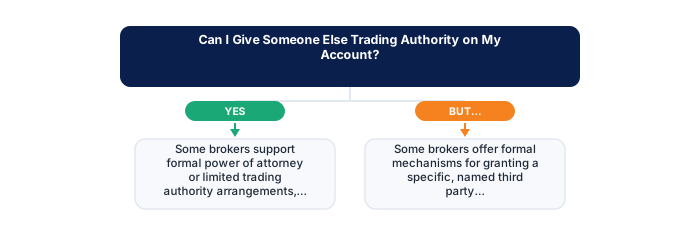
Some brokers support formal power of attorney or limited trading authority arrangements, allowing a designated third party to trade on your behalf under defined terms.
However, simply sharing your login credentials directly with someone else carries genuine security risk and isn't the recommended approach for granting this kind of access.
📋 ON THIS PAGE
1. Formal trading authority arrangements explained
Some brokers offer a formal mechanism for granting a named third party limited trading authority, the kind of arrangement used when a professional money manager trades on behalf of multiple clients, or when someone with a power of attorney needs to manage another person's account during illness or absence. The formal version involves documented authorisation with defined scope, creating a legal record of what authority was granted and to whom.
It's worth asking your broker specifically what this arrangement involves before assuming it's available or accessible. Some brokers structure it as a limited power of attorney, others as a discretionary management agreement, and the documentation required, regulatory obligations involved, and limitations on what the authorised party can do vary accordingly.
A key point: if you're granting trading authority to someone who will be actively managing money on your behalf as a business, rather than as a one-time favour or family arrangement, that party may need to be registered with the FSCA as a financial services provider. The activity of managing other people's money professionally is regulated in South Africa, and an informal arrangement that bypasses that registration creates compliance risk for both parties.
The formal arrangements that do exist serve a genuine purpose: they create accountability, define limits on the authority granted, and create a documented record that both protects you and clarifies the boundaries of what the authorised party can do. Understanding what your broker offers before granting any third-party access is the right starting point.
| Feature | Formal Authority Arrangement | Sharing Login Credentials |
|---|---|---|
| Defined limits | Yes, position size, instruments, drawdown | None |
| Auditable by broker | Yes | No |
| Revocable cleanly | Yes, formal removal | Requires full password reset |
| Withdrawal access can be excluded | Yes | No, full access granted |
2. Why sharing login credentials directly is genuinely risky
Sharing your login credentials directly, the approach that happens most often informally, bypasses every control that a formal authority arrangement would provide. There are no defined limits on what can be done, no audit trail distinguishing your actions from theirs, and no documented scope that would allow you to dispute a decision if something goes wrong.
It's worth being honest about how often this happens informally. A family member who asks to 'just check something' in your account, or a friend who offers to manage a few trades while you're travelling, creates the same structural risks as a more deliberate unauthorised arrangement, just with less awareness of those risks on both sides.
- South African ID or valid passport
- Proof of residential address dated within 3 months
- Proof of bank account ownership
- Selfie or photo for biometric verification (some brokers)
- Source of funds declaration if depositing above threshold
Choose an FSCA-regulated broker
Verify the FSP number is current at fsca.co.za.
Submit FICA documents
SA ID or passport, recent proof of address, and bank account proof.
Fund via EFT
Make the initial deposit from your South African bank account in ZAR.
Open demo first
Practice on demo until you are confident in the platform and strategy.
Start with minimum capital
Begin with an amount you can afford to lose while building experience.
From a regulatory standpoint, your broker's terms almost certainly prohibit sharing login credentials, and doing so means that if something goes wrong, whether an unauthorised trade, account compromise, or a dispute over a position, your terms may not provide the protection you'd expect. FSCA-regulated brokers maintain logs of account activity associated with your login, and responsibility for actions taken under your credentials generally sits with you.
The practical implication is that even a trusted person managing your account through your shared credentials has no regulatory accountability for their actions under that arrangement. Any losses, disputes, or account changes that result from their access are your problem, not a shared one. This asymmetry is the most compelling reason to use a formal arrangement if any third-party access is genuinely needed.
3. The due diligence needed before granting this kind of authority
Before granting anyone authority over your account, formally or otherwise, apply the same verification standard you'd apply before handing over any significant financial responsibility. A verifiable track record of managing their own money over a meaningful period is a stronger signal than demonstrated skill in a specific system or strategy.
This verification is worth treating as non-negotiable regardless of how well you personally know or trust the individual. The most common scenario in which informal trading authority arrangements go badly wrong involves people who genuinely trusted the person they were dealing with, trust and competence are not the same thing, and neither substitutes for a verified track record.
If the person you're considering has a relevant professional background, registered as a financial services provider, with a documented track record of managing client funds, that provides a level of verifiable accountability that informal relationships don't. The FSCA's public register is the starting point for confirming whether someone claiming professional credentials is actually registered to provide the services they're describing.
It's also worth being explicit about your own risk tolerance and objectives with any authorised party before granting access. Vague authority over an account, without defined parameters around risk limits, drawdown thresholds, and position sizing, creates the conditions for misaligned decision-making even when both parties have the best intentions.
4. Limiting the scope of any granted authority
Where a formal authority mechanism exists, use it to define real limits: maximum position sizes, specific instruments or markets, exclusion of withdrawal authority, or a drawdown limit that triggers automatic revocation of the authority. These aren't bureaucratic constraints, they're the practical risk controls that convert a vague authority arrangement into a governed one.
It's worth thinking through these limits as carefully as you'd apply to your own position sizing and risk management rules, since the limits you set effectively define your maximum exposure to the decisions of another person. An authority arrangement with no defined limits is simply an open mandate that could be exercised in ways you never anticipated.
| Rejection reason | Fix |
|---|---|
| Address proof older than 3 months | Get a recent utility bill or bank statement |
| Name mismatch between documents | Use documents with exactly matching full name |
| Poor quality scan | Retake with good lighting, all corners visible |
| PO Box address | Brokers require physical residential address only |
Excluding withdrawal authority specifically is usually the right default position in any third-party arrangement. Granting trading authority over positions is a meaningful form of access; granting withdrawal authority is a fundamentally different level of trust that should require a much higher bar to justify. Most formal authority arrangements in regulated contexts are structured to separate these explicitly.
If your broker's formal arrangement mechanism doesn't allow the granular limits you want to set, that's worth factoring into whether a formal arrangement through that particular broker is the right approach. A mechanism that only allows all-or-nothing authority provides much weaker protection than one that allows genuinely scoped access.
5. How this differs from copy trading
Granting direct trading authority over your account is structurally different from copy trading, which runs through the platform's own built-in safeguards and creates a distinct, auditable relationship with defined terms. Copy trading can be switched off, has platform-level risk controls, and creates no direct access to your account beyond the automated position mirroring.
This distinction is worth being clear about because the two are sometimes discussed in similar terms despite carrying very different risk profiles. Copy trading operates within a regulated framework with specific terms about how the relationship works and what happens when you stop copying. Direct account authority operates outside that framework unless explicitly structured through a formal mechanism your broker sanctions.
For South African retail traders who want exposure to another person's strategy or skill, copy trading through a regulated platform with its inherent safeguards is almost always the more appropriate mechanism than direct trading authority. The reduction in control is more apparent than real, you maintain the ability to stop copying, set risk parameters, and monitor performance, while the structural protections are considerably stronger.
The scenario where direct trading authority genuinely makes more sense than copy trading is narrow: typically a professional relationship with a registered financial advisor or asset manager who needs direct account access to implement a personalised strategy that a generic copy mechanism can't accommodate. Outside that specific context, copy trading's safeguards make it the more sensible approach for most retail situations.
6. Revoking authority if you later change your mind
Revoking authority properly means two things: notifying your broker formally to remove the access from their systems, and separately changing your account password and any other security credentials that were shared. Doing only one of these is not the same as fully revoking access, particularly if credentials were shared informally.
Something to weigh carefully: in formal authority arrangements, you remain legally and financially responsible for the account's activity throughout. If the authorised party places a losing trade before you revoke their access, that loss is yours, the arrangement changes who makes the decisions, not who bears the consequences. This asymmetry is the most important thing to internalise before granting any form of trading authority to a third party.
Having a clear exit plan for the authority arrangement before you grant it, knowing how you'd end it and under what circumstances, is a useful discipline. Authority arrangements that end badly often do so because the process of revoking them creates conflict or confusion that wouldn't have arisen if the scope, terms, and exit conditions had been clearly defined at the outset.
After revoking any third-party access, reviewing your account activity for any positions or changes made during the period of their access is worth doing comprehensively rather than relying on the authorised party to have acted within the scope you intended. The review creates a documented record of what happened under the arrangement and establishes a clean baseline for your independent management going forward.
✕ Common mistakes
- Sharing login credentials instead of using a formal authority arrangement. This carries unnecessary security and liability risk.
- Assuming an informal arrangement removes your own responsibility. You remain financially and legally accountable for the account regardless.
- Not defining the scope of authority clearly in writing. Vague arrangements create disputes if something goes wrong.
- Granting authority without reviewing performance regularly. Ongoing oversight matters even with a trusted party.
Key Takeaways
- Some brokers support power of attorney or limited trading authority arrangements, though sharing login credentials directly carries genuine security risk.
- Some brokers support formal power of attorney or limited trading authority arrangements, allowing a designated third party to trade on your behalf under defined terms.
- However, simply sharing your login credentials directly with someone else carries genuine security risk and isn't the recommended approach for granting this kind of access.
- Formal trading authority arrangements explained.
- Why sharing login credentials directly is genuinely risky.
Frequently asked follow-up questions
Is granting trading authority the same as using a managed account service?
These can overlap, though managed account services often have their own specific structure and terms beyond simply granting individual trading authority; checking the specific service's exact arrangement clarifies this.
Can I limit authority to specific instruments only?
Where supported by your broker's formal mechanism, yes; checking your specific broker's available options for this kind of limitation is worthwhile.
What if someone I granted authority to misuses my account?
This could potentially involve both broker-level dispute resolution and, depending on severity, legal recourse. Thorough due diligence beforehand is the best protection against this scenario arising.
