i Short answer
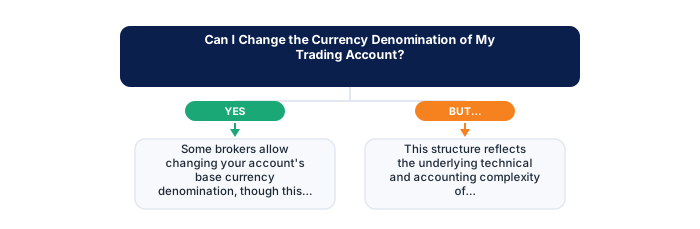
Some brokers allow changing your account's base currency denomination, though this typically requires opening a new account rather than converting the existing one in place.
📋 ON THIS PAGE
- Why base currency is usually fixed at account opening
- The typical process for changing currencies
- Why brokers structure this as a new account rather than conversion
- Transferring funds between differently denominated accounts
- Considerations before switching your base currency
- Checking your specific broker's policy on this
1. Why base currency is usually fixed at account opening
Most brokers lock in your account's base currency the moment you open it. From there, it governs how every profit, loss, and margin figure gets calculated in your account, a USD-denominated account converts all instrument P&L into dollars; a ZAR account keeps everything in rand. The practical implication is that the base currency you choose is also the currency your trading capital is most naturally denominated in.
It's worth treating this choice with the same seriousness you'd give to picking a broker in the first place, since reversing it later genuinely means opening a new account, transferring funds, and rebuilding your account history from scratch. The decision costs nothing at the point of account opening and is much more expensive to undo afterward.
For South African traders, the currency choice often reflects a trade-off between administrative simplicity and trading efficiency. A ZAR account eliminates the need to convert funds through the SARB's exchange control process on every deposit and withdrawal, but a USD account may simplify the cost calculations on USD-priced instruments that make up the bulk of the global CFD and forex markets.
The interaction between your trading account currency and your tax obligations under SARS is also worth considering at this stage. Profits earned in a foreign currency that are periodically converted to ZAR create a slightly more complex tax picture than profits that remain in rand throughout. A tax practitioner familiar with trading income can clarify how this applies to your specific situation.
2. The typical process for changing currencies
Changing your account currency in practice means opening a separate account in the denomination you want, then transferring funds across rather than converting the existing account. This is the standard approach across most regulated brokers, since retroactive currency conversion of an existing account is an accounting problem they're not structured to solve.
It's worth planning for the practical overlap period this creates, briefly managing two separate accounts, two sets of login details, and two balances. The overlap is temporary, but it's genuinely there, and treating it as a deliberate transition rather than an inconvenience makes the process smoother. Set a clear timeline for closing the old account once the new one is funded and operational.
- South African ID or valid passport
- Proof of residential address dated within 3 months
- Proof of bank account ownership
- Selfie or photo for biometric verification (some brokers)
- Source of funds declaration if depositing above threshold
Choose an FSCA-regulated broker
Verify the FSP number is current at fsca.co.za.
Submit FICA documents
SA ID or passport, recent proof of address, and bank account proof.
Fund via EFT
Make the initial deposit from your South African bank account in ZAR.
Open demo first
Practice on demo until you are confident in the platform and strategy.
Start with minimum capital
Begin with an amount you can afford to lose while building experience.
The logistics of the transfer itself deserve attention. Moving funds from a ZAR account to a USD account at the same broker, or across brokers, involves a currency conversion step that carries both a cost and a timing consideration. Exchange rates fluctuate, and the rate applied to your transfer affects how much capital ends up in the new account.
Some brokers allow multiple base currency accounts under a single client profile, which reduces the administrative overhead of maintaining separate logins and verification processes. If your broker supports this, it's worth asking whether you can add a second-currency account to your existing profile rather than going through a full new account opening.
3. Why brokers structure this as a new account rather than conversion
Converting an entire historical record, every past trade, statement, and realised P&L figure, into a different currency retroactively is a genuine accounting problem. Starting fresh with a new account sidesteps this entirely: the new account has clean history in the correct currency from day one.
This is worth appreciating as a genuine accounting and compliance constraint rather than a deliberately unhelpful policy. Retroactively recalculating historical balances at accurate historical exchange rates, ensuring statement integrity, and maintaining audit trails that satisfy FSCA record-keeping requirements would require infrastructure that no retail broker maintains for individual account conversions.
The new-account approach also provides cleaner documentation for tax purposes. Your original account's statements remain an accurate and complete record of that account's activity in its original currency. The new account starts a fresh record. Keeping two separate records in two currencies is more complex than a single record, but it's at least accurate, something a retroactive conversion wouldn't guarantee.
If you're considering this change primarily because you find the currency mismatch between your account and your trading instruments confusing, it's worth first checking whether your platform has a display setting that shows instrument prices and P&L in a currency of your choice overlaid on your account figures. Some platforms offer this as a view preference without requiring an actual account currency change.
4. Transferring funds between differently denominated accounts
Moving funds into the new, differently-denominated account involves the same currency conversion you'd see with any cross-currency transfer, including your bank's or the broker's conversion spread. This isn't a fixed fee, it's a variable cost determined by the exchange rate applied and the spread the converting institution charges, which can vary meaningfully depending on the size of the transfer and the institutions involved.
It's worth timing this transfer deliberately rather than moving funds impulsively, since the exchange rate applied genuinely affects how much capital lands in the new account. Large transfers made in a hurry during thin market conditions may be converted at worse rates than transfers made during core London or New York session hours when liquidity in the currency pair is highest.
| Rejection reason | Fix |
|---|---|
| Address proof older than 3 months | Get a recent utility bill or bank statement |
| Name mismatch between documents | Use documents with exactly matching full name |
| Poor quality scan | Retake with good lighting, all corners visible |
| PO Box address | Brokers require physical residential address only |
South African traders transferring funds offshore through a broker's ZAR-to-foreign-currency mechanism should also ensure the mechanism aligns with SARB's exchange control requirements. Using your single discretionary allowance versus your foreign investment allowance for larger transfers involves different administrative steps, and ensuring these are correctly handled at the point of transfer avoids compliance issues later.
Keeping a record of the exchange rate applied at the point of transfer is useful for your own cost tracking and for accurate tax reporting. The base cost of your trading capital in ZAR terms matters when calculating any eventual realised gain or loss for SARS purposes.
5. Considerations before switching your base currency
Before going through the hassle, it's worth asking whether the reason actually justifies the process. Simplifying pip value calculations for one specific instrument, or reducing confusion about P&L figures, are genuine convenience benefits but may not outweigh the administrative cost of opening and maintaining a second account and executing a structured transfer.
A useful question to ask honestly: does this specific instrument represent a large enough share of your actual trading activity to justify the overhead? A trader who primarily trades ZAR-denominated JSE instruments but occasionally trades EUR/USD is probably better served by a ZAR account than by switching to a EUR account for the occasional trade.
If the mismatch between your account currency and your primary trading instruments is creating genuine calculation friction, particularly if you're running a strategy that requires precise margin and position size calculations in the instrument's native currency, then the switch is more defensible. The cost of getting those calculations wrong repeatedly can exceed the administrative cost of restructuring your accounts.
There's also a broader consideration around consolidation. Managing fewer accounts with clarity is generally better than managing more accounts with complexity, even if each individual account is optimised for its purpose. If the currency switch would result in simpler ongoing management, that's a genuine argument in its favour; if it would create ongoing complexity to solve a problem that better position sizing could address, that's a reason to think twice.
6. Checking your specific broker's policy on this
Not every broker offers multiple base currencies, and the process for opening an additional one varies. Check your specific provider's options directly by contacting their support team, rather than assuming the standard industry approach applies to your situation.
Practically speaking, opening a second account in your preferred currency is usually faster than attempting to convert an existing one, since most brokers have a standardised new account opening process that they execute routinely. The conversion of an existing account, by contrast, involves custom operational steps that support teams handle less frequently and may route to a more senior approval process.
If you're comparing brokers at the point of deciding whether to switch, checking which base currencies a broker offers alongside their account opening process and fee structure is worth including in your due diligence. A broker that supports ZAR, USD, and EUR accounts under a single client profile offers meaningfully more flexibility than one that locks you into a single base currency at registration.
One practical note: if you're planning to use your new account for the same strategy as your existing account, ensure the instruments available, the leverage terms, and the fee structure are identical across the new account type. Occasionally, brokers structure different account tiers or denominations with different product sets or pricing, and discovering a discrepancy after transferring capital is more disruptive than discovering it in advance.
✕ Common mistakes
- Trying to convert an existing account instead of opening a new one. Most brokers require a fresh account for a currency change.
- Not checking re-verification requirements for a new account. Existing clients sometimes still face a lighter but real onboarding step.
- Ignoring how currency choice affects reported P&L. Profit figures will differ depending on the account's denomination.
- Assuming this decision is easily reversible later. Treat the initial choice as effectively permanent.
Does this apply to JSE shares too?
Several local brokers offer CFDs on larger JSE shares, with the spread and overnight financing that come with any CFD. Trading JSE shares through a forex broker covers the detail.
Key Takeaways
- Some brokers allow changing your account's base currency, though this typically requires opening a new account rather than converting an existing one.
- Some brokers allow changing your account's base currency denomination, though this typically requires opening a new account rather than converting the existing one in place.
- Why base currency is usually fixed at account opening.
- The typical process for changing currencies.
- Why brokers structure this as a new account rather than conversion.
Frequently asked follow-up questions
Does my historical trading record transfer to the new currency account?
Generally not automatically in the new currency; your original account's historical record remains in its original denomination, separate from the new account.
Is there a fee for opening an additional account in a different currency?
This varies by broker; checking your specific broker's account opening terms clarifies whether any fee applies to this kind of additional account.
Can I close my original account after switching to a new currency account?
Yes, once funds are successfully transferred and you no longer need the original account, you can typically proceed with closing it following your broker's standard closure process.
