i Short answer
A pip value calculator converts pip movement into monetary terms for your specific position size and account currency.
📋 ON THIS PAGE
- What this calculator specifically converts
- Why this conversion isn't always straightforward manually
- How lot size factors into this calculation
- A worked example using this kind of calculator
- Where to find this tool on most platforms
- Connecting this to your broader position sizing process
- Pip value at current rand levels
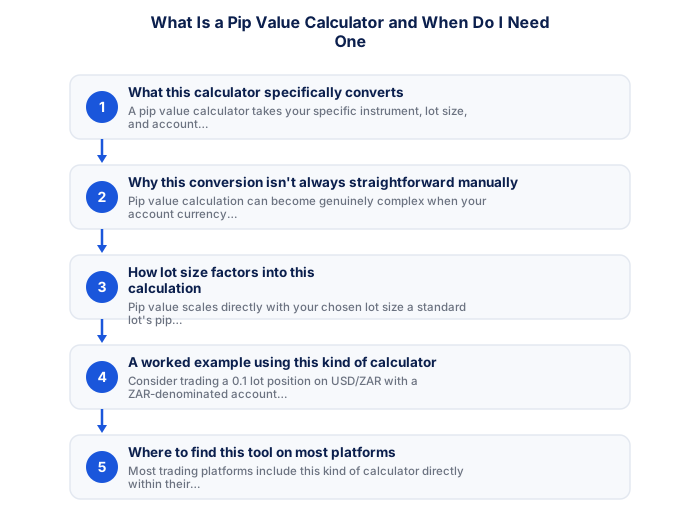
1. What this calculator specifically converts
A pip value calculator takes your specific instrument, lot size, and account currency as inputs, then calculates exactly how much one pip of price movement is worth in monetary terms for that specific position, removing the need for manual calculation.
2. Why this conversion isn't always straightforward manually
Pip value calculation can become genuinely complex when your account currency differs from the currency pair you're trading, requiring an additional conversion step that a calculator handles automatically.
3. How lot size factors into this calculation
Pip value scales directly with your chosen lot size. A standard lot's pip value is considerably larger than a micro lot's, making this input essential for the calculator to provide an accurate, position-specific figure.
4. A worked example using this kind of calculator
Consider trading a 0.1 lot position on USD/ZAR with a ZAR-denominated account, entering these specific details into a pip value calculator instantly returns the exact Rand value of one pip movement, information you'd otherwise need to calculate manually using the underlying formula and current exchange rates.
5. Where to find this tool on most platforms
Most trading platforms include this kind of calculator directly within their tools section, while numerous free, independent online versions also exist for use outside your specific broker's own platform.
6. Connecting this to your broader position sizing process
Knowing accurate pip value is an essential input for broader position sizing calculations, since translating your intended stop-loss distance into an actual monetary risk amount requires this specific conversion figure.
Pip values vary across instruments and don't translate directly from one pair to another. A pip value calculator converts the exact pip value into your account currency for accurate position sizing.
★ Why It Matters
Worth checking: confirm whether your calculator's output accounts for your account's actual base currency or defaults to USD. A pip value calculated in the wrong currency can be off by a meaningful margin depending on the current exchange rate between the two.
✕ Common mistakes
- Assuming pip value is identical across all pairs and position sizes. It varies by both the specific pair and your chosen lot size.
- Skipping this calculation and estimating pip value roughly instead. Rough estimates can lead to meaningfully mis-sized positions.
- Using an outdated exchange rate assumption in manual calculations. Pip value in your account currency shifts as exchange rates move.
The same tool is available as an embeddable pip calculator widget, free for any website, and it handles account currencies other than the dollar properly.
Pip value at current rand levels
Pip value is easiest to understand with real numbers rather than a formula. At the levels prevailing in late September 2026, with USD/ZAR trading in the mid-sixteens, the arithmetic works out as follows for a standard lot of 100,000 units.
On USD/ZAR the pip is the fourth decimal place, so one pip on a standard lot is 100,000 multiplied by 0.0001, which is 10 rand. Because the quote currency is already rand, no conversion step is needed for a rand-denominated account. That is the simplest case, and it is why ZAR crosses are a good place to learn the concept.
On EUR/USD the same standard lot gives a pip value of 10 US dollars. A trader with a rand account has to convert that, so at USD/ZAR around 16.30 the pip is worth roughly R163. This is the step most calculators built for American traders skip entirely, and it is why a pip value figure taken from an international site can be out by a factor of sixteen for a South African account.
Yen pairs break the pattern again. On USD/JPY the pip is the second decimal place, not the fourth, so the same standard lot gives a pip value of 1,000 yen rather than 10 dollars. Converted through the dollar and then the rand, that is a different number again.
The reason to use a calculator rather than memorise this is that all three variables move. The pair changes, the lot size changes, and the conversion rate changes daily. A pip value worked out in January on a rand account was using a materially different USD/ZAR level than one worked out today.
| Position, 1 standard lot | Pip value on a ZAR account |
|---|---|
| USD/ZAR | R10 exactly, no conversion |
| EUR/ZAR | R10 exactly, no conversion |
| EUR/USD | about R163 at USD/ZAR 16.30 |
| GBP/USD | about R163 at USD/ZAR 16.30 |
| USD/JPY | about R110, via yen then dollar |
See also: What Is a Risk of Ruin Calculator and Why Might I Use One?.
Frequently asked follow-up questions
Does pip value change as the exchange rate moves during my trade?
For cross-currency conversions, pip value can shift slightly as exchange rates move, though most calculators use the current rate at the time of calculation.
Is pip value calculation different for JPY-based pairs?
Yes, JPY pairs typically use a different decimal convention, which a proper calculator accounts for automatically.
Can I use one calculator for all the different instruments I trade?
Many calculators support multiple instrument types, though confirming your specific tool covers the particular instruments you trade ensures accurate results.
Does my broker's calculator account for my specific account currency automatically?
Most platform-integrated calculators do automatically use your actual account currency, though confirming this for your specific platform avoids any assumption-based error.
Should I recalculate pip value for every single trade I place?
Since lot size and sometimes exchange rates vary between trades, recalculating for each specific position ensures your risk management remains accurate rather than relying on an outdated figure.
