i Short answer
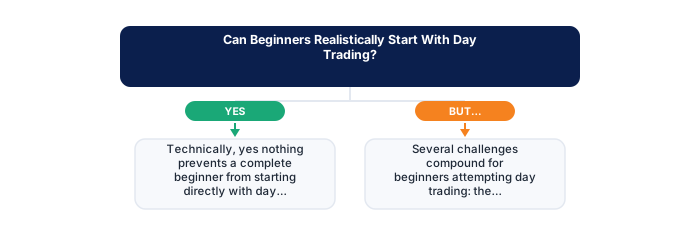
Technically, yes, nothing stops a complete beginner from starting directly with day trading. But between the intensive time demands, rapid real-time decisions, and accumulating transaction costs, it's a genuinely harder entry point than swing or position trading.
📋 ON THIS PAGE
- Why this question deserves a honest answer
- The specific challenges that compound for beginners particularly
- What beginners specifically tend to underestimate about this style
- A more measured alternative path worth considering
- If you still want to start with day trading anyway
- Signs you're not yet ready for this specific style
1. Why this question deserves a genuinely honest answer
Trading education marketing loves selling day trading as the exciting, accessible entry point into financial markets. What it rarely mentions is how consistently difficult it proves for most beginners, and that the people selling the dream have an obvious commercial interest in making it sound achievable.
It's worth noticing why this particular gap exists commercially: day trading content, courses, signal services, and broker marketing all tend to be more engaging and more profitable as products when day trading is framed as a viable starting point rather than an advanced discipline. The incentives in this industry do not consistently align with the interests of the beginner.
A more useful framing than whether day trading is possible for a beginner is whether it's the most efficient use of limited capital, limited time, and a developing skill set. Framed that way, the answer is almost always no, regardless of natural talent or work ethic, simply because the feedback loop of day trading gives you less time to absorb each mistake and adjust.
The honest version of this question also involves acknowledging that most people asking it have been attracted by the lifestyle imagery rather than a careful analysis of the strategy's edge and execution requirements. Noticing that honestly about your own motivation is a useful starting point before committing capital.
2. The specific challenges that compound for beginners particularly
A few things stack up against beginners specifically in day trading. Chart-reading and risk-management skills are still forming, yet day trading demands applying them under real-time pressure with limited time to think. Emotional discipline is developing, yet day trading produces more emotional triggers per day than slower styles simply by virtue of greater frequency and faster feedback.
This compounding effect is worth understanding concretely: a mistake made once a week in a slower trading style gives you roughly a week to reflect, adjust, and rebuild psychological composure before the next decision. A day trader might make a similar mistake multiple times in a single session, with each subsequent trade potentially compromised by the previous one's emotional residue.
- 100+ demo trades completed with consistent rules
- Positive expectancy over full demo sample
- Every demo trade documented in journal
- Written trading plan: entry, exit, position sizing
- FSCA-regulated broker chosen and FSP verified
- Starting capital is genuinely disposable
- Backup connectivity tested
Open a demo account
Choose an FSCA-regulated broker and open a demo with realistic capital (R50,000-R100,000).
Write your trading rules
Define entry criteria, stop-loss method, and position sizing before the first demo trade.
Trade for 2-3 months
Complete at least 50-100 trades across varied market conditions.
Journal every trade
Record rationale, emotional state at entry, and outcome for each position.
Evaluate against your rules
Only move to a live account when performance consistently meets your benchmark.
Capital constraints create a further headwind. Day trading requires sufficient capital to absorb volatility, cover the spread costs of frequent trading, and weather normal drawdown periods without being forced to close positions at the worst moment. A small account under real drawdown pressure produces a set of psychological challenges that a demo account simply cannot replicate.
There's also a concentration-of-effort problem worth acknowledging. Day trading isn't compatible with holding a full-time job, managing other responsibilities, or applying sustained analytical effort to improving your approach. The same hours that most beginners use to develop their skills are consumed by the act of day trading itself, leaving little time for the reflection and study that would accelerate development.
3. What beginners specifically tend to underestimate about this style
New traders consistently underestimate three things. Time, first: day trading rarely works as a casual, part-time pursuit regardless of what the marketing implies, and the assumption that a few hours per day is sufficient ignores the preparation, review, and mental load that surrounds the actual trading sessions. Cost, second: the friction of frequent trading accumulates into a meaningful headwind that most beginners don't model before starting.
The cost factor is worth quantifying rather than treating as an abstract concern. A trader placing multiple trades daily, each incurring a spread cost, operating in a South African retail account where currency conversion charges may apply on USD-denominated instruments, faces a compounding cost burden that means their strategies must generate a substantially higher gross return just to reach net profitability.
The third underestimation is edge: most beginners assume that with sufficient chart knowledge, day trading will produce consistent profitability. But the edge required in day trading is thinner, harder to maintain, and more sensitive to execution quality than in longer-duration strategies. A slight hesitation in order entry, a missed level, or an emotional deviation from the plan can eliminate an entire session's potential edge in a single trade.
The psychological reality of seeing your account equity fluctuate in real time, multiple times per session, is also more difficult to manage than most beginners anticipate. Reading about loss psychology is qualitatively different from experiencing a run of consecutive losses and deciding whether to continue trading that session or stop. This is one of those things that genuinely has to be experienced rather than understood intellectually.
4. A more measured alternative path worth considering
Most experienced traders and educators steer beginners toward swing or position trading first. These styles use the same foundational skills, chart reading, risk discipline, a coherent rationale for entries and exits, but operate on a timeframe that allows reflection between decisions. You can be wrong and learn from it before the next trade creates a new emotional state.
Once that foundation is genuinely demonstrated in a lower-pressure environment, moving into day trading, if it still appeals, starts from a far stronger position. The conceptual framework is already established; the only adaptation required is applying it to a faster timeframe. Many experienced day traders describe this as the actual sequence that worked for them.
This progression is worth thinking of as building the same foundational muscles under lower-stakes conditions first, rather than a separate, lesser path. The chart patterns, risk management principles, and market understanding developed through swing trading transfer directly to day trading. What doesn't transfer is the psychological pressure of intraday timing, and that's precisely what benefits from being encountered after the foundational skills are solid.
For South African traders specifically, swing trading on USD/ZAR and JSE-listed instruments also provides the advantage of trading in familiar market contexts before adding the complexity of managing intraday positions across multiple international sessions with different liquidity profiles.
| Factor | Day Trading | Swing Trading |
|---|---|---|
| Holding period | Minutes to hours: all closed by day end | Days to weeks |
| Daily time required | 3-6 hours of active monitoring | 15-60 minutes for daily review |
| Compatible with a full-time job | No: requires continuous attention | Yes: evening review is sufficient |
| Capital required | Higher: frequent spread costs compound | Lower threshold practical |
| Stress level | Very high: constant real-time decisions | Moderate: decisions outside market hours |
| Number of trades per week | Many, 10 to 100+ | Few, 1 to 5 |
| Effect of one bad trade | Small: next trade minutes away | Larger: next trade days away |
| Best session for SA traders | London-NY overlap, 15:00-17:00 SAST | Any time: works from daily candles |
| Learning curve | Steep and expensive | Moderate: more time to reflect |
5. If you still genuinely want to start with day trading anyway
If you've weighed all that and still want to start with day trading, a few adjustments help manage the risk of an expensive early learning curve. Extend your demo period well past the usual guidance and set a specific performance threshold, not just profitability, but consistent execution and emotional stability across a genuine market cycle, before transitioning to live funds.
Start live with the smallest position sizes your broker allows. The psychological difference between demo and live trading is real regardless of position size position size, but smaller positions let you experience that difference without the capital consequences that can end a trading journey prematurely. Gradually scaling up as demonstrated discipline justifies it is more durable than starting at the size you eventually intend to trade.
Limit your live sessions to a specific window, ideally the London-New York overlap from roughly 15:00 to 17:00 SAST where liquidity and volatility are most reliable, rather than attempting to trade all available hours. Most day trading losses occur in low-volume periods where price action is harder to read and execution costs are higher relative to the available range.
None of this removes the underlying difficulty of day trading. It limits the financial and psychological cost of learning it in a way that gives you the best chance of reaching the point where accumulated experience can genuinely compound into skill.
6. Signs you're not yet ready for this specific style
A few signs point to not being ready yet: struggling to hold discipline even on low-pressure demo trades, finding the pace genuinely overwhelming rather than stimulating, or making trading decisions based on how a position feels rather than on its original rationale. These aren't permanent verdicts, they're developmental signals.
Recognising any of these and choosing the slower path instead isn't a failure. It's exactly the kind of self-awareness that separates traders who develop into consistent performers from those who cycle through capital and strategies without building durable skill.
South African hours put the deepest liquidity in the late afternoon, where the two largest sessions overlap.
It's worth revisiting this honest self-assessment periodically rather than treating it as a one-time verdict. Readiness for day trading specifically can genuinely develop over time as foundational skills solidify through practice on slower timeframes. The traders who eventually succeed at day trading are often those who first developed patience on longer timeframes rather than those who pushed hardest to start at the most demanding level immediately.
✕ Common mistakes
- Underestimating the screen-time demands. Sustained attention that most beginners simply don't anticipate.
- Skipping a structured learning phase entirely. Jumping straight to live day trading bypasses the foundational stages most successful traders actually went through.
- Forcing trades during quiet, directionless periods. A leading cause of overtrading.
- Undercapitalising the account for this cost structure. Frequent trading racks up costs faster than slower styles do.
Which trading session suits this best?
The London afternoon and the New York open overlap with the South African working day and carry the deepest liquidity. Session timing from South Africa covers the hours.
How many trades per day should a day trader aim for?
A selective day trader typically places two to five high-quality trades per session. More trades does not mean better results. Overtrading is one of the most consistent causes of day trader account drawdown.
Key Takeaways
- Technically yes, but the combination of intensive time demands and rapid decision-making makes day trading a genuinely difficult starting point for most beginners.
- Technically, yes, nothing stops a complete beginner from starting directly with day trading.
- But between the intensive time demands, rapid real-time decisions, and accumulating transaction costs, it's a genuinely harder entry point than swing or position trading.
- Why this question deserves a genuinely honest answer.
- The specific challenges that compound for beginners particularly.
Frequently asked follow-up questions
Is it ever a mistake to start with day trading as a complete beginner?
Not necessarily a mistake for everyone, but it's a meaningfully steeper, more compressed learning curve than the alternative paths covered above, worth weighing honestly before committing either way.
How long should a beginner practise day trading on demo before going live?
Given the particular demands here, many sources suggest an even longer demo period than the general guidance you'll find elsewhere, specifically to build comfort with the rapid pace before real financial pressure enters the picture.
Can a beginner succeed at day trading if they're naturally disciplined?
Natural discipline helps, sure, but the specific skills day trading demands, rapid chart reading, fast risk calculation, sustained focus, still need real development through practice, whatever your underlying disposition.
