ℹ Short answer
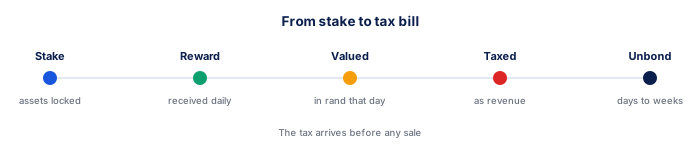
Staking commits crypto to secure a network and pays a reward for doing it. SARS treats that reward as revenue at the rand value on the day you receive it, which means a tax bill arrives before any sale and regardless of what the token does afterwards.
1. What staking actually does
A proof-of-stake network chooses who validates the next block according to how much of the asset has been committed to the task. Committing it is staking, and the reward compensates for the capital tied up and for the risk of being penalised if the validator misbehaves or goes offline. It is closer to posting a performance bond than to earning interest, and the difference matters both for understanding the risk and for understanding the tax, because interest and a payment for performing a function are treated differently.
2. Where the yield comes from
The reward is paid in newly issued tokens plus a share of transaction fees. That first part is important and routinely glossed over: a 5% staking yield paid in a token whose total supply is growing 3% a year is not a 5% real return against other holders, it is closer to 2%. Quoted yields almost never make that adjustment, and comparing a staking yield to a bank deposit rate without making it is comparing two different things.
3. Lock-ups and unbonding periods
Most networks require a waiting period before staked assets can be withdrawn, ranging from a few days to several weeks depending on the chain and on queue length. During that window you hold the full price risk with no ability to exit. Anyone staking an asset they might need to sell quickly has misunderstood what they agreed to, and the people who discover this are usually discovering it during a sharp fall, which is exactly when unbonding queues are longest.
4. Slashing, and provider risk
A validator that double-signs or stays offline can have part of its stake destroyed. If you stake directly you carry that operational risk yourself. If you stake through an exchange or a provider, their operational failure becomes your loss, and the quoted yield is advertised before this risk rather than net of it. A provider taking a cut of the reward is being paid to manage that risk, which is reasonable, and does not transfer it away from you.
5. Liquid staking and its own risk
Some services issue a token representing your staked position so it can be traded while the underlying stays locked. That solves the liquidity problem and introduces a new one: the derivative token can trade below the value of the asset it represents, and has done so during periods of stress, sometimes substantially. A position that appeared liquid turns out to be liquid only at a discount, which is the same shape of problem as the lock-up it was meant to avoid.
6. How SARS treats the reward
A staking reward is revenue in the year of receipt, valued in rand at the date it is received. You owe tax on it whether or not you sold, and whether or not the token has since fallen. The amount you declared becomes the base cost for the eventual disposal, so declaring it correctly protects you later: fail to declare the receipt and you also lose the base cost, which inflates the gain when you finally sell. Someone who staked through a year in which the token halved can easily owe tax on receipts worth more than the holding is now worth.
7. The record-keeping problem nobody warns about
Rewards often arrive daily, or per epoch, or per block, and each one is a separate receipt requiring a rand value at that date. A year of daily rewards is 365 valuation events on one asset. Exchange statements rarely present this in a form SARS would accept, and reconstructing it afterwards from block explorers is slow. Anyone staking seriously should export the reward history as it accrues rather than discover the problem in the filing season, and should keep the exchange rate source used, because consistency matters more than which source you pick.
★ Why It Matters
Staking produces a tax liability before it produces any cash. In a year where the token falls, that combination can leave you owing tax on receipts worth more than the holding. The record-keeping burden is the part people underestimate, because a daily reward is a daily valuation event.
Where to take this next: the How SARS taxes crypto gains covers the mechanics in detail; Reporting crypto on your tax return sets out the rules behind it; and SARS Income Tax Tables is the figure to check alongside this.
✕ Common mistakes
- Treating the reward as untaxed until sold. SARS taxes the receipt at the rand value on the day it arrives.
- Reading the quoted yield as a real return. A yield paid in a token whose supply is inflating is not what it appears.
- Staking an asset you may need to sell. Unbonding queues are longest exactly when you want out.
- Leaving the reward records to year end. A year of daily rewards is hundreds of separate valuation events.
Frequently asked follow-up questions
Is staking the same as earning interest?
No. Interest is a return on a loan. A staking reward is payment for performing a network function, with the risk of being penalised for doing it badly.
When do I pay tax on a staking reward?
In the year you receive it, at the rand value on that date, whether or not you have sold anything.
What if the token falls after I am taxed on the reward?
You still owe the tax on the receipt. The later fall is a separate loss when you dispose of it, and the declared value is your base cost.
Can I lose staked crypto?
Yes, through slashing if the validator misbehaves, and through the price falling while the assets are locked and cannot be sold.
Is liquid staking safer?
It solves the lock-up and adds a new risk: the derivative token can trade below the asset it represents, and has.
