i Short answer
The most reliable safeguard is setting a predetermined maximum daily trade count or loss limit before the session begins, and treating reaching either as a firm signal to stop for the day.
📋 ON THIS PAGE
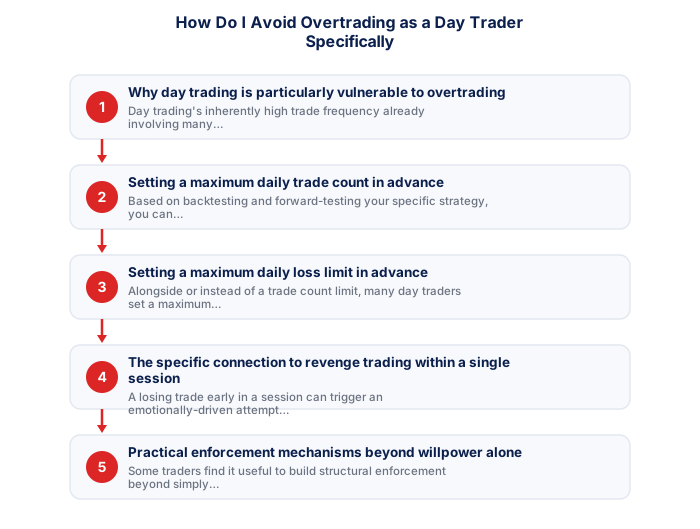
- Why day trading is particularly vulnerable to overtrading
- Setting a maximum daily trade count in advance
- Setting a maximum daily loss limit in advance
- The specific connection to revenge trading within a single session
- Practical enforcement mechanisms beyond willpower alone
- Reviewing overtrading patterns specifically in your journal
1. Why day trading is particularly vulnerable to overtrading
Overtrading means placing trades that don't genuinely meet your strategy's predetermined criteria, driven instead by boredom, impatience, or emotional reaction. Day trading's inherently high trade frequency, already involving many legitimate, criteria-meeting trades in a single session, makes it easy for extra, criteria-violating trades to blend in unnoticed, unlike a lower-frequency style where any single extra trade stands out more.
That blending effect is exactly why day traders benefit from hard, numerical limits rather than relying on general self-awareness alone, which is harder to apply reliably amid day trading's rapid pace and high baseline activity.
This blending effect is worth demonstrating to yourself directly: reviewing a day's trades afterward and honestly marking each one as either genuinely criteria-meeting or not is a more reliable way to spot the pattern than trying to judge it in real time, since in-the-moment, an overtrade rarely feels obviously different from a legitimate one while you're actually placing it.
2. Setting a maximum daily trade count in advance
Backtesting and forward-testing your strategy gives you a realistic sense of how many genuine, criteria-meeting trades a typical session should produce. Setting a maximum daily trade count modestly above that range, and stopping firmly once you hit it, however compelling a further trade looks in the moment, gives you a concrete, easily-tracked safeguard against the gradual creep of extra, less disciplined trades.
Decide this number calmly in advance, as part of your predetermined planning, rather than raising it mid-session just because you feel confident or want to keep going, which is exactly the scenario this limit exists to guard against.
- Search FSP name or number at fsca.co.za
- Confirm licence is current and not suspended
- Check scope covers forex and CFD activity
- Confirm client funds in segregated accounts
- Read FSCA enforcement actions history
- Test customer support before depositing
- Client funds legally segregated
- FSCA complaints process available
- SA consumer protections apply
- ZAR account, no FX conversion costs
- Some offshore brokers offer wider instruments
- Regulatory overhead passed on in spreads
- Stricter position limits for retail clients
- FICA verification required before trading
- Client funds segregated
- Formal FSCA complaints process
- SA consumer protections apply
- ZAR account available
- Fund safety not guaranteed
- Overseas disputes only
- SA law does not apply
- Currency conversion costs
It helps to treat this number as genuinely non-negotiable rather than a soft guideline. The specific danger with day trading's pace is that the trade which pushes you past your limit rarely feels like the one that matters, it feels like just one more reasonable opportunity, which is exactly why a hard, predetermined stopping point matters more here than in slower trading styles where each individual trade decision gets more natural deliberation.
3. Setting a maximum daily loss limit in advance
Alongside or instead of a trade count limit, many day traders set a maximum daily loss limit, a set monetary or percentage figure that, once reached, triggers a mandatory stop for the rest of the session regardless of how many trades it took to get there. This is essentially the same cooling-off principle behind revenge trading prevention, applied at the daily session level.
Set this limit at a level that reflects your genuine, predetermined risk tolerance, rather than an arbitrarily high figure that effectively never triggers, so the safeguard actually functions instead of existing only on paper.
It's worth choosing whichever safeguard, trade count or loss limit, actually fits how overtrading tends to show up in your own trading, since the two catch somewhat different patterns. A trader who overtrades through many small, frequent extra trades is better served by a trade count limit, while one whose overtrading shows up as a few larger, emotionally-driven trades may find a loss limit the more effective, relevant safeguard.
4. The specific connection to revenge trading within a single session
Day trading's compressed timeframe means the emotional cycle from loss to attempted recovery can unfold within minutes rather than days, which makes revenge trading especially relevant and especially dangerous for day traders. A losing trade early in a session can trigger an emotionally-driven attempt to recover it immediately through more undisciplined trades in that same session, exactly what the daily loss limit above is designed to interrupt.
Treating this compressed emotional cycle as a heightened risk specific to day trading, rather than assuming general revenge-trading awareness automatically covers it without a session-level safeguard, supports more effective, day-trading-specific discipline.
| Protection | FSCA Regulated | Offshore Unregulated |
|---|---|---|
| Client fund segregation | ✓ Required | Varies by broker |
| SA complaints process | ✓ Available | ✗ Not available |
| SA consumer law applies | ✓ Yes | ✗ No |
| ZAR account available | ✓ Typically | Often USD/EUR only |
This compression is worth taking seriously specifically because it can happen faster than a trader's own self-awareness can reliably catch it. By the time the emotional pull to recover a loss has been consciously noticed, several undisciplined trades may already have been placed, which is exactly why a predetermined, automatic-feeling limit matters more than relying on catching the feeling early enough to intervene manually.
5. Practical enforcement mechanisms beyond willpower alone
Some traders find it useful to build in structural enforcement beyond just intending to respect these limits, physically closing the trading platform or stepping away from the screen entirely once a daily limit is reached, removing the temptation and easy access that could otherwise undermine a purely willpower-based commitment to stop.
This mirrors a broader principle: environmental and structural safeguards tend to be more reliable than in-the-moment willpower alone, particularly during the heightened emotional state that often follows a difficult session.
The specific mechanism matters less than its actual effectiveness for you personally. Some traders find simply logging out of their platform sufficient, while others need something more deliberate, leaving the room, using an app-blocking tool, or having an accountability partner they message once a limit is hit, worth experimenting with until you find an enforcement method that genuinely holds up under real pressure rather than one that sounds reasonable in theory.
6. Reviewing overtrading patterns specifically in your journal
Regularly reviewing your trading journal for sessions where you exceeded your trade count or came close to your loss limit helps you see whether overtrading is a recurring pattern for you, and under what conditions it tends to happen most (perhaps after an early loss, or during particularly volatile sessions).
That kind of evidence-based pattern recognition, applied to your own actual day trading history, supports more targeted, effective discipline-building than generic awareness of overtrading as a concept alone.
Volume concentrates late in the day in South African time, in the hours London and New York share. liquidity
Tracking concrete daily limits, like a maximum trade count and loss limit, turns overtrading prevention from an intention into something enforceable in the moment.
★ Why It Matters
A pattern worth watching for in your own journal: overtrading often clusters in the 30 minutes immediately after a losing trade, not randomly throughout the day, which makes a short mandatory pause after any loss a more targeted fix than a blanket daily trade limit alone.
✕ Common mistakes
- Trading immediately after a loss without a cooling-off period. This is when overtrading is most likely to occur.
- Setting a daily trade limit that's too high to be meaningful. The limit should genuinely constrain behaviour, not just exist on paper.
- Treating boredom as a reason to enter a trade. A lack of genuine setups is not the same as a trading opportunity.
- Not tracking trade frequency in your own journal. Without measurement, overtrading patterns are easy to miss.
How do I check the broker behind this?
Search the FSCA register by the registered company name and confirm the FSP number is current and covers the product. Verifying a licence covers the steps.
Where do I find the FSP number?
It appears in the footer of a licensed provider's site and on the FSCA register against the registered company name. FSP numbers covers what it does and does not prove.
Key Takeaways
- Set a maximum daily trade count or loss limit in advance, and treat hitting either as a signal to stop for the day. Learn practical day-trading-specific safeguards.
- The most reliable safeguard is setting a predetermined maximum daily trade count or loss limit before the session begins, and treating reaching either as a firm signal to stop for the day.
- Why day trading is particularly vulnerable to overtrading.
- Setting a maximum daily trade count in advance.
- Setting a maximum daily loss limit in advance.
Frequently asked follow-up questions
Should my daily trade limit be the same every single day?
It can be a fixed number based on your strategy's typical backtested frequency, though some traders adjust slightly for known higher or lower volatility days, provided this adjustment is decided in advance, not reactively.
What should I do once I hit my daily loss limit?
Stop trading entirely for the remainder of the session, ideally stepping away from the platform physically, and save any reflection or analysis for your structured post-session review rather than attempting further trades.
Does this discipline apply to scalping too?
Yes, arguably even more so, given scalping's even higher trade frequency, these same safeguards matter more, not less, for scalpers.
