i Short answer
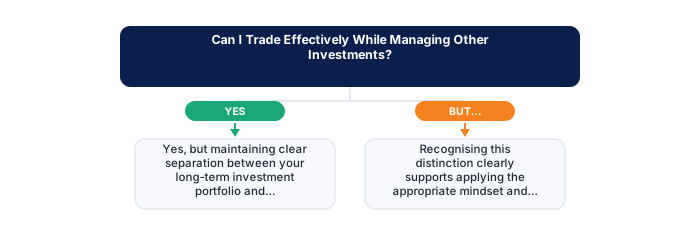
Yes, but maintaining clear separation between your long-term investment portfolio and your discretionary trading capital prevents these two distinct financial activities from undermining each other's purpose.
📋 ON THIS PAGE
- Why these are distinct financial activities
- The time and attention allocation question
- Avoiding trading mindset bleeding into investment decisions
- Using separate accounts or clear mental accounting
- How each activity can actually inform the other constructively
- Practical time management for managing both activities
1. Why these are genuinely distinct financial activities
Long-term investing: a diversified share portfolio, retirement contributions, property, pursues fundamentally different goals, time horizons, and decision-making approaches than active trading. Investing aims to capture long-run economic growth through patient, low-friction capital allocation. Trading aims to capture shorter-term price inefficiencies through more active, more frequent decision-making.
It's worth articulating this distinction explicitly to yourself rather than treating them as variations on the same activity. The mental frameworks, the risk tolerance, the reaction to volatility, and the time horizons involved are genuinely different, and blurring that distinction creates a specific set of errors that traders with concurrent investment portfolios are particularly prone to.
Understanding both activities as legitimate but distinct tools for different purposes, rather than competing approaches to the same goal, is the framing that makes managing both most effective. Your investment portfolio might hold a JSE-listed index ETF through a market dip while your trading account is short on the same index. That's not contradiction: it's appropriate separation of purpose and time horizon.
For South African investors managing retirement savings through a pension fund or RA alongside active trading, the regulatory and tax treatment of each also differs. Retirement fund contributions benefit from specific tax deductions and tax-deferred growth; trading profits are assessed as income or capital gains depending on how the activity is classified by SARS. Keeping clear records for each context is part of managing both correctly.
2. The time and attention allocation question
Active trading demands far more frequent attention than long-term investing, which typically only needs a quarterly or annual review. The attention cost of trading extends beyond the hours you're directly at a screen: it includes background cognitive load, preparation time, market monitoring, and the mental overhead of managing open positions.
It's worth mapping this out concretely on your calendar rather than assuming that good intentions will naturally balance both activities. If you're committing to active trading, what specific blocks of time are genuinely available for it without compromising your investment portfolio review, your professional commitments, and your personal life? The number that comes back is often smaller than people initially estimate.
- FSCA-regulated broker verified at fsca.co.za
- Demo account tested for minimum 60 days
- Trading plan written: entry, exits, position sizing
- Risk per trade defined (1-2% of account)
- Backup internet connection tested for load shedding
- Tax implications understood
The asymmetry in attention demands is also worth acknowledging: investment portfolios can be managed with relative neglect during busy periods without immediate consequence. Active trading positions cannot. A swing trade that requires management at a specific point will require management at that point regardless of how busy you are with other things: creating a conflict that needs to be resolved in advance rather than improvised in the moment.
Some traders address this by deliberately choosing a trading style whose attention demands are compatible with their investment management obligations. A position trader who works from weekly charts and reviews positions once or twice a week has a fundamentally different attention profile than an intraday trader, and the former is much more compatible with concurrent long-term investment management.
3. Avoiding trading mindset bleeding into investment decisions
The real risk is letting a trader's short-term mindset bleed into long-term investment decisions. Reacting to a dip in your retirement portfolio by wanting to sell: because you're accustomed to acting on short-term price moves in your trading account, is a category error with potentially significant long-run consequences.
This cross-contamination risk is most acute during periods of market volatility, which is precisely when both activities demand attention simultaneously. A volatile period that creates trading opportunities also creates pressure on your long-term portfolio, and managing both coherently while maintaining the appropriate time-horizon thinking for each is genuinely difficult.
Building separate decision-making rules for each context: explicitly different stop-loss logic for trading positions versus hold-through-volatility rules for long-term investments, provides a structural defence against this contamination. When you know in advance which framework applies to each account, the question 'should I sell?' has a different answer depending on which account you're looking at.
Regular, scheduled investment reviews: quarterly or biannually, regardless of market conditions, also help maintain the long-term perspective that investment accounts require. Reviewing your investment portfolio only when markets are moving, which is when you're also most active in your trading account, invites the short-term mindset to influence long-term decisions.
4. Using separate accounts or clear mental accounting
Keeping genuinely separate accounts, and separate record-keeping systems, for investments and trading capital is the most reliable structural defence against the contamination problem. Separate accounts create a physical distinction that makes the different rules governing each activity more tangible.
Genuinely separate accounts tend to work more reliably than mental accounting alone, particularly during high-stress market periods when the temptation to treat the two pools of capital as fungible is highest. Knowing that your investment account is a different account on a different platform makes it much harder to impulsively reallocate from it in response to a short-term trading perspective.
| Item | Detail |
|---|---|
| Regulator | FSCA, fsca.co.za |
| Exchange control | SARB, resbank.co.za |
| Tax authority | SARS, sars.gov.za |
| JSE hours | 09:00-17:00 SAST Mon-Fri |
| Best forex session | 15:00-17:00 SAST |
| CGT annual exclusion | R50,000 (individuals) |
If truly separate accounts aren't practical for your situation, the next best approach is rigidly separate record-keeping: a distinct section of your trading journal for investment decisions, with different criteria and different time-horizon language applied to investment decisions versus trading ones. The explicit differentiation in how you write about each activity tends to reinforce the different mental frameworks each requires.
Tax implications in South Africa also favour separate records: SARS's treatment of trading profits versus long-term investment returns may differ depending on the nature of the activity, and having clean, separate records for each makes accurate tax reporting substantially simpler than trying to disentangle combined records at year-end.
5. How each activity can actually inform the other constructively
The market awareness you build through active trading can genuinely inform your broader investment thinking, not by creating short-term reactions to long-term holdings, but by deepening your understanding of market mechanics, sector dynamics, and macroeconomic signals in ways that improve the quality of your investment analysis.
A useful discipline here: when market awareness from your trading informs an investment thought, treat it as one input into a longer-horizon analysis rather than as an actionable signal. The fact that you observed something interesting in your trading account this week doesn't mean your JSE equity portfolio needs to change, but it might be a data point worth weighing in your next scheduled investment review.
Long-term investing can also inform trading by providing perspective on shorter-term volatility. A trader who understands the long-run earnings power and balance sheet of a company is better placed to distinguish genuine deterioration from temporary noise when monitoring that company's CFD or share price in their trading account. The knowledge flows constructively in both directions when the mental frameworks remain appropriately separate.
The most common constructive cross-influence is at the research level: sector research done for your investment portfolio can surface trading opportunities in the same sector, and trading analysis of macro trends can highlight investment themes worth exploring at a longer time horizon. Keeping both activities is enriched by the other as long as each remains governed by its appropriate rules.
6. Practical time management for managing both activities
In practice, managing both effectively means distinct time blocks: one for trading activity, one for periodic investment portfolio review, rather than blending both into a single undifferentiated financial management time. The review frequency, the decision frameworks, and the performance metrics are genuinely different for each activity.
A useful distinction worth making explicit: if a single spreadsheet or app shows both your trading account and your long-term investment portfolio side by side, that design actively encourages comparisons that don't serve either activity. Keeping the two in separate systems, reviewed at separate times, reduces the cognitive contamination problem structurally rather than relying on discipline alone to manage it.
The practical scheduling question: how much time each month is genuinely available for each activity, is worth answering honestly before committing to both simultaneously. Active trading that isn't being given adequate dedicated time tends to produce poor outcomes, and those poor outcomes can create pressure to compensate from long-term savings. Knowing your actual time budget prevents reaching that situation.
✕ Common mistakes
- Viewing trading losses and investments as one combined pot. This blurs the line between speculative and long-term capital.
- Letting a bad trading day influence long-term investment decisions. These should be governed by entirely separate logic and timeframes.
- Not tracking trading and investment performance separately. Combined reporting can mask how each is actually performing.
- Treating investment capital as a backup source for trading losses. This undermines the very separation that protects your long-term plan.
Key Takeaways
- Yes, but maintaining clear separation between your long-term investment portfolio and discretionary trading capital prevents these distinct activities from blending.
- Yes, but maintaining clear separation between your long-term investment portfolio and your discretionary trading capital prevents these two distinct financial activities from undermining each other's purpose.
- Why these are genuinely distinct financial activities.
- The time and attention allocation question.
- Avoiding trading mindset bleeding into investment decisions.
Frequently asked follow-up questions
Should my trading capital ever come from my investment portfolio?
Generally not advisable, since this would blend genuinely distinct financial purposes and risk tolerances inappropriately.
Can I use the same broker for both trading and long-term investing?
Some platforms support both activities, though confirming the specific account structures and whether genuine separation is maintained matters more than which broker you use.
Does experience trading make me a better long-term investor?
Some transferable market awareness can develop, discussed in this piece, though the different mindset and time horizon required for each activity means this transfer isn't automatic or complete.
