i Short answer
The Swiss Franc is widely regarded as a safe-haven currency, often strengthening during periods of global market uncertainty.
This reflects Switzerland's particular economic and political stability reputation.
📋 ON THIS PAGE
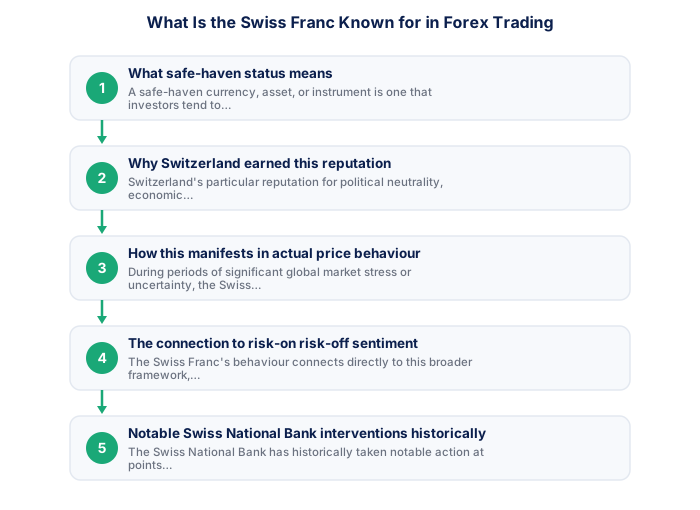
1. What safe-haven status specifically means
A safe-haven currency is one that investors tend to buy during periods of market uncertainty, geopolitical stress, or risk aversion, seeking to preserve capital rather than pursue returns. In practice this means demand for the currency increases specifically when other asset classes are falling or when global uncertainty rises, a counter-cyclical pattern that distinguishes safe-haven assets from most others.
The Swiss Franc shares this status with a small group of assets and currencies: the Japanese Yen, gold, and US Treasuries are typically cited alongside CHF. What they have in common is a perception of stability, limited downside risk during crises, and a long track record of holding or gaining value during periods when most other investments are declining.
Understanding what safe-haven status actually means mechanically matters for trading it. The demand that drives CHF strength during crises is often rapid and decisive, flows into CHF during stress events can move the currency sharply and quickly, sometimes in ways that create extreme short-term volatility before settling at a new level.
See also: EUR/USD: Why Is It the Most Traded Pair?
See also: How Can SA Investors Use Forex to Hedge Rand Risk?
See also: How Do Political Events Affect Markets?
See also: What Is the FAIS Act and How Does It Relate to Trading?
See also: What Are Common SA Trading Scams and How Do I Spot Them?
2. Why Switzerland specifically earned this reputation
Switzerland's particular reputation rests on a combination of factors that have remained consistent over decades: genuine political neutrality in global conflicts, a strong and diversified domestic economy, historically conservative and credible central bank policy from the Swiss National Bank, a stable banking sector with deep institutional trust, and a regulatory framework that protects capital reliably.
The Swiss banking system's historical role as a secure repository for international private wealth created a self-reinforcing dynamic: the more capital that flows into Switzerland for safety, the more infrastructure and institutional capacity develops to handle that capital, further reinforcing Switzerland's safe-haven credentials.
| Lot type | Size | USD/ZAR pip value | Min recommended account |
|---|---|---|---|
| Standard | 100,000 units | ~R1.00 | R100,000+ |
| Mini | 10,000 units | ~R0.10 | R10,000+ |
| Micro | 1,000 units | ~R0.01 | R1,000+ |
| Nano | 100 units | ~R0.001 | R100+ |
- V = Pip value in account currency
- E = Current exchange rate of quote vs account currency
- L = Lot size (100,000 standard / 10,000 mini / 1,000 micro)
- USD/ZAR example = 1 pip = R1 per standard lot
- Leveraged instrument
- Long and short available
- Overnight financing applies
- No ownership of asset
- Typically unleveraged
- Physical currency received
- No daily financing
- Currency ownership
Unlike the Yen, whose safe-haven status partly reflects Japan's position as a large creditor nation, Switzerland's status is more directly connected to its institutional stability and political neutrality. Switzerland's genuine non-alignment in geopolitical conflicts means that escalating tensions, wherever they occur, rarely disadvantage Switzerland directly.
3. How this manifests in actual price behaviour
During significant global market stress, equity market sell-offs, geopolitical escalations, banking system concerns, CHF pairs typically move sharply. EUR/CHF and USD/CHF, the two most actively traded CHF pairs, tend to fall when the Franc strengthens, since the Franc's appreciation means fewer Dollars or Euros are needed to buy one Franc.
The speed of these movements is worth noting. Safe-haven flows during crisis events can move CHF pairs significantly in minutes, particularly if the triggering event is unexpected. This speed means that traders holding CHF short positions, effectively betting against the Franc, face asymmetric risk during stress events, since adverse movements can be rapid and difficult to exit at planned levels.
Outside crisis periods, CHF pairs tend to trade in tighter ranges with less directional momentum, since the safe-haven premium compresses when broader risk appetite is calm. EUR/CHF in particular has shown extended periods of limited movement between risk events, interspersed with sharp directional moves when global sentiment shifts.
4. The connection to risk-on risk-off sentiment
The Swiss Franc is one of the most reliable risk-off beneficiaries in the currency market. The risk-on/risk-off framework, which describes how market positioning shifts between risk-seeking and risk-avoiding behaviour, provides useful context for understanding when CHF strength is likely to emerge and when it's likely to fade.
Risk-off conditions (equity market stress, credit events, geopolitical escalation) typically strengthen CHF against most counterparts. Risk-on conditions (stable or rising equities, improving growth outlook, easing financial conditions) tend to see CHF give back some of its safe-haven premium as investors reduce their defensive positioning.
For South African traders, this risk-on/risk-off dynamic has a direct connection to the rand. Risk-off episodes that strengthen CHF frequently also weaken emerging market currencies including ZAR, creating a negative correlation between CHF strength and rand strength that makes CHF behaviour a useful leading indicator for ZAR stress periods.
5. Notable Swiss National Bank interventions historically
The Swiss National Bank has taken significant market action at points specifically to manage what it considered excessive Franc strength, most notably when it maintained a floor in EUR/CHF at 1.20 for several years starting in 2011. The SNB's intervention was explicit: the bank stated it would buy unlimited foreign currency to defend the level, and it did so repeatedly.
The sudden removal of that floor in January 2015 is one of the most discussed events in recent forex history. EUR/CHF fell approximately 30% in seconds when the SNB announced the change without prior warning, creating losses large enough to render many broker accounts insolvent. The event demonstrated the extreme tail risk inherent in positions that assume a central bank floor will hold indefinitely.
The SNB continues to monitor and occasionally intervene in CHF markets. The bank views excessive CHF strength as deflationary and damaging to Swiss exporters, which means the Franc's safe-haven appreciation is sometimes met with direct counter-pressure from the SNB. Understanding this creates an additional consideration for CHF traders beyond pure safe-haven dynamics.
6. Trading implications for South African traders
Risk-off sentiment that strengthens the Swiss Franc often simultaneously pressures emerging-market currencies including the rand, making CHF direction a useful broader risk indicator for South African traders even if they're not directly trading CHF pairs. A sharp CHF rally is frequently a signal of the kind of risk-off environment that also weakens ZAR against major currencies.
For traders directly interested in CHF pairs, the asymmetric risk profile of CHF shorts during stress events deserves careful consideration in position sizing. Being short CHF in calm markets carries reasonable risk; being short CHF when global uncertainty is elevated means carrying a position that could move sharply against you on any escalation.
The 2015 SNB decision to remove its EUR/CHF floor remains a critical reference point for understanding SNB intervention risk. It demonstrated that central bank-maintained currency floors are not permanent and can be removed abruptly, creating extreme gap risk for traders positioned on the assumption of continuity. Any SNB-managed level in CHF markets deserves to be treated as contingent rather than guaranteed.
✕ Common mistakes
- Trading the Franc without understanding its historical tail-risk events. The 2015 SNB floor removal illustrates genuine, extreme tail risk in currency markets.
- Assuming safe-haven currencies are inherently lower risk than other pairs. Tail risk events show even traditionally 'safe' currencies can move extremely.
- Not adjusting position sizing for the Franc's specific historical volatility episodes. Past extreme events are worth factoring into risk planning, even if rare.
- Treating the Franc's safe-haven reputation as guaranteeing predictable behaviour. Its history includes genuinely unpredictable, severe single-day moves.
Key Takeaways
- The Swiss Franc is widely regarded as a safe-haven currency, often strengthening during periods of broader global market uncertainty or risk aversion.
- The Swiss Franc is widely regarded as a safe-haven currency, often strengthening during periods of global market uncertainty.
- This reflects Switzerland's particular economic and political stability reputation.
- What safe-haven status specifically means.
- Why Switzerland specifically earned this reputation.
Frequently asked follow-up questions
Does safe-haven status mean the Swiss Franc never experiences significant volatility?
No, this reflects a behavioural tendency during specific conditions rather than guaranteed permanent stability; the Franc can still experience significant moves, including from central bank intervention.
Is the Japanese Yen also considered a safe-haven currency?
Yes, the Yen is commonly cited alongside the Swiss Franc as another widely recognised safe-haven currency, reflecting similar broader investor risk-aversion behaviour during stress periods.
Does South Africa have any direct safe-haven currency status?
No, the Rand is generally classified as an emerging-market currency, typically experiencing the opposite tendency, weakening rather than strengthening during risk-off periods.
Can I trade Swiss Franc pairs through South African brokers?
Many FSCA-regulated brokers do offer Franc-related pairs. Checking your specific provider confirms exact availability.
Does this safe-haven characteristic ever reverse or change over time?
Currency relationships and reputations can theoretically evolve over very long timeframes, though the Swiss Franc's safe-haven status has remained notably persistent across many decades and various market cycles.
