i Short answer
A currency peg fixes one currency's value to another, typically a major currency like the US Dollar.
South Africa instead operates a freely floating Rand without any such fixed exchange rate arrangement.
📋 ON THIS PAGE
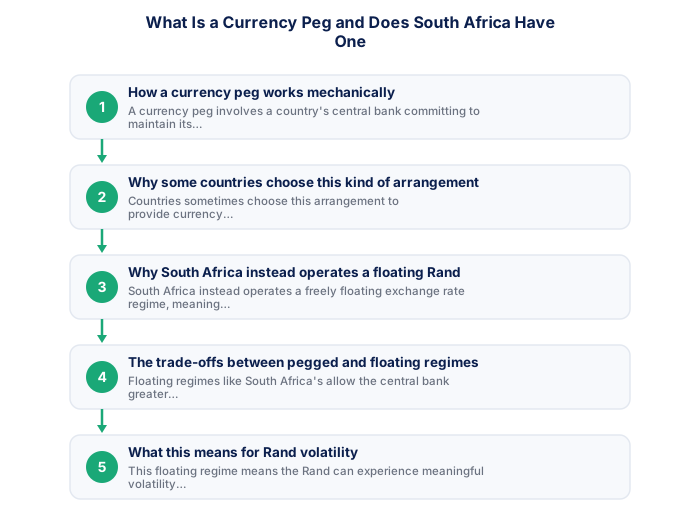
1. How a currency peg works mechanically
A currency peg fixes the exchange rate between two currencies at a predetermined level, with the central bank committing to defend that rate through market intervention as needed. When market forces push the exchange rate away from the pegged level, the central bank buys or sells its own currency against the anchor currency to return the rate to the target.
Defending a peg requires holding substantial foreign currency reserves to intervene in the market as needed. When the market wants to sell the domestic currency, the central bank must be willing and able to buy it, using reserves of the anchor currency. The depth of those reserves determines how long the peg can be maintained against sustained market pressure.
Pegs can be maintained at a fixed rate (hard peg), allowed to move within a defined band (soft peg or crawling peg), or managed against a basket of currencies rather than a single anchor. The specifics of the arrangement determine both the stability it provides and the policy constraints it creates.
See also: How Do I Use the JSE Earnings Calendar as a Trader?
2. Why some countries choose this kind of arrangement
Currency pegs are typically adopted to achieve stability for trade and investment purposes, or to borrow credibility from the anchor currency's monetary policy. For a country with a history of high inflation, pegging to a low-inflation anchor like the USD can help anchor domestic price expectations by importing the anchor currency's monetary discipline.
For smaller, open economies where international trade represents a large share of economic activity, exchange rate volatility creates real planning and pricing difficulties for businesses. A peg removes that uncertainty, making cross-border transactions more predictable and reducing the hedging costs that businesses face in floating exchange rate environments.
- SARB economic calendar checked for the week
- Next Eskom load shedding schedule reviewed
- GNU stability news reviewed
- Stats SA data releases noted
- Credit agency review dates checked
- US/global events that move EM risk noted
Gulf states like Saudi Arabia and the UAE maintain pegs to the USD partly because their oil revenues are denominated in dollars, a peg aligns their currency's value with their primary income stream. Hong Kong's peg to the USD has been maintained since 1983 as a cornerstone of its status as an international financial centre.
3. Why South Africa instead operates a floating Rand
South Africa operates a freely floating exchange rate, with the Reserve Bank setting monetary policy based on domestic conditions rather than currency defence obligations. The rand's value is determined by market supply and demand, capital flows, trade balances, risk sentiment, and relative interest rates all feed into its level continuously.
A floating regime gives the SARB flexibility to set interest rates appropriate for domestic economic conditions without the constraint of maintaining a specific exchange rate level. When South Africa needs lower rates to support growth, the SARB can cut without worrying that lower rates will force a currency defence. A pegged regime would remove this flexibility.
| Event | Frequency | ZAR impact | Source |
|---|---|---|---|
| SARB MPC | 6x per year | High | resbank.co.za |
| Budget Speech | Annual (February) | Very high | treasury.gov.za |
| Credit reviews | Annual each agency | Very high | Agency sites |
| Stats SA CPI | Monthly | Medium | statssa.gov.za |
| Eskom stage | As needed | Low-medium | eskomsepush.com |
- SA context provides genuine informational edge
- ZAR pairs accessible via FSCA brokers in ZAR accounts
- Rand volatility creates larger intraday ranges
- 6 SARB meetings/year create regular macro setups
- Higher geopolitical risk than G10 pairs
- Load shedding creates unique operational disruptions
- SA rand liquidity thinner than major G10 pairs
- SA-specific news requires constant local monitoring
The floating rand also functions as an automatic economic stabiliser. When commodity prices fall and South Africa's export earnings decline, rand weakness makes South African goods and services cheaper internationally, partially offsetting the export volume impact. A peg would prevent this adjustment mechanism from operating.
4. The trade-offs between pegged and floating regimes
Pegged regimes offer stability for international trade and investment at the cost of monetary policy independence, the central bank must prioritise currency defence over domestic economic conditions. Floating regimes offer monetary policy flexibility at the cost of exchange rate uncertainty that can complicate international trade and investment planning.
The choice between these regimes involves a fundamental trade-off known as the 'impossible trinity' or 'trilemma': a country cannot simultaneously maintain a fixed exchange rate, free capital flows, and independent monetary policy. South Africa's choice of a floating rate with an inflation-targeting mandate and open capital account reflects a specific position in this trade-off.
For traders, the regime matters because it determines whether exchange rate risk is managed primarily by the market (floating) or primarily by the central bank (pegged). In floating regimes, exchange rate movements are continuous and can be meaningful; in pegged regimes, exchange rate risk is compressed until the peg breaks, at which point the adjustment can be extreme, as events like the Swiss franc's 2015 revaluation demonstrated.
5. What this means for Rand volatility specifically
South Africa's floating regime means the rand's value fluctuates continuously in response to the full range of market forces: commodity price cycles, global risk appetite, domestic economic data, SARB policy, and political developments all feed into USD/ZAR and ZAR cross rates in real time.
This genuine volatility is one reason USD/ZAR is actively traded both by South Africans managing real currency exposure and by global traders seeking emerging-market currency exposure. The rand's movements are driven by identifiable, analysable factors, making it more tradeable than a currency whose central bank intervenes to smooth movements.
The rand's sensitivity to global risk-off episodes is particularly notable. As an emerging-market currency from a commodity-exporting economy, ZAR tends to weaken sharply during periods of broad risk aversion, when global investors reduce exposure to higher-risk assets. This makes broader market sentiment a relevant input for anyone trading ZAR pairs.
6. Examples of other pegged currencies for context
Several currencies currently operate under some form of peg or managed arrangement. The Hong Kong dollar maintains a tight band against the USD, backed by substantial reserves, and has done so since 1983. Gulf state currencies including the Saudi riyal and UAE dirham are pegged to the USD, reflecting the dollar-denomination of oil revenues.
China operates a managed float, the renminbi is allowed to move within a daily band set by the People's Bank of China against a basket of currencies, with the PBOC occasionally intervening to manage the pace or direction of movement. This occupies the middle ground between a hard peg and a genuinely free float.
The Lesotho loti and the Swazi lilangeni are both pegged at parity to the South African rand through their participation in the Common Monetary Area, meaning these currencies move exactly in line with ZAR. For South African traders, this is a useful piece of context when these currencies appear in regional economic discussions.
✕ Common mistakes
- Assuming South Africa maintains a currency peg. The Rand floats freely with no fixed exchange rate target.
- Confusing the Rand's policy with regional currencies pegged to it. Lesotho and Namibia's currencies are pegged to the Rand, not the reverse.
- Treating reserve levels as irrelevant to South Africa's exchange rate choice. A peg requires substantial reserves South Africa hasn't maintained at that scale.
- Assuming a floating regime means government has no influence on the Rand at all. Policy still affects sentiment even without a formal peg.
Key Takeaways
- A currency peg fixes one currency's value to another, with South Africa instead operating a freely floating Rand without any such fixed exchange arrangement.
- A currency peg fixes one currency's value to another, typically a major currency like the US Dollar.
- South Africa instead operates a freely floating Rand without any such fixed exchange rate arrangement.
- How a currency peg works mechanically.
- Why some countries choose this kind of arrangement.
Frequently asked follow-up questions
Has South Africa ever operated a pegged exchange rate historically?
South Africa's exchange rate history includes various different arrangements over time; checking specific historical economic records provides detailed context on any past regime changes.
Does a floating currency mean the SARB never intervenes at all?
The SARB can engage in certain market operations, though this differs fundamentally from the active, sustained intervention a genuine peg requires to maintain a fixed rate.
Which African countries currently operate pegged currencies?
Various African nations operate different exchange rate regimes, including some pegged arrangements; checking current, specific economic data provides accurate, up-to-date information on any particular country.
Does a floating Rand make South African forex trading more or less attractive?
This creates genuine trading opportunities given real market-driven movement, though it also means accepting genuine volatility rather than artificially suppressed price action.
Could South Africa ever adopt a pegged exchange rate in the future?
This would represent a significant policy change; checking current SARB and government economic policy announcements provides the most accurate information on any potential future direction.
