i Short answer
Currency intervention involves a central bank directly buying or selling its own currency in the open market to influence its value.
SARB has used this tool sparingly and selectively, given South Africa's generally floating exchange rate approach.
📋 ON THIS PAGE
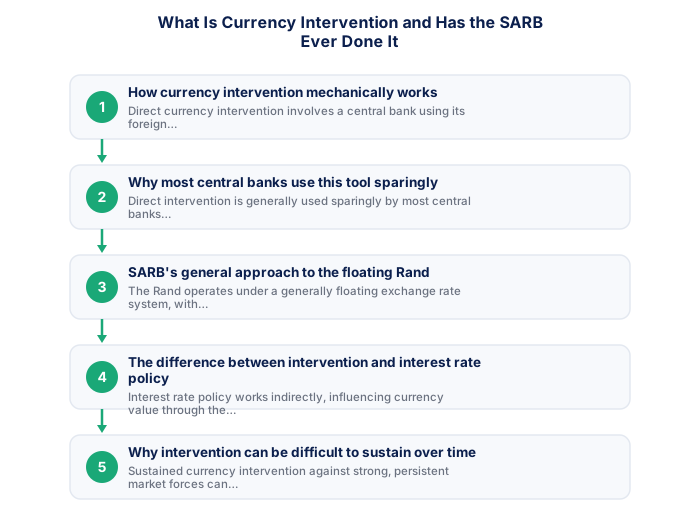
1. How currency intervention mechanically works
Direct currency intervention involves a central bank using its foreign exchange reserves to buy its own currency (supporting its value if it's perceived as too weak) or sell its own currency (weakening its value if it's perceived as too strong), directly affecting supply and demand in the currency market through this deliberate, large-scale buying or selling activity.
It's worth appreciating the sheer scale genuinely required for this to work meaningfully, a central bank's intervention needs to represent a genuinely significant portion of market activity to move price noticeably, against the enormous daily trading volume of global forex markets, discussed elsewhere on this site.
The Currency and Exchanges Act treats unauthorised offshore transfers as a serious violation. Penalties include forfeiture, fines, and potential criminal prosecution.
2. Why most central banks use this tool sparingly
Direct intervention is generally used sparingly by most central banks operating floating exchange rate systems, since it requires deploying finite foreign exchange reserves, can be only temporarily effective against strong, persistent underlying market forces, and can sometimes signal a degree of concern that itself affects market sentiment in ways the central bank might not intend.
It's worth understanding why this restraint reflects sound policy judgement rather than reluctance, direct intervention consumes finite foreign exchange reserves and can prove ultimately unsustainable against genuine, persistent market pressure, most central banks reserve it for genuinely exceptional circumstances rather than routine currency management.
3. SARB's general approach to the floating Rand
The Rand operates under a generally floating exchange rate system, with SARB's primary policy tool being interest rate decisions, rather than frequent direct currency intervention, South Africa has generally allowed market forces to determine the Rand's value rather than relying heavily on this more interventionist approach.
It's worth understanding this hands-off general approach as consistent with South Africa's broader floating exchange rate commitment, discussed elsewhere on this site regarding currency pegs, direct intervention would represent a genuine departure from this established, longstanding policy stance.
| Type | Annual limit | Tax clearance | Reset |
|---|---|---|---|
| Single Discretionary | R2,000,000 | Not required | 1 January |
| Foreign Investment | R10,000,000 | SARS compliance status required | 1 January |
| Above both limits | No fixed limit | Treasury approval required | Case by case |
4. The difference between intervention and interest rate policy
Interest rate policy works indirectly, influencing currency value through the interest rate differential and resulting capital flow dynamics over time, while direct intervention works immediately and directly through actual currency buying or selling activity, these represent genuinely different policy mechanisms with different typical use cases.
It's worth keeping these two genuinely distinct policy tools clearly separated in your own analysis, interest rate decisions work indirectly through the yield-seeking mechanism discussed elsewhere on this site, while direct intervention works through immediate, mechanical market transactions, worth distinguishing between the two.
- Calculate transfers made this calendar year to date
- Confirm remaining allowance before proceeding
- Obtain SARS tax clearance if using foreign investment allowance
- Contact bank FX desk with transfer details
- Retain all confirmation documents
- Record transfer in personal allowance tracker
5. Why intervention can be difficult to sustain over time
Sustained currency intervention against strong, persistent market forces can be genuinely difficult given the finite nature of foreign exchange reserves available for this purpose, meaning intervention is more typically used, when it does occur, for managing excessive short-term volatility or disorderly market conditions rather than attempting to permanently fix a currency's value against underlying fundamental market forces.
It's worth researching historical examples of failed interventions by other countries' central banks if you're genuinely interested in this topic, seeing concrete historical cases where intervention ultimately failed against persistent market pressure illustrates this limitation more vividly than the abstract principle alone.
6. What this means for traders monitoring SARB
For South African traders following USD/ZAR specifically, this means SARB's interest rate decisions and broader policy commentary, discussed throughout this category, generally carry more consistent, ongoing relevance than anticipating direct currency intervention, which remains a genuinely less common, more exceptional tool within SARB's broader policy approach.
The SARB exchange control framework has been substantially liberalised since 2021, moving from a transaction-approval model to an outcomes-based approach. South African residents can now move meaningful amounts offshore annually through the allowance structure without requiring prior SARB approval. However, the banking system retains reporting obligations, and SARS has increasingly integrated tax compliance status into the offshore transfer process. South African traders should maintain clear records of all offshore transfers across the calendar year, both for managing cumulative allowance usage and for demonstrating compliance if either SARB or SARS requests documentation. Your bank's foreign exchange desk can confirm current limits and required documentation before any significant international transfer.
The SARB doesn't target a specific exchange rate and rarely intervenes. When it does, intervention is aimed at reducing excessive volatility, not maintaining a particular level, so it's not a reliable floor.
★ Why It Matters
Worth knowing : SARB's general policy preference for minimal direct intervention means any rare instance is itself a meaningful signal, traders sometimes overestimate how often this tool gets used given how much attention any single instance receives when it does happen.
✕ Common mistakes
- Expecting frequent SARB intervention given South Africa's floating regime. SARB's general policy preference is for minimal direct intervention.
- Treating any rare intervention instance as routine going forward. Each instance is itself a meaningful, relatively unusual signal.
- Assuming intervention always succeeds in moving the currency as intended. Effectiveness varies and isn't guaranteed even when attempted.
- Not tracking the broader context behind why intervention might occur. The underlying circumstances matter as much as the action itself.
Does this need tax clearance?
Not under R2 million a calendar year, which is the single discretionary allowance. Above it, SARS approval through the AIT process. Tax clearance for offshore funding covers it in full.
When does the allowance reset?
On 1 January, by calendar year rather than tax year, and unused capacity does not carry over. The allowance year covers the detail.
Key Takeaways
- Currency intervention involves a central bank directly buying or selling its own currency to influence its value, a tool used sparingly and selectively by SARB.
- Currency intervention involves a central bank directly buying or selling its own currency in the open market to influence its value.
- SARB has used this tool sparingly and selectively, given South Africa's generally floating exchange rate approach.
- How currency intervention mechanically works.
- Why most central banks use this tool sparingly.
See also: What Is a Currency War and Has This Ever Affected the Rand?.
Frequently asked follow-up questions
Does SARB publicly announce when it intervenes in currency markets?
Disclosure practices vary by central bank and specific circumstances; checking official SARB communications provides the most accurate, current information on this specific topic.
Can currency intervention permanently change a currency's long-term value?
Generally not against strong, persistent underlying fundamental forces; intervention is more typically used for managing short-term volatility rather than permanently overriding fundamental market dynamics.
Do other emerging-market central banks intervene more frequently than SARB?
Approaches vary considerably across different emerging-market central banks, reflecting each country's own specific economic circumstances and policy philosophy.
