i Short answer
Onshore Rand trading occurs within South Africa's regulatory framework through locally-regulated entities.
Offshore Rand trading occurs through international venues and instruments outside this direct South African oversight.
📋 ON THIS PAGE
- What onshore Rand trading specifically means
- What offshore Rand trading involves instead
- Non-deliverable forwards as a common offshore instrument
- Why this distinction matters for retail traders specifically
- How this relates to using an international broker
- Which category most South African retail traders actually use
1. What onshore Rand trading means
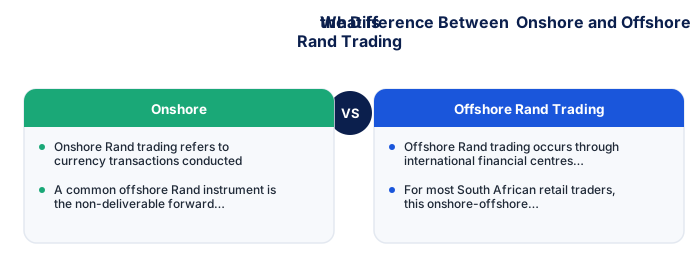
Onshore Rand trading refers to currency transactions conducted within South Africa's domestic regulatory framework, typically through South African banks and FSCA-regulated brokers, subject to SARB exchange control rules and South African regulatory oversight directly.
It's worth understanding this as the framework governing most South African retail forex trading, discussed throughout this site's legal content, activity within South Africa's own regulatory and banking system, subject to SARB exchange control and FSCA oversight together.
The Currency and Exchanges Act treats unauthorised offshore transfers as a serious violation. Penalties include forfeiture, fines, and potential criminal prosecution.
| Feature | Onshore USD/ZAR | Offshore/NDF USD/ZAR |
|---|---|---|
| Where it trades | South African market, SARB oversight | International centres: London, Singapore |
| SARB regulation | Direct: SARB sets intervention boundaries | No direct SARB oversight |
| Liquidity | Highest during SA business hours | 24-hour liquidity offshore |
| Price discovery | Primary | Follows onshore with some divergence |
| Access for SA retail traders | Direct via FSCA-regulated CFD broker | Less direct: depends on broker |
| Volatility pattern | Higher around SA market open/close | More uniform intraday |
| Spreads | Tight during ZA hours | Can widen outside SA session |
2. What offshore Rand trading involves instead
Offshore Rand trading occurs through international financial centres and entities operating outside South Africa's direct regulatory jurisdiction, often involving larger institutional participants trading Rand-related instruments through structures and venues based in major global financial hubs rather than within South Africa itself.
It's worth appreciating this as a genuinely institutional, wholesale market rather than something typical retail traders access directly, this offshore trading activity happens largely outside South Africa's own regulatory perimeter, among international banks and large institutional participants.
3. Non-deliverable forwards as a common offshore instrument
A common offshore Rand instrument is the non-deliverable forward (NDF), a derivative contract letting international participants gain Rand exposure and hedge currency risk without the actual physical exchange of Rand a standard forward contract would normally involve. This structure exists partly because of exchange control considerations affecting Rand convertibility for some international participants.
It's worth understanding this specific instrument as illustrative of how offshore Rand markets function, an NDF settles in a hard currency rather than requiring actual, physical Rand delivery, letting international parties gain Rand exposure without directly engaging South Africa's own currency controls.
| Type | Annual limit | Tax clearance | Reset |
|---|---|---|---|
| Single Discretionary | R2,000,000 | Not required | 1 January |
| Foreign Investment | R10,000,000 | SARS compliance status required | 1 January |
| Above both limits | No fixed limit | Treasury approval required | Case by case |
4. Why this distinction matters for retail traders specifically
For most South African retail traders, this onshore-offshore distinction matters more as broader market structure context than as a direct, practical trading consideration, since typical retail USD/ZAR CFD trading through an FSCA-regulated broker operates within the onshore framework regardless of whether that broker also serves international clients.
It's worth appreciating why this genuinely doesn't affect your own everyday retail trading, discussed throughout this site regarding forex trading generally, your CFD and forex trading through a properly regulated broker operates within the onshore framework regardless of this broader institutional distinction.
- Calculate transfers made this calendar year to date
- Confirm remaining allowance before proceeding
- Obtain SARS tax clearance if using foreign investment allowance
- Contact bank FX desk with transfer details
- Retain all confirmation documents
- Record transfer in personal allowance tracker
5. How this relates to using an international broker
Even when using a broker based outside South Africa, your own trading relationship and account typically still falls under whatever regulatory framework governs that specific broker relationship, a somewhat different consideration from the broader onshore-offshore market structure distinction above.
It's worth keeping this distinct from the offshore rand market discussed here, using an internationally-headquartered broker, discussed elsewhere on this site, is a genuinely separate question from this institutional onshore-offshore currency market distinction.
6. Which category most South African retail traders actually use
The large majority of South African retail USD/ZAR trading happens through onshore-regulated brokers using the standard CFD structure, with the offshore NDF market being considerably more relevant to larger institutional participants than typical individual retail traders.
The SARB exchange control framework has been substantially liberalised since 2021, moving from a transaction-approval model to an outcomes-based approach. South African residents can now move meaningful amounts offshore annually through the allowance structure without requiring prior SARB approval. However, the banking system retains reporting obligations, and SARS has increasingly integrated tax compliance status into the offshore transfer process. South African traders should maintain clear records of all offshore transfers across the calendar year, both for managing cumulative allowance usage and for demonstrating compliance if either SARB or SARS requests documentation. Your bank's foreign exchange desk can confirm current limits and required documentation before any significant international transfer.
The offshore NDF market trades globally and can diverge during stress.
The onshore Rand market operates within South Africa's interbank system, setting the domestic benchmark rate. The offshore NDF market trades globally and can diverge from the onshore rate, particularly during market stress.
★ Why It Matters
Worth knowing: onshore and offshore Rand pricing can occasionally diverge meaningfully during periods of acute local political or economic stress. When that gap widens, it's a signal worth watching in its own right, separate from whatever the headline USD/ZAR rate is doing.
✕ Common mistakes
- Not tracking the gap between these two pricing venues during stress periods. A widening gap is itself a signal worth watching, separate from the headline rate.
- Treating offshore Rand trading as entirely disconnected from onshore regulatory considerations. SARB exchange control rules remain relevant when money moves between these markets.
- Assuming this distinction is irrelevant to typical retail CFD trading. It's more relevant to larger institutional flows, but worth understanding regardless.
Do I need tax clearance to fund an offshore trading account?
Payments within the single discretionary allowance do not require tax clearance. The foreign investment allowance requires a tax compliance status confirmation from SARS via eFiling. Check current limits at the SARB website.
When does the allowance reset?
On 1 January, by calendar year rather than tax year, and unused capacity does not carry over. The allowance year covers the detail.
Key Takeaways
- Onshore Rand trading occurs within South Africa's regulatory framework, while offshore trading occurs through international venues outside this direct oversight.
- Onshore Rand trading occurs within South Africa's regulatory framework through locally-regulated entities.
- Offshore Rand trading occurs through international venues and instruments outside this direct South African oversight.
- What onshore Rand trading means.
- What offshore Rand trading involves instead.
Frequently asked follow-up questions
Can South African retail traders access NDF markets directly?
This is generally less accessible to typical retail traders, who instead get Rand exposure through standard CFD trading.
Does offshore Rand trading affect the onshore exchange rate?
These markets can influence each other to some degree, given their connection to overall global Rand sentiment, though they operate as genuinely distinct market structures.
Is offshore Rand trading illegal for South Africans?
It's not about legality in that sense. It's simply a different market structure, typically more relevant to international institutional participants than individual South African retail traders.
