i Short answer
Safe-haven currencies, including the US Dollar, Japanese Yen, and Swiss Franc, tend to strengthen during periods of global risk aversion.
International capital flows toward perceived stability and away from riskier assets, including emerging-market currencies like the Rand, a dynamic that also connects to gold's own safe-haven role and its effect on the Rand.
📋 ON THIS PAGE
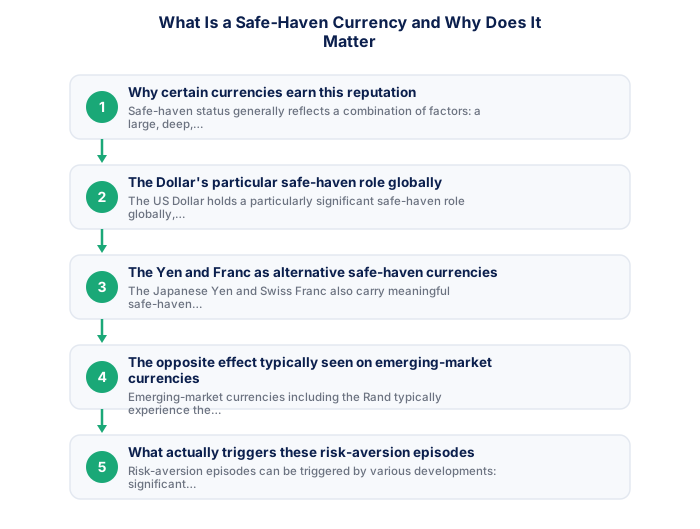
- Why certain currencies specifically earn this reputation
- The Dollar's particular safe-haven role globally
- The Yen and Franc as alternative safe-haven currencies
- The opposite effect typically seen on emerging-market currencies
- What actually triggers these risk-aversion episodes
- Practical implications for Rand-related trading
1. Why certain currencies specifically earn this reputation
Safe-haven status generally reflects a combination of factors: a large, deep, highly liquid market that can absorb significant capital inflows without excessive disruption, predictable domestic political and economic environment; and often, a history of the specific currency or its underlying economy demonstrating relative resilience during previous periods of global stress, reinforcing this reputation over time through repeated historical experience.
| Currency | Typical Role |
|---|---|
| US Dollar | Primary global safe haven |
| Japanese Yen | Alternative safe haven |
| Swiss Franc | Alternative safe haven |
| Emerging-market currencies (incl. Rand) | Typically weaken during risk-aversion episodes |
2. The Dollar's particular safe-haven role globally
The US Dollar holds a particularly significant safe-haven role globally, reflecting its status as the world's primary reserve currency, and the deep, liquid US Treasury market that provides a perceived-safe destination for capital during periods of global uncertainty. This safe-haven role means the Dollar can sometimes strengthen broadly even during periods of genuine US-specific economic difficulty, simply because global capital flows toward it regardless of US-specific conditions, purely seeking relative safety compared to other available options.
- FSCA-regulated broker verified at fsca.co.za
- Demo account tested for minimum 60 days
- Trading plan written: entry, exits, position sizing
- Risk per trade defined (1-2% of account)
- Backup internet connection tested for load shedding
- Tax implications understood
3. The Yen and Franc as alternative safe-haven currencies
The Japanese Yen and Swiss Franc also carry meaningful safe-haven reputations, reflecting Japan's and Switzerland's respective histories of political stability, current account surpluses, and (particularly relevant to the Yen specifically) the carry trade unwinding dynamic, where Yen-funded carry trades tend to unwind during risk-aversion periods, mechanically strengthening the Yen as this unwinding occurs.
4. The opposite effect typically seen on emerging-market currencies
Emerging-market currencies including the Rand typically experience the opposite effect during risk-aversion episodes, international capital flows away from these perceived-riskier currencies and toward the safe havens, often producing meaningful Rand weakness during periods of acute global risk aversion, regardless of South Africa-specific economic conditions at that particular moment.
This dynamic is precisely why broader global risk sentiment, separate from South Africa-specific news, remains a genuinely important factor for USD/ZAR traders specifically to track.
| Item | Detail |
|---|---|
| Regulator | FSCA, fsca.co.za |
| Exchange control | SARB, resbank.co.za |
| Tax authority | SARS, sars.gov.za |
| JSE hours | 09:00-17:00 SAST Mon-Fri |
| Best forex session | 15:00-17:00 SAST |
| CGT annual exclusion | R50,000 (individuals) |
5. What actually triggers these risk-aversion episodes
Risk-aversion episodes can be triggered by various developments: significant geopolitical events, unexpected financial market stress or instability, sudden shifts in global growth expectations, or other developments that broadly increase perceived uncertainty across global markets. These triggers aren't always predictable in advance, though their general pattern of effect, safe-haven strength, emerging-market currency weakness, tends to follow this broadly consistent pattern once an episode genuinely begins.
Emerging market currencies like the Rand tend to weaken during those periods.
During risk-off periods, safe-haven currencies like the USD, JPY, and CHF tend to strengthen while emerging market currencies like the Rand tend to weaken. The relationship generally reverses in risk-on conditions.
★ Why It Matters
Something worth tracking if you trade ZAR: safe-haven flows during global risk-off periods tend to move directly against emerging-market currencies like the Rand, meaning a Yen or Franc rally and a Rand selloff are often two sides of the exact same underlying capital flow.
✕ Common mistakes
- Treating all safe-haven currencies as behaving identically during risk-off periods. Each carries somewhat different characteristics and historical behaviour.
- Ignoring the connection between a Yen or Franc rally and a Rand selloff. These are often two sides of the exact same underlying capital flow.
- Not tracking global risk sentiment indicators alongside ZAR-specific analysis. Broader sentiment frequently explains Rand moves that look domestic in isolation.
Key Takeaways
- Safe-haven currencies like the US Dollar, Japanese Yen, and Swiss Franc tend to strengthen during periods of global risk aversion and market stress.
- Safe-haven currencies, including the US Dollar, Japanese Yen, and Swiss Franc, tend to strengthen during periods of global risk aversion.
- International capital flows toward perceived stability and away from riskier assets, including emerging-market currencies like the Rand.
- Why certain currencies specifically earn this reputation.
- The Dollar's particular safe-haven role globally.
Frequently asked follow-up questions
Is gold also considered a safe-haven asset?
Yes, gold is commonly considered a safe-haven asset alongside these currencies, sometimes showing similar strengthening behaviour during risk-aversion episodes.
Can safe-haven status change over time?
Yes, though established safe-haven reputations, built over long historical periods, tend to be relatively durable rather than shifting frequently or easily.
Does the Rand ever benefit during global risk aversion?
This is uncommon given its typical emerging-market currency characteristics, though specific, unusual circumstances could theoretically produce atypical Rand behaviour during any particular episode.
