i Short answer
Extended global commodity super-cycles can produce sustained Rand support during broad upswings and sustained pressure during broad downswings.
📋 ON THIS PAGE
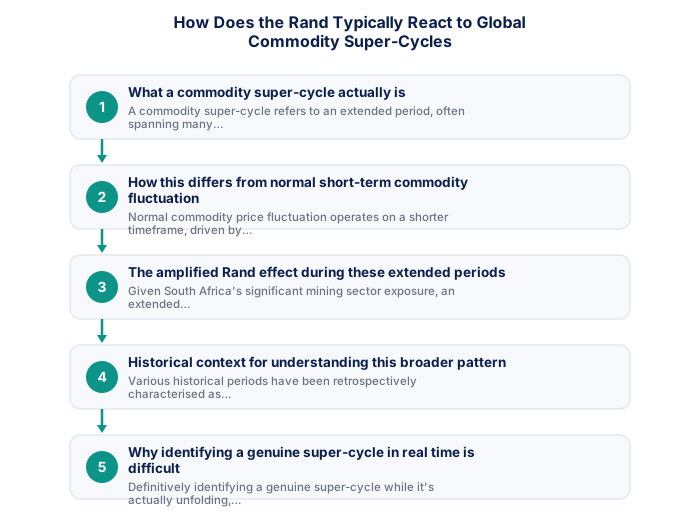
- What a commodity super-cycle actually is
- How this differs from normal short-term commodity fluctuation
- The amplified Rand effect during these extended periods
- Historical context for understanding this broader pattern
- Why identifying a genuine super-cycle in real time is difficult
- Practical implications for longer-term Rand analysis
1. What a commodity super-cycle actually is
A commodity super-cycle refers to an extended period, often spanning many years or even a decade or more, of sustained, broad-based commodity price strength or weakness, typically driven by major structural shifts in global demand (such as rapid industrialisation in large economies) or supply (such as major new resource discoveries or extraction technology changes).
It's worth understanding this concept as describing a genuinely different kind of pattern from the more frequent price movements discussed elsewhere on this site, a super-cycle operates on a timescale considerably longer than anything a typical retail trader would directly trade around, useful mainly as broader macroeconomic context.
2. How this differs from normal short-term commodity fluctuation
Normal commodity price fluctuation operates on a shorter timeframe, driven by more immediate supply and demand developments, while a super-cycle represents a genuinely longer, structural trend that can persist through and override many of these shorter-term fluctuations for an extended period.
It's worth keeping this distinction clear specifically to avoid confusing genuinely short-term, tradeable price movements with the much longer, structural pattern a super-cycle represents, conflating the two timeframes can lead to drawing overly confident conclusions from what might simply be normal, shorter-term volatility.
See also: How Does SA's February Tax Year-End Affect Markets?
- SARB economic calendar checked for the week
- Next Eskom load shedding schedule reviewed
- GNU stability news reviewed
- Stats SA data releases noted
- Credit agency review dates checked
- US/global events that move EM risk noted
3. The amplified Rand effect during these extended periods
Given South Africa's significant mining sector exposure, an extended commodity super-cycle upswing can produce sustained, structural Rand support over years, beyond what any single short-term commodity price movement would typically produce, while a sustained downswing can produce the opposite, more persistent pressure.
It's worth appreciating why this sustained effect differs meaningfully from a brief commodity price spike, an extended upswing gives the South African economy genuine time to structurally benefit through sustained export revenue, investment, and employment effects, rather than a brief windfall that fades before meaningfully affecting broader economic fundamentals.
| Event | Frequency | ZAR impact | Source |
|---|---|---|---|
| SARB MPC | 6x per year | High | resbank.co.za |
| Budget Speech | Annual (February) | Very high | treasury.gov.za |
| Credit reviews | Annual each agency | Very high | Agency sites |
| Stats SA CPI | Monthly | Medium | statssa.gov.za |
| Eskom stage | As needed | Low-medium | eskomsepush.com |
- SA context provides genuine informational edge
- ZAR pairs accessible via FSCA brokers in ZAR accounts
- Rand volatility creates larger intraday ranges
- 6 SARB meetings/year create regular macro setups
- Higher geopolitical risk than G10 pairs
- Load shedding creates unique operational disruptions
- SA rand liquidity thinner than major G10 pairs
- SA-specific news requires constant local monitoring
4. Historical context for understanding this broader pattern
Various historical periods have been retrospectively characterised as commodity super-cycles, often connected to major global economic developments, checking current economic analysis and historical commentary provides useful context for understanding how these extended cycles have previously played out and their general relationship to Rand performance over comparable historical periods.
It's worth researching these historical episodes specifically for how they affected South African markets and the Rand at the time, connecting the broader global commodity narrative to concrete, historical South African market outcomes builds a more grounded, applied understanding than the general concept alone provides.
5. Why identifying a genuine super-cycle in real time is difficult
Definitively identifying a genuine super-cycle while it's actually unfolding, rather than only recognising it clearly in retrospect once the extended pattern has already played out, remains genuinely difficult, this distinguishes super-cycle analysis from the more immediately actionable, shorter-term factors.
It's worth applying genuine epistemic humility here specifically, resisting the temptation to confidently declare a current commodity upswing a genuine super-cycle while it's still unfolding, since this kind of confident, real-time labelling has historically proven unreliable even among professional economists and analysts.
6. Practical implications for longer-term Rand analysis
For most retail traders following the shorter-term strategies, super-cycle awareness serves more as useful background context for understanding extended historical Rand patterns than as a directly actionable trading signal, given the genuine difficulty of confidently identifying these extended cycles while they're still actively unfolding in real time.
This connects directly to the SARB's Monetary Policy Committee (MPC), which meets several times a year to set the repo rate, decisions that ripple through borrowing costs, the Rand, and market sentiment well beyond the immediate announcement.
Precious and industrial metals tend to matter more directly for ZAR sentiment than broad commodity indices, which are often weighted heavily toward oil instead.
★ Why It Matters
Something worth tracking over a longer horizon: South Africa's Rand tends to show its strongest commodity-cycle correlation specifically with precious and industrial metals prices, rather than with broad commodity indices that are heavily weighted toward oil, where South Africa is a net importer rather than exporter.
✕ Common mistakes
- Expecting an immediate Rand reaction to every commodity price move. Super-cycles operate over a much longer horizon than daily price action.
- Ignoring South Africa's status as an oil importer when assessing commodity effects. This makes oil's relationship with the Rand different from metals.
- Not distinguishing cyclical commodity moves from structural, longer-term shifts. These carry different implications for sustained Rand strength or weakness.
Key Takeaways
- Extended global commodity super-cycles can produce sustained Rand support during upswings and sustained pressure during downswings, beyond normal short-term moves.
- Extended global commodity super-cycles can produce sustained Rand support during broad upswings and sustained pressure during broad downswings.
- What a commodity super-cycle actually is.
- How this differs from normal short-term commodity fluctuation.
- The amplified Rand effect during these extended periods.
See also: How Do I Invest in Gold in South Africa? and Why Is August Historically the Rand's Worst Month?.
Frequently asked follow-up questions
Is South Africa currently in a commodity super-cycle?
This requires checking current economic analysis and commentary for the most accurate, up-to-date assessment, since identifying this in real time remains genuinely difficult.
Does a super-cycle affect all South African commodities equally?
Not necessarily; different specific commodities can be affected by different structural global demand and supply dynamics, even within a broader super-cycle period.
Should short-term traders factor super-cycles into their analysis?
This serves more as background context than a directly actionable signal for most short-term strategies, given the genuine difficulty of real-time identification.
