i Short answer
Scalping targets very small price movements with extremely high trade frequency, holding positions for seconds to a few minutes.
This sits at the most intensive end of the day trading spectrum, with considerably shorter holding periods.
📋 ON THIS PAGE
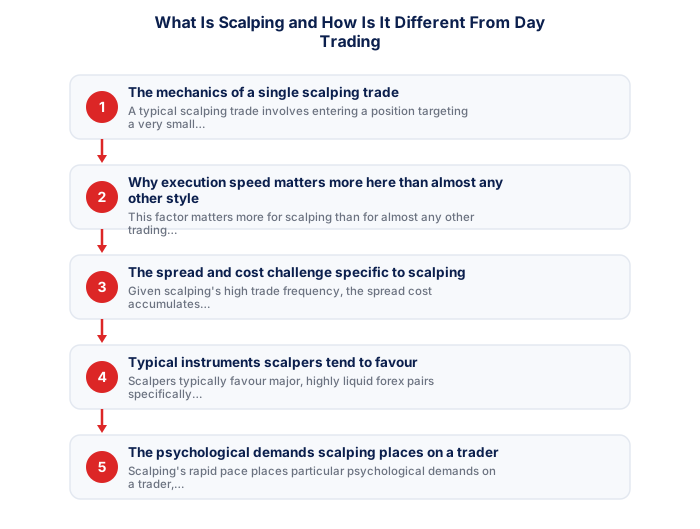
1. The mechanics of a single scalping trade
A typical scalping trade means entering a position targeting a very small price movement, sometimes just a handful of pips, and exiting almost immediately once that target is reached, or cutting the position quickly if it moves against the trader even slightly. This rapid in-and-out pattern repeats many times through a session, with individual trades sometimes lasting only seconds.
Because each trade targets such a small move, scalpers rely on high trade frequency and consistency, not any single trade's outcome, to generate meaningful results. A single scalping trade in isolation is a genuinely small fraction of a scalper's overall session activity.
This is a genuinely different mental model from most other trading styles, where a trader typically evaluates each trade individually, on its own merits. A scalper is closer to evaluating a session as a whole, accepting that a meaningful share of individual trades will be small losses or breakeven, provided the aggregate pattern across dozens of trades produces a net positive result.
| Feature | Scalping | Day Trading |
|---|---|---|
| Trade duration | Seconds to minutes | Minutes to hours |
| Trades per session | Very high | Moderate |
| Execution speed sensitivity | Extreme | Moderate |
| Spread/cost impact | High, due to frequency | Lower relative impact |
2. Why execution speed matters more here than almost any other style
Execution speed matters more for scalping than for almost any other trading style, since its small target price movements mean even minor delays or slippage can eat up a disproportionately large share of the intended profit on any given trade.
That's exactly why scalpers, more than traders following other styles, often pay close attention to their broker's execution speed and infrastructure, sometimes even considering tools like a VPS specifically to minimise any delay that could meaningfully affect their tightly-targeted trades.
This sensitivity extends beyond the broker's own infrastructure to the trader's own setup: a slow or unreliable internet connection, an underpowered device, or even a cluttered platform interface that takes an extra second to manage can all erode the same tight margins that scalping depends on, in a way that matters far less for a trader holding positions for hours or days.
3. The spread and cost challenge specific to scalping
Given scalping's high trade frequency, spread costs pile up considerably faster relative to account size than for lower-frequency styles, since every trade, however brief, incurs this cost. A scalping strategy needs to overcome that accumulated cost on top of the underlying challenge of correctly predicting numerous short-term price movements.
That cost sensitivity is exactly why scalpers tend to favour the most liquid instruments, where spreads are typically tightest, and why comparing spread costs across candidate brokers matters even more for scalpers than for traders following less frequent styles.
- Economic calendar checked for high-impact events
- Key levels marked for target instruments
- Maximum trades per session defined
- Stop-losses set on overnight positions
- Backup connectivity available
- Eskom schedule checked
- Post-session journal time scheduled
It's worth actually calculating this cost concretely rather than treating it as a vague concern. A trader placing 30 trades in a session, each incurring even a small spread cost, is paying that cost 30 times over, a cumulative figure that can meaningfully exceed the total spread cost a lower-frequency trader pays across an entire week or month of considerably fewer trades.
4. Typical instruments scalpers tend to favour
Scalpers typically favour major, highly liquid forex pairs specifically because of the tight spreads and reliable execution these instruments generally offer. Less liquid instruments, including some individual shares or certain commodities, are generally less suited to scalping given their typically wider spreads and less consistent liquidity.
This instrument preference is a direct, practical consequence of scalping's cost sensitivity above, the style's viability depends heavily on minimising the accumulated cost drag from frequent trading, which naturally points toward the tightest-spread, most liquid instruments available.
| Session | SAST | Instruments | Liquidity |
|---|---|---|---|
| Pre-market | 07:00-09:00 | Any | Low |
| JSE morning | 09:00-12:00 | JSE shares | High |
| Midday lull | 12:00-15:00 | Any | Low |
| London-NY overlap | 15:00-17:00 | Major forex | Very high |
| NY afternoon | 17:00-21:00 | Major forex | Medium |
This doesn't mean less liquid instruments are unsuitable for trading generally, only that they're typically poorly suited specifically to the scalping style. A swing or position trader, holding for days or weeks, can absorb a wider spread far more comfortably than a scalper attempting to profit from a handful of pips on each individual trade.
5. The psychological demands scalping places on a trader
Scalping's rapid pace places particular psychological demands on a trader: maintaining consistent discipline across many rapid decisions, avoiding the overtrading pattern even though high trade frequency is itself part of the style, and managing sustained, rapid decision-making without the fatigue that degrades judgement over a long session.
This intensity is genuinely different from the more deliberate, spaced-out decision-making swing or position trading typically involves, and anyone considering scalping should honestly assess whether this particular psychological demand actually suits their temperament before committing significant capital to it.
Fatigue in particular deserves more attention than it often gets. The quality of rapid, repeated decision-making tends to degrade measurably over the course of a long, intense session, meaning a scalper's later trades in a session are often statistically worse than their earlier ones, purely as a function of accumulated mental fatigue rather than any change in market conditions.
6. Is scalping suitable for beginners
Scalping is generally one of the more demanding trading styles for beginners, given the combination of execution-speed sensitivity, accumulated cost challenges, and intense psychological pace, all of which compound the general learning curve of becoming a competent trader in any style.
Many experienced traders suggest building foundational skill and discipline through a lower-frequency style like swing or position trading first, before considering a move toward scalping, rather than starting directly with this particularly demanding style as a complete beginner.
This progression, building discipline on a slower style before attempting scalping, isn't simply cautious advice; it reflects the fact that scalping's tight margins leave very little room to absorb the kind of undisciplined mistakes, chasing missed entries, moving stops, hesitating on exits, that a beginner is statistically likely to make while still developing basic trading discipline.
Scalping targets 1-5 pip moves very frequently, making spread costs critical and execution speed essential. Day trading holds positions longer with larger targets, making spread costs proportionally more manageable.
★ Why It Matters
Worth calculating before attempting scalping: your break-even win rate once spread and commission costs are included on every trade. Scalping's high frequency means transaction costs eat into a bigger share of typical profit targets than with any slower style.
✕ Common mistakes
- Assuming scalping suits any trader willing to put in the screen time. It demands a specific combination of focus, speed, and tolerance for rapid decisions.
- Treating scalping and day trading as identical in their demands. Scalping sits at the more intensive, shorter-holding-period end of that spectrum.
- Underestimating how quickly costs accumulate at scalping's typical trade frequency. This is a meaningfully different cost structure than slower trading styles face.
Key Takeaways
- Scalping targets very small price movements with extremely high trade frequency, holding positions for seconds to minutes. Learn how it compares to day trading.
- Scalping targets very small price movements with extremely high trade frequency, holding positions for seconds to a few minutes.
- This sits at the most intensive end of the day trading spectrum, with considerably shorter holding periods.
- The mechanics of a single scalping trade.
- Why execution speed matters more here than almost any other style.
See also: What Is Fading the Move and Is It a Sound Day Trading Approach?.
Frequently asked follow-up questions
How many trades does a typical scalper place in a session?
This varies considerably by individual strategy, but scalpers often place many more trades per session than day traders following less frequent approaches, sometimes dozens or more.
Do all brokers allow scalping?
Most regulated brokers permit scalping, though it's worth confirming this directly, since a small number of brokers historically restricted very high-frequency strategies under certain account terms.
Is scalping more stressful than other trading styles?
Many traders find it more psychologically intense given the rapid pace and continuous decision-making involved, though individual experience varies based on personal temperament.
